No Point In Economic Reforms When We Don't Have An Economy: Sri Lankan President
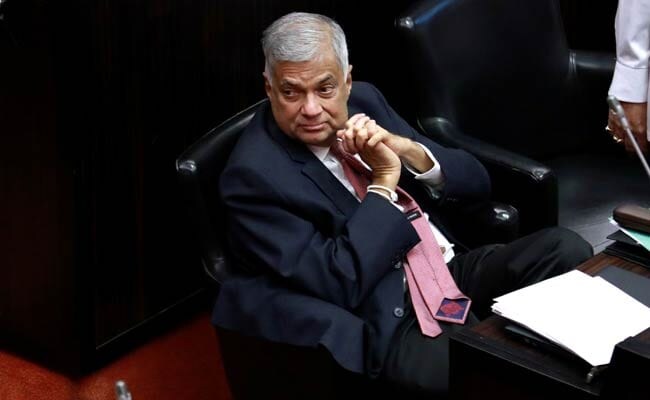
President Ranil Wickremesinghe has acknowledged that there was no point in economic reforms in Sri Lanka because the cash-starved island nation didn't have an economy, as he made a strong pitch for a new economic model.
Sri Lanka is going through its worst economic crisis since its independence in 1948, triggered by a severe paucity of foreign exchange reserves.
In mid-April, Sri Lanka declared its international debt default due to the forex crisis.
Addressing the inaugural session of the Sri Lanka Economic Summit 2022 on Monday, Ranil Wickremesinghe said the country's beleaguered economy cannot be set right through outdated economic systems.
As Sri Lanka's economy went into a perpetual tailspin in recent times, Ranil Wickremesinghe acknowledged that economic reforms were not the antidote for the current malaise.
"What is the plan for reform? Frankly, I have no plan for it. What reforms when we don't have an economy," the Daily Lanka Mirror newspaper quoted Ranil Wickremesinghe as saying.
"What we want to do is to build a new economy," he explained.
The current economy is not worth reforming because it is so fragile that it will crumble again, the report quoted him as saying.
"Our trade balance is not in our favour. So are we going to rebuild the same structure and come down again much faster? Therefore I thought it's not worth reforming it," Ranil Wickremesinghe said.
Bolstering the foreign exchange reserves would be the key reform goal for our government, Ranil Wickremesinghe said, adding that developing Sri Lanka as a logistics centre was also the need of the hour.
Colombo seeks to secure the release of a $2.9 billion rescue package from the International Monetary Fund (IMF), which was announced in September.
For this to happen, Sri Lanka must restructure its debt.
"We are now discussing with our creditors, bilateral creditors, with India and we had very successful talks and we have started talks with China," Ranil Wickremesinghe said. He said the development of Colombo Harbour's west terminal with India's Adani group was a pragmatic move.
"If you want to get going you have to give the East terminal out. We have given the first choice to Japan, if they don't we will ask others to come" he added.
The Sri Lankan government in May appointed international legal and debt advisors for debt restructuring after the country declared its international debt default for the first time in history.
Sri Lanka is nearly bankrupt and has suspended repaying its $51 billion foreign debt, of which it must repay $28 billion by 2027.
Sri Lanka, a country of 22 million people, plunged into financial and political turmoil earlier this year as it faced a shortage of foreign currencies.
Due to this, the island nation has been unable to afford key imports, including fuel, fertilisers and medicines, leading to long queues.
(Except for the headline, this story has not been edited by NDTV staff and is published from a syndicated feed.)

-
AI Bias In Investing Cannot Be Eliminated, But It Can Be Governed

Framing is a particularly important example as identical financial information presented in terms of gains rather than losses can lead an LLM to reach a different assessment.
-
Joining The Dots | Dark Skies, Steady Diya: Why Hope Holds This Diwali
With war, a weak rupee and foreign outflows weighing on sentiment, policymakers at the NDTV World Summit and market veterans at NDTV Profit Ignite: Diwali Edition offered the same advice: stay invested and filter out the noise.
-
The Curious Case of Equitas Small Finance Bank And A CEO Who Quit For Stock
PN Vasudevan believes persistent investor concerns over a perceived conflict of interest had become a governance overhang on Equitas Small Finance Bank's stock, even as the lender improved profitability and asset quality.
-
Talking Points This Week: AI Cash Burn, A Tiger Comeback And An India That Still Finds Its Own Path
India is not immune to higher oil or tighter global liquidity, yet its earnings base is broader, its domestic policy levers are still available.
-
Foreign Investors Own Half Of HDFC Bank and ICICI Bank. An LTCG Cut Could Matter Most Here
Foreign portfolio investors have US$115 billion parked in HDFC Bank, ICICI Bank. If the government cuts long-term capital gains tax, Jefferies says returning foreign money could land here first.
-
'Never Seen This Level Of Negativity': Sandeep Tandon Says The Next Rally May Be Closer Than You Think
Veteran investor Sandeep Tandon says foreign selling is easing, large-caps are due a comeback and mid-caps are crowded, while he turns positive on gold, power and pharma this Diwali.
-
Indians Stay With Family, Not In Hotels | The Reason Why
India still lacks enough clean, reliable and affordable hotels for budget-conscious travellers.
-
The Economic Imperative: Analysing The Material Driving Force Behind India-Canada Strategic Reset
This economic complementarity is further reinforced by deep institutional investment ties and talent mobility, which form the bedrock of the bilateral framework.
-
Medicine Pricing: Where Must Profit Stop?
India must confront excessive margins, hidden incentives and regulatory gaps that threaten the integrity of medicine.
-
Why Amazon And Flipkart Are Struggling To Beat Meesho In India's Smaller Cities
With 274 million users and lowest-cost logistics, Meesho is defending its value commerce crown against giants like Amazon and Flipkart.










