No One Will Emerge As Winner In Trade War: Chinese President Xi Jinping
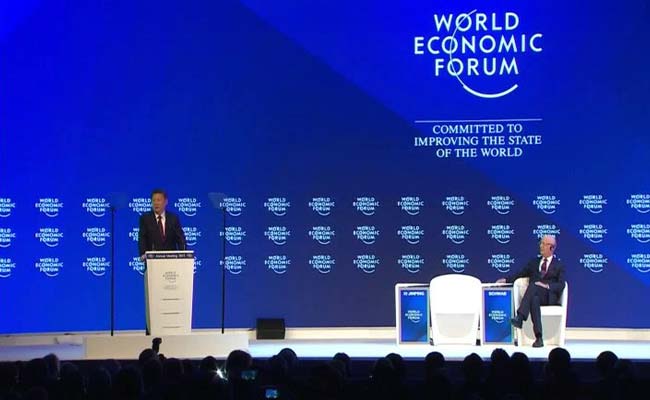
In what will be read by many as a veiled swipe against incoming US President Donald Trump's protectionist rhetoric, Chinese President Xi Jinping said "pursing protectionism is like locking oneself up in a dark room. Wind and rain may be kept outside, but so are light and air."
"No one will emerge as a winner in a trade war," he added in a speech that lasted over 30 minutes and touched upon a range of issues confronting the global economic and political order, from the backlash against globalization to the emergence of new technologies such as 3D printing and artificial intelligence. He also spelt out the progress China has made to structurally transform its economy and its achievements in lifting nearly 700 million people out of poverty.
Evoking Charles Dickens' famous opening paragraph from 'A Tale of Two Cities': "It was the best of times, it was the worst of times", the Chinese President said, "We live in a world full of contradictions where growing material prosperity and advances in science and technology go hand in hand with frequent conflicts, terrorism, a mammoth refugee crisis, poverty, unemployment and a widening gap between the rich and poor."
But rather than blaming globalization for the chaos in the world, he said, "We need to cushion its negative impacts and deliver its benefits for all countries."
The international financial crisis, he said, was not an inevitable outcome of globalization, but the consequence of the excessive chase of profit by global financial institutions and a "grave failure of regulation".
"There was a time when China also had doubts about economic globalization...(but) we came to the conclusion that China must have the capacity to swim in the vast ocean of global market."
Speaking about the state of the global economy, he said the pace of growth remains at its "slowest in seven years", with global trade clocking even slower numbers, short-term policy stimuli proving to be ineffective and the role of traditional growth engines weakening further, even as new growth sources take time to emerge despite artificial intelligence and 3D printing becoming realities of the world.
In the light of this, problems with global growth, governance and development models must be addressed effectively, and with a relentless pursuit of innovation, he added.
The Chinese President also called for the need to sustain the momentum on the issue of the IMF (International Monetary Fund) quota reforms that have already entered into force, and asked all signatories of the Paris climate agreement to stick to their commitment.
Speaking about China's structural transformation, he said the economy has entered a "new normal" with major changes taking place on the rate and drivers of growth, the economic model etc. "Despite the sluggishness of the global economy, China will grow by 6.7 per cent in 2016," he said, adding that as a result of its bigger size, China now generates far more output than it did when it grew in double digits.
While acknowledging the downward pressures and lack of internal growth drivers facing the Chinese economy, he said there was still an enormous space for the country to develop, as standards of living were still comparatively low. He vowed to stay ahead of the curve by accelerating reform, continuing to cut overcapacity, deleveraging financing, developing an advanced manufacturing system and making innovation a prominent feature in the growth agenda.
"China has no intentions to boost competitiveness by devaluing the RMB or launching a currency war," he added.

-
Signature Play: The Classic Cocktail Is Dead. Or Is It?

Classic cocktails are disappearing from India's cocktail menus. But they're still being ordered, taught to bartenders and borrowed from. So, who's really having the last drink?
-
A New Samvat Wishlist: Inclusive Prosperity And Human Development
India has strengthened its economic foundations through infrastructure, digital access and enterprise. Its next growth chapter must deepen productivity, create better livelihoods and widen participation in prosperity.
-
Love, Sex Aur Dhokha: The Audacious Plot To Spy On Jensen Huang
A Taipei dinner, a Singapore chip buyer and a suspected Chinese asset: inside the alleged spy operation that got close to NVIDIA's Jensen Huang.
-
Ten Things I Learnt This Samvat
Patience can be a trap. Cheap stocks can stay cheap. Leverage can wipe you out. What did Samvat 2082 teach us? Niraj Shah writes on 10 lessons from the year gone by.
-
Talking Points This Week: Tech Nerves, FII Buying, And A Faraway Banking Shock
The global markets are not shining this Diwali. The exception in the large markets is, India.
-
Midterm Rally Lasted A Day. The Hard Reality Of A Divided US May Last Two Years | Opinion
Between a contested AI boom, a debt ceiling that arrives in 2027 and a president with every incentive to act alone, the next two years may prove more volatile than the first day's rally suggests.
-
Blue Wave Will Derail the AI Trade but Won't Dismantle the AI Era | Unhedged Position
The Democrats' sweep of the US Congress will see politics collide with economic forces both over the long and short term.
-
It's Time To Take The GST Council's Bet On Trust Global
Payment records can prove India's services exports, and clear, proportionate rules can bring foreign digital sellers into the tax net.
-
Opinion | India at 38: From Innovation Overperformer to Innovation Powerhouse
India now has 453 VC-backed deep science startups, 18 of them late-stage, after 117 percent growth since 2020. Laurus Labs, at USD 9.3 billion, is the most valuable deep science company in any middle-income economy outside China.









