NITI Aayog's 3-Year Agenda Sets Stiff Economic Targets: Arun Jaitley
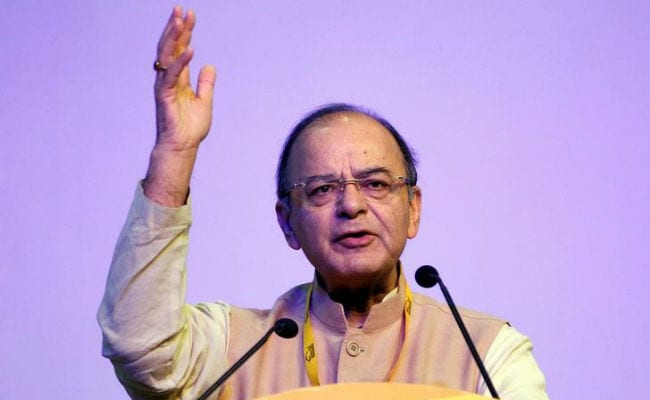
New Delhi: Finance Minister Arun Jaitley said NITI Aayog's three year action agenda has set stiff economic targets and meeting those would benefit the economy.
"You (NITI Aayog) have mentioned the broad growth outlook, the macroeconomic parameters which an economy itself will have to follow, the revenue projections and expenditure itself and therefore its impact of fiscal deficit and current account deficit etc," he said.
"I see that sticking to those stiff targets and sticking to those stiff targets itself can bring benefits to economy in many a ways," he said after unveiling the Three-Year Action Agenda prepared by NITI Aayog.
According to the 'Three-Year Action Agenda' India has good prospects of achieving over 8 per cent growth within 2-3 years, while suggesting a host of reforms to ensure prosperity for all citizens.
The government think tank has come out with a detailed plan for reforms in the economy, judiciary, regulatory structure and social sectors, in the three-year document to be implemented from 2017-18 to 2019-20.
"Now to prepare a three-year action agenda which is specific which has the capacity if implemented in these specific areas to trigger much more economic activity than we have today," Mr Jaitley said appreciating the publication.
This publication really has potential for becoming a good text book for those in government, he said.
Mr Jaitley said, "The state of things as they are could continue is something which people are not expecting and therefore they expect higher growth rate, expect more decisions to be taken and a lot of activities itself to take place."
On the 'Three Year Action Agenda', NITI Aayog vice chairman Arvind Panagariya said the document is the culmination of lot of work done by hundreds of people.
The entire document is divided in seven different parts, he said.
Participating in the panel discussion, he said the major impediment in job creation is that India Inc simply do not invest in labour intensive activities.
"I have to tell little harder to all entrepreneurs. In Gujarat's Special Economic Zones, National Investment and Manufacturing Zone (NIMZ) Gujarat has complete flexibility on labour laws ... in other ways Gujarat also has got good infrastructure. But I still don't see kind of activity in labour intensive industries that you would like to see," he said.
Former Revenue Secretary N K Singh said steps have been taken by this government to reform labour laws.
He also observed that the agenda released today has set many daunting timelines which government has to meet.
Pointing out that inflexibility in labour laws is a major concern, Mahindra Group Chairman Anand Mahindra said this discourages foreign investors to invest in India.
"I believe that Small and Medium Enterprise in the country are going to create jobs. I am also big supporter of the Coastal Employment Zones (CEZs)," he said citing the growth story of China which started with coastal cities like Shenzhen.
TeamLease chairman Manish Sabharwal said India don't have a job problem but has a wage problem. "Regulatory cholesterol around labour regulations has to reduce if we need to create more jobs."
(Except for the headline, this story has not been edited by NDTV staff and is published from a syndicated feed.)

-
We May Need Another Tukaram Mundhe To Fight Air Pollution | The Reason Why

Developers may install basic measures such as sprinklers and green nets, resume work, and continue violating rules when this equipment stops working.
-
Extracting Value From Battery Scrap Could Be Challenging For India | The Reason Why
A discarded lithium-ion battery still contains valuable materials such as lithium, nickel and cobalt. These can be recovered and reused. When such batteries are crushed and shredded, they produce a dark powder called black mass.
-
One El Nino, India Can Handle. Two Could Break The Granary
India's grain stocks can absorb one bad year, but a second El Nino could drain the buffer in two to three years, economists say.
-
India's Troika Of Good Luck | Joining The Dots
As Jensen Huang's exit drags Nvidia down, a cooling AI trade and resilient earnings have revived investor interest in India. A likely RBI rate hike looms.
-
Talking Points This Week: Leadership Shock At Nvidia, Earnings Strength, And The Fog Over Hormuz
The Anthropic IPO pricing and first trading day, Nvidia's upcoming earnings, and any fresh signals from Iran will set the tone for the following week.
-
Signature Play: The Classic Cocktail Is Dead. Or Is It?
Classic cocktails are disappearing from India's cocktail menus. But they're still being ordered, taught to bartenders and borrowed from. So, who's really having the last drink?
-
A New Samvat Wishlist: Inclusive Prosperity And Human Development
India has strengthened its economic foundations through infrastructure, digital access and enterprise. Its next growth chapter must deepen productivity, create better livelihoods and widen participation in prosperity.
-
Love, Sex Aur Dhokha: The Audacious Plot To Spy On Jensen Huang
A Taipei dinner, a Singapore chip buyer and a suspected Chinese asset: inside the alleged spy operation that got close to NVIDIA's Jensen Huang.
-
Ten Things I Learnt This Samvat
Patience can be a trap. Cheap stocks can stay cheap. Leverage can wipe you out. What did Samvat 2082 teach us? Niraj Shah writes on 10 lessons from the year gone by.
-
Talking Points This Week: Tech Nerves, FII Buying, And A Faraway Banking Shock
The global markets are not shining this Diwali. The exception in the large markets is, India.









