Netflix Sees Stronger Second Half on Password-Sharing Crackdown
(Bloomberg) -- Netflix Inc. will begin cracking down this quarter on US viewers who share someone else's account, predicting plans to charge such customers will boost growth in the second half of the year.
The company, which reported a lower-than-expected subscriber gain for the first quarter, has been testing ways to reduce account sharing in Latin America, and rolled out a plan to charge such users in four additional territories in the first quarter.
Netflix estimates that more than 100 million people use an account they don't pay for, and analysts see paid sharing as a large potential source of new customers or sales. The company had planned to begin charging for password sharing in the US in the first three months of 2023. Now it says it will do so in the next couple months.
Shares of Netflix were down 1% at $330.47 in extended trading, erasing a loss of as much as 12% after the results were announced. In addition to forecasting a pickup in the second half of the year, Netflix raised its free cash flow forecast for 2023 to $3.5 billion.
In Canada, one of the markets where the company has cracked down, the paid member customer base is now larger.
“Their comments on results in Canada seem better than some had feared,” said Magalie Grossheim, senior analyst at M Science, a research unit of Jefferies Financial Group Inc.
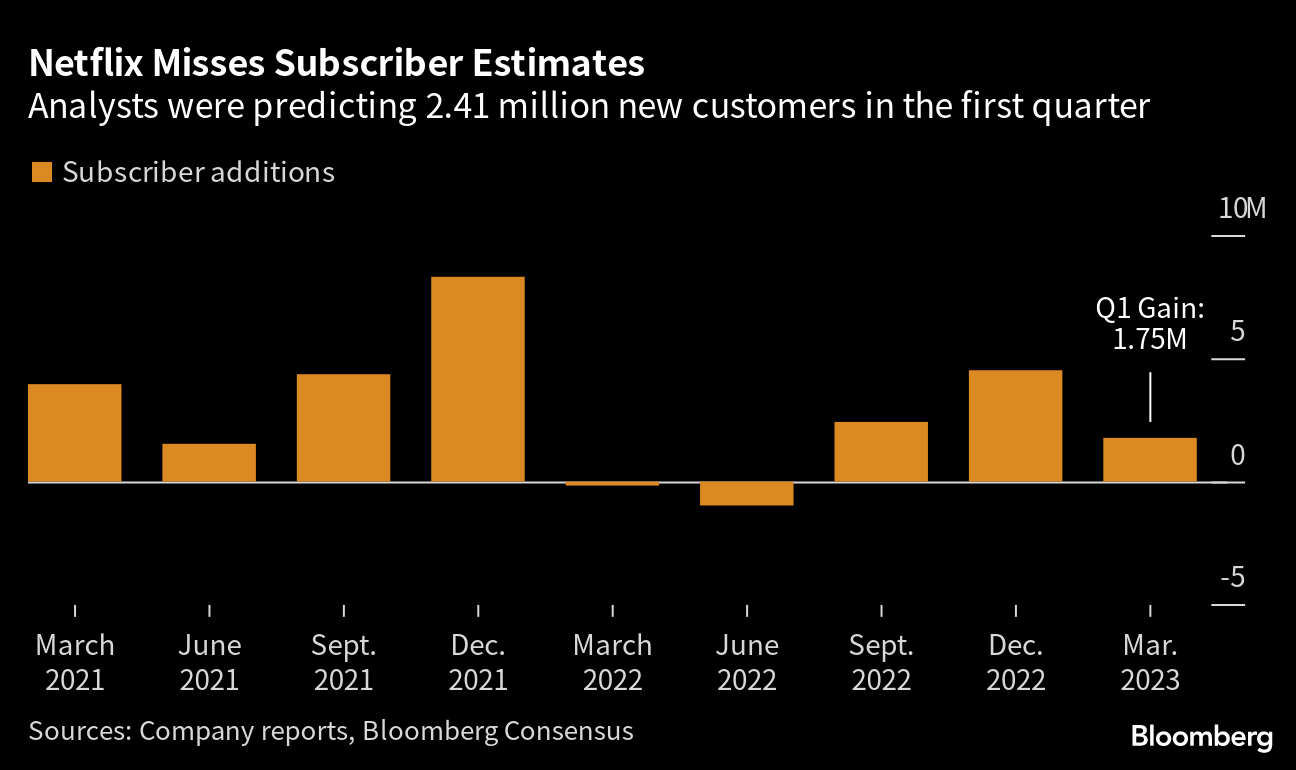
Netflix could use a lift. The company got off to a slow start to 2023, missing Wall Street estimates by adding only 1.75 million customers in the first quarter. Investors were expecting 2.41 million new customers. But the company predicted new initiatives like the password sharing plan and a new tier of service with ads will allow “growth to accelerate over the course of the second half of 2023.”
This is the second year in a row where Netflix has gotten off to a shaky start as the company has gone from a high-flying phenom to a middle-aged star searching for its next big hit. The streaming service lost customers in the first half of 2022 and added fewer than 9 million customers for the full 12 months, its slowest pace since 2011, the year it split its streaming service from its DVD-by-mail business. Netflix said Tuesday it is shutting down its DVD delivery operation, ending its original business after a 25-year run. That business has been shrinking for years.
The streaming industry pioneer has responded to its slowing growth by introducing two new initiatives: the plan to crack down on password sharing and an advertising-supported tier. The advertising tier debuted in November but has yet to contribute a material number of subscribers. The company had said that both advertising and password sharing will offer modest contributions in the first quarter of the year but would pick up over the course of the year.
Netflix has urged investors to stop fixating on subscriber additions and instead look at traditional financial metrics like sales and profit. The company generated more than $2 billion in free cash flow in the first quarter, and reported net income of $1.31 billion.
Cracking down on password sharing will cause some customers to stop using the service in the short term. Netflix's challenge is to get them to pay for their own account or pay to share the one they currently use. Either scenario would boost sales in markets like the US and Latin America.
The service added just 100,000 customers in the US and Canada after losing almost 1 million customers last year. It lost subscribers in Latin America, a development that could be the result of the crackdown on password sharing.
Netflix is still the most popular TV network in the US by a good margin. It accounts for more than 7% of all TV viewing in the US each month, according to Nielsen, more than double any paid service. It also tops linear networks, according to CBS. Netflix released several new hits in the quarter, including new seasons of and , the new show and the film .
The Asia-Pacific region continues to be Netflix's bigger source of new customers. The service added 1.46 million customers there in the quarter, thanks in part to lowering prices in India and other poorer countries. Netflix said it is growing more sophisticated about pricing.
(Updates shares in sixth paragraph.)
More stories like this are available on bloomberg.com
©2023 Bloomberg L.P.

-
Gold Is Rs 22,000 Cheaper Than A Month Ago. Should You Buy Amid The Wedding Season?

Gold's potential slide to $3,500 could save around Rs 4,700 per 10 grams, but a soft inflation print could just as easily push prices back up. One way to split the risk is to buy in parts, some now and the rest after the Fed's Dec. 9 decision.
-
AI Agents Are Gaining Power. Who Governs Them?
Artificial intelligence agents promise to transform productivity by moving machines from assisting decisions to executing them. But as organisations delegate greater authority to these AI-agents, they must first establish who controls that authority and who remains accountable when things go wrong.
-
Why Swapping Your Old Gold Can Trigger A Rs 5 Lakh Tax Bill, And How You Can Avoid It Legally
Swapping old gold for new is taxed as a sale and a fresh purchase. Getting your own gold remade can cut most of that bill, though it has its own costs.
-
The AI Trade is Done. The Real Opportunity for Investors Starts in 2027 | Unhedged Position
As pureplay AI stocks plunge and circular, capex-led financing unwinds, 2027 is set to be a year of reckoning for AI companies. Yet the bust clears the way for a better opportunity for investors in 2027 -- shifting the spotlight from AI builders to the companies using AI.
-
Leadership As Mission: Why The Age Of AI Demands More Human Leadership
Debjani Ghosh examines how AI is changing leadership, arguing that its success must be measured by its impact on people and the accountability of those guiding its use.
-
We May Need Another Tukaram Mundhe To Fight Air Pollution | The Reason Why
Developers may install basic measures such as sprinklers and green nets, resume work, and continue violating rules when this equipment stops working.
-
Extracting Value From Battery Scrap Could Be Challenging For India | The Reason Why
A discarded lithium-ion battery still contains valuable materials such as lithium, nickel and cobalt. These can be recovered and reused. When such batteries are crushed and shredded, they produce a dark powder called black mass.
-
One El Nino, India Can Handle. Two Could Break The Granary
India's grain stocks can absorb one bad year, but a second El Nino could drain the buffer in two to three years, economists say.
-
India's Troika Of Good Luck | Joining The Dots
As Jensen Huang's exit drags Nvidia down, a cooling AI trade and resilient earnings have revived investor interest in India. A likely RBI rate hike looms.
-
Talking Points This Week: Leadership Shock At Nvidia, Earnings Strength, And The Fog Over Hormuz
The Anthropic IPO pricing and first trading day, Nvidia's upcoming earnings, and any fresh signals from Iran will set the tone for the following week.









