PM Modi Urges India Inc To Step Up Investment
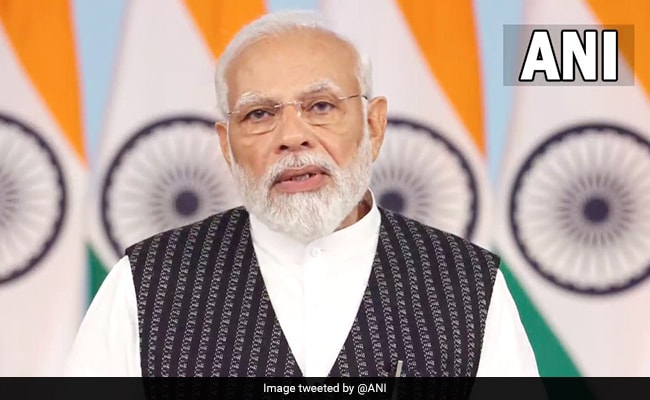
Prime Minister Narendra Modi on Tuesday urged India Inc to increase investment in tandem with the government's decision to raise capital expenditure (capex) and take advantage of the opportunities unveiled in the Budget 2023-24.
Addressing the 10th webinar on Budget, PM Modi said the government has increased outlay on capex to a historic high of Rs 10 lakh crore.
He further said that India is being described as a bright spot of the global economy and the country has attracted the highest FDI in the country in the year 2021-22 with major part going into manufacturing sector.
"I would also call upon the private sector of the country to increase their investment just like the government so that the country gets maximum benefit from it," he said while talking about the key proposals of the Budget.
He stressed that applications are continuously pouring in to avail of the Production Linked Incentive (PLI) scheme which makes India an important part of the global supply chain.
Dwelling on the tax-related post-Budget narratives, the prime minister said as opposed to the past, the tax burden has come down significantly in India due to GST, reduction in income tax and corporate tax.
This, he said, has resulted in better tax collection as the gross tax revenue was about Rs 11 lakh crore in FY14, which can rise to Rs 33 lakh crore in 2023-24, an increase of 200 per cent.
The number of individual tax returns filed increased from 3.5 crore to 6.5 crore from 2013-14 to 2020-21, he said.
"Paying tax is such a duty, which is directly related to nation building. The increase in the tax base is proof that people have faith in the government, and they believe that the tax paid is being spent for public good," he said.
He said Amrit Kaal Budget laid the roadmap of an all-inclusive financial sector for India's growth and India is moving with new capabilities, the responsibility of those in the financial world of India has increased.
Modi asked the banking sector that they have a robust financial system of the world and a banking system that is in profit after being on the verge of collapse 8-10 years ago.
Also, he said, there is a government that is taking policy decisions with courage, clarity and confidence.
"Today, the need of the hour is that the benefits of the strength in India's banking system should reach the maximum number of people," he said.
Giving an example of the government's support to the MSME sector, the prime minister asked the banking system to reach out to the maximum number of sectors.
"1 crore 20 lakh MSMEs have received huge help from the government during the pandemic. In this year's budget, the MSME sector has also got additional collateral-free guaranteed credit of 2 lakh crores. Now it is very important that our banks reach out to them and provide them adequate finance," he said.
Modi pointed out that the government's policies related to financial inclusion have made crores of people part of the formal financial system.
The government has helped fulfil the dreams of crores of youth by giving Mudra loans of more than Rs 20 lakh crore without a bank guarantee, he said.
For the first time, he said, more than 40 lakh street vendors and small shopkeepers received help from banks through PM Swanidhi Yojana.
The prime minister said that the entire world is witnessing the impact of India's fiscal and monetary policy during the COVID-19 pandemic and lauding its efforts in strengthening the fundamentals of the country's economy in the last 9 years.
Recalling the time when the world looked at India with suspicion, he said that discussions on India's economy, budget and goals would often begin and end with a question.
He highlighted the changes in financial discipline, transparency and inclusive approach and noted that the question mark at the beginning and end of the discussion has been replaced by 'vishwas' (trust) and 'apeksha' (expectations).
Touching upon the issue of 'vocal for local' he said that this is not a matter of choice but 'vocal for local and vision of self-reliance is a national responsibility'.
"Our exports have been at an all-time high, whether in goods or services. This indicates growing possibilities for India," he said, adding, the stakeholders like organisations and chambers of industry and commerce to take up the responsibility to promote local artisans and entrepreneurs up to the district level.
He clarified that 'vocal for local' is bigger than just buying products from the Indian cottage industry.
"We have to see which are the areas where we can save the country's money by building capacity in India itself," he said citing examples of higher education and edible oil where a lot of money goes out.
The prime minister said Indian talent, infrastructure and innovators can take the Indian financial system to the top.
"In the era of 'Industry 4.0', platforms developed by India are becoming models for the world," he said giving examples of Government e Marketplace (GeM) and digital transactions.
He said that in the 75th year of independence, 75,000 crore transactions were done digitally, which shows how wide the expansion of Unified Payments Interface (UPI) has become.
"RuPay and UPI are not just a low-cost and highly secure technology, but it is our identity in the world. There is immense scope for innovation. UPI should become a means of financial inclusion and empowerment for the whole world, we have to collectively work for it. I suggest that our financial institutions should also have maximum partnership with fintechs to increase their reach," he said.
Sometimes, even a small step can make a huge difference in boosting the economy, he said and gave the example of buying goods without the bill.
Pointing out that the feeling that there is no harm done by this, Modi underlined the need to increase awareness about getting a copy of the bill that will benefit the nation in return.
The benefits of India's economic development should reach every class and person, he said urging all stakeholders to work with this vision.
He also stressed creating a large pool of well-trained professionals.
(Except for the headline, this story has not been edited by NDTV staff and is published from a syndicated feed.)

-
Extracting Value From Battery Scrap Could Be Challenging For India | The Reason Why

A discarded lithium-ion battery still contains valuable materials such as lithium, nickel and cobalt. These can be recovered and reused. When such batteries are crushed and shredded, they produce a dark powder called black mass.
-
One El Nino, India Can Handle. Two Could Break The Granary
India's grain stocks can absorb one bad year, but a second El Nino could drain the buffer in two to three years, economists say.
-
India's Troika Of Good Luck | Joining The Dots
As Jensen Huang's exit drags Nvidia down, a cooling AI trade and resilient earnings have revived investor interest in India. A likely RBI rate hike looms.
-
Talking Points This Week: Leadership Shock At Nvidia, Earnings Strength, And The Fog Over Hormuz
The Anthropic IPO pricing and first trading day, Nvidia's upcoming earnings, and any fresh signals from Iran will set the tone for the following week.
-
Signature Play: The Classic Cocktail Is Dead. Or Is It?
Classic cocktails are disappearing from India's cocktail menus. But they're still being ordered, taught to bartenders and borrowed from. So, who's really having the last drink?
-
A New Samvat Wishlist: Inclusive Prosperity And Human Development
India has strengthened its economic foundations through infrastructure, digital access and enterprise. Its next growth chapter must deepen productivity, create better livelihoods and widen participation in prosperity.
-
Love, Sex Aur Dhokha: The Audacious Plot To Spy On Jensen Huang
A Taipei dinner, a Singapore chip buyer and a suspected Chinese asset: inside the alleged spy operation that got close to NVIDIA's Jensen Huang.
-
Ten Things I Learnt This Samvat
Patience can be a trap. Cheap stocks can stay cheap. Leverage can wipe you out. What did Samvat 2082 teach us? Niraj Shah writes on 10 lessons from the year gone by.
-
Talking Points This Week: Tech Nerves, FII Buying, And A Faraway Banking Shock
The global markets are not shining this Diwali. The exception in the large markets is, India.
-
Midterm Rally Lasted A Day. The Hard Reality Of A Divided US May Last Two Years | Opinion
Between a contested AI boom, a debt ceiling that arrives in 2027 and a president with every incentive to act alone, the next two years may prove more volatile than the first day's rally suggests.









