Mukesh Ambani, Asia's Richest, Added $17 Billion To His Wealth In 2019
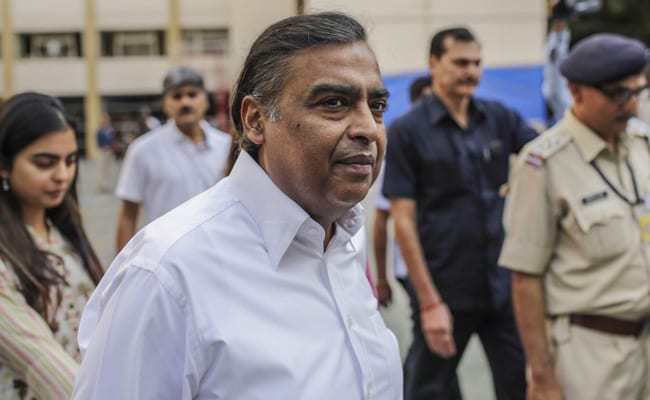
It's been a good year for Asia's richest man, Mukesh Ambani.
The Indian tycoon added almost $17 billion to his wealth as of December 23, the most in Asia, taking his net worth to about $61 billion, according to the Bloomberg Billionaires Index. In comparison, Alibaba Group founder Jack Ma's net worth grew $11.3 billion, while Jeff Bezos lost $13.2 billion.
The surge in Mr Ambani's fortune this year was fueled by a 40% jump in the shares of his Reliance Industries Ltd., a conglomerate that's pivoting more toward consumer offerings than its core oil refining and petrochemicals businesses. The rally in the stock is more than double the gains for India's benchmark S&P BSE Sensex index during the period.
Investors are piling money on Reliance, betting newer businesses such as telecommunications and retail could soon unlock value. With a goal of building a local e-commerce giant to challenge the likes of Amazon.com Inc. in India, Mr Ambani has spent almost $50 billion -- mostly debt -- on a wireless carrier that's become India's No. 1 within three years of debut.
"Mukesh Ambani changed the narrative for Reliance Industries" as a leader not just in oil and gas but also in telecom and retail, and possibly soon in e-commerce as well, said Chakri Lokapriya, chief investment officer at TCG Asset Management, which oversees $3 billion in assets in Mumbai.
"He successfully identified, invested and executed rapidly to create this new narrative," Lokapriya said. "We believe this can potentially double shareholder value over the next four years."
The newer businesses are likely to contribute 50% of Reliance's earnings in a few years, from about 32% now, Mr Ambani said in August. A representative for Reliance didn't reply to an email seeking comment on Mr Ambani's wealth.
Zero Net Debt
While the success of the phone operator was a cause for cheer, the business mogul's plans to pare Reliance's debt has sent Reliance's stock soaring to a record.
Mr Ambani, 62, has vowed to slash the group's net debt to zero by early 2021. Plans include a stake sale in Reliance's oil-to-chemicals business to Saudi Arabian Oil Co., listings of the telecommunications and retail units within five years, sale of tower assets and strategic partners for a digital platform linked to Reliance Jio Infocomm Ltd., the phone company.
The value of Reliance's shares have almost tripled since the end of 2016, when Jio entered the Indian market with free calls and cheap data and forced some heavily indebted incumbents to exit or merge with rivals. With more than 350 million users, unlisted Jio reported a net income of Rs 996 crore ($140 million) for the September quarter while the other two private sector operators amassed record losses.
Still, investors have been wary of the ballooning debt at the group that spent about $76 billion in the last five years. Reliance Industries had a net debt of 1.54 trillion rupees at the end of March 31, Ambani told shareholders in August.
Aiding Reliance's efforts to cut debt would be:
Aramco
- Proposed sale of 20% of Reliance's oil-to-chemicals business in a transaction that would value the enterprise at $75 billion (including debt)
- Deal, expected to complete by March, is subject to due diligence, definitive agreements and regulatory approvals
Holding Firm
- In late October, Reliance unveiled a sweeping plan to create a $24 billion digital-services holding firm, with an aim to make Jio almost debt free by March
- "Given the reach and scale of our digital ecosystem, we have received strong interest from potential strategic partners," Mr Ambani said
Brookfield
- In July, Reliance announced selling a stake in an investment trust that will manage its mobile-phone tower business to Canada-based Brookfield Asset Management Inc. for 252.2 billion rupees
- The proposed transaction with Aramco has run into a hurdle, threatening Ambani's debt paring plans. An Indian court has sought details of Reliance's assets after the Indian government petitioned to stop the proposed sale in an unrelated arbitration lawsuit.
Mr Ambani, however, has a proven record in keeping his promises that investors are relying on.
"Mr Ambani created value in Jio, which he deleveraged by hiving off his infrastructure assets to Brookfield," said Sandeep Gupta, managing director, Protiviti India. "He can further deleverage the company from a debt point of view by bringing in strategic investors, which will raise the value further."

-
Indians Are Travelling, But Not Every Journey Is A Holiday | The Week In Whys

Pilgrims, patients and working women are the real travellers, and the system hasn't quite caught up with them.
-
Getting To Work Costs Women More | The Reason Why
It is not just about women paying more than men. It is about women paying much more in cities than in villages.
-
AI Bias In Investing Cannot Be Eliminated, But It Can Be Governed
Framing is a particularly important example as identical financial information presented in terms of gains rather than losses can lead an LLM to reach a different assessment.
-
Joining The Dots | Dark Skies, Steady Diya: Why Hope Holds This Diwali
With war, a weak rupee and foreign outflows weighing on sentiment, policymakers at the NDTV World Summit and market veterans at NDTV Profit Ignite: Diwali Edition offered the same advice: stay invested and filter out the noise.
-
The Curious Case of Equitas Small Finance Bank And A CEO Who Quit For Stock
PN Vasudevan believes persistent investor concerns over a perceived conflict of interest had become a governance overhang on Equitas Small Finance Bank's stock, even as the lender improved profitability and asset quality.
-
Talking Points This Week: AI Cash Burn, A Tiger Comeback And An India That Still Finds Its Own Path
India is not immune to higher oil or tighter global liquidity, yet its earnings base is broader, its domestic policy levers are still available.
-
Foreign Investors Own Half Of HDFC Bank and ICICI Bank. An LTCG Cut Could Matter Most Here
Foreign portfolio investors have US$115 billion parked in HDFC Bank, ICICI Bank. If the government cuts long-term capital gains tax, Jefferies says returning foreign money could land here first.
-
'Never Seen This Level Of Negativity': Sandeep Tandon Says The Next Rally May Be Closer Than You Think
Veteran investor Sandeep Tandon says foreign selling is easing, large-caps are due a comeback and mid-caps are crowded, while he turns positive on gold, power and pharma this Diwali.
-
Indians Stay With Family, Not In Hotels | The Reason Why
India still lacks enough clean, reliable and affordable hotels for budget-conscious travellers.
-
The Economic Imperative: Analysing The Material Driving Force Behind India-Canada Strategic Reset
This economic complementarity is further reinforced by deep institutional investment ties and talent mobility, which form the bedrock of the bilateral framework.










