Morgan Stanley Explains Why Indian Stocks Aren't Hurting More Amid Oil Spike

Amid oil supply, rate and currency concerns, India's stocks appear to be “relatively calm”. Morgan Stanley analyses why.
India's "strong policy environment" and domestic institutions more than making up for the exodus by foreign portfolio investors are among the key factors for this "insulation" so far, according the financial services provider.
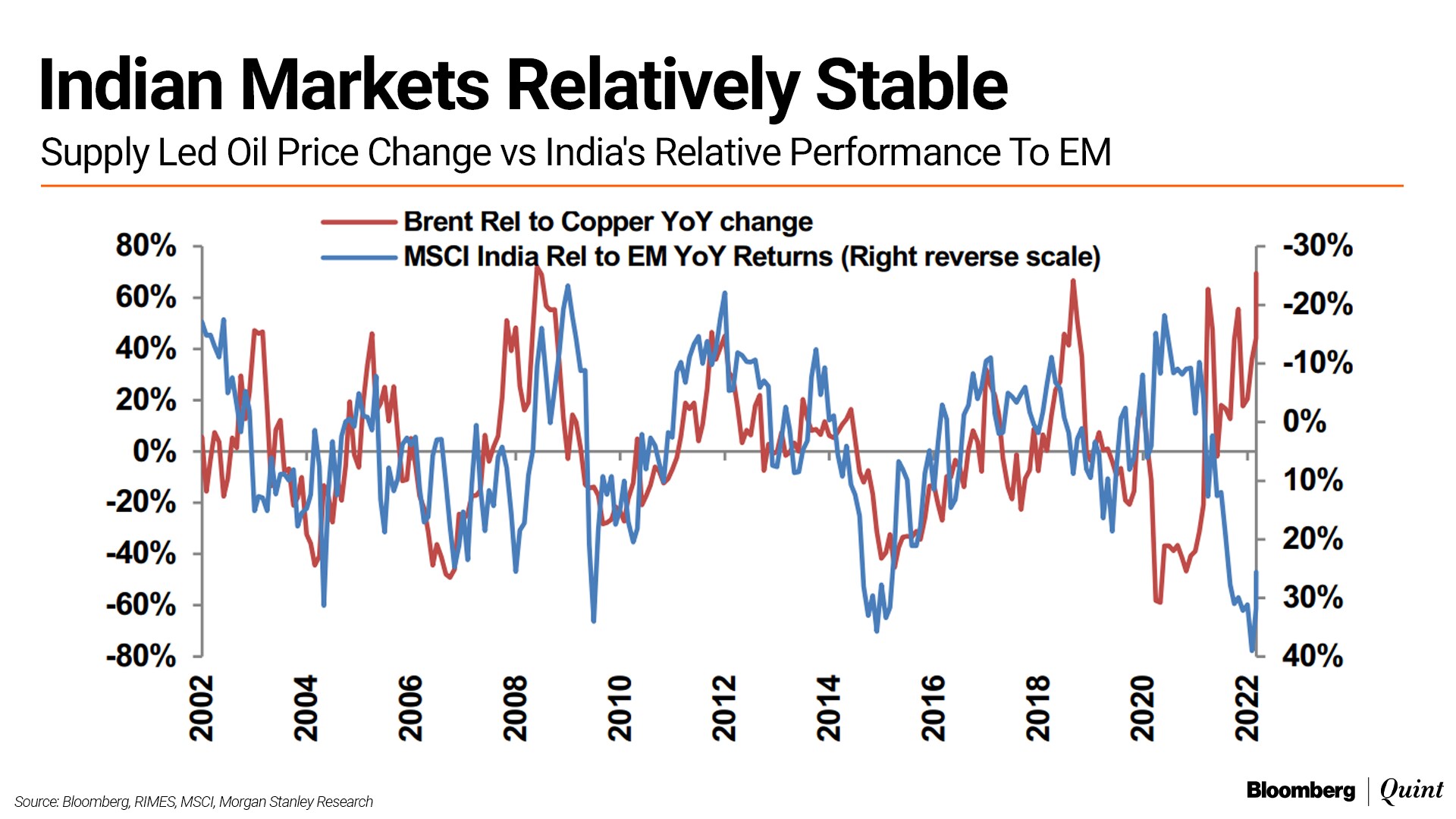
Supply-constrained oil price rises are bad for India as the current account deficit widens and inflation spikes, Morgan Stanley said in a March 4 note authored by equity strategists Ridham Desai and Nayant Parekh, and equity analyst Sheela Rathi. “Historically, India's relative stock prices to emerging markets have reacted poorly to oil price increases caused by supply outages.”
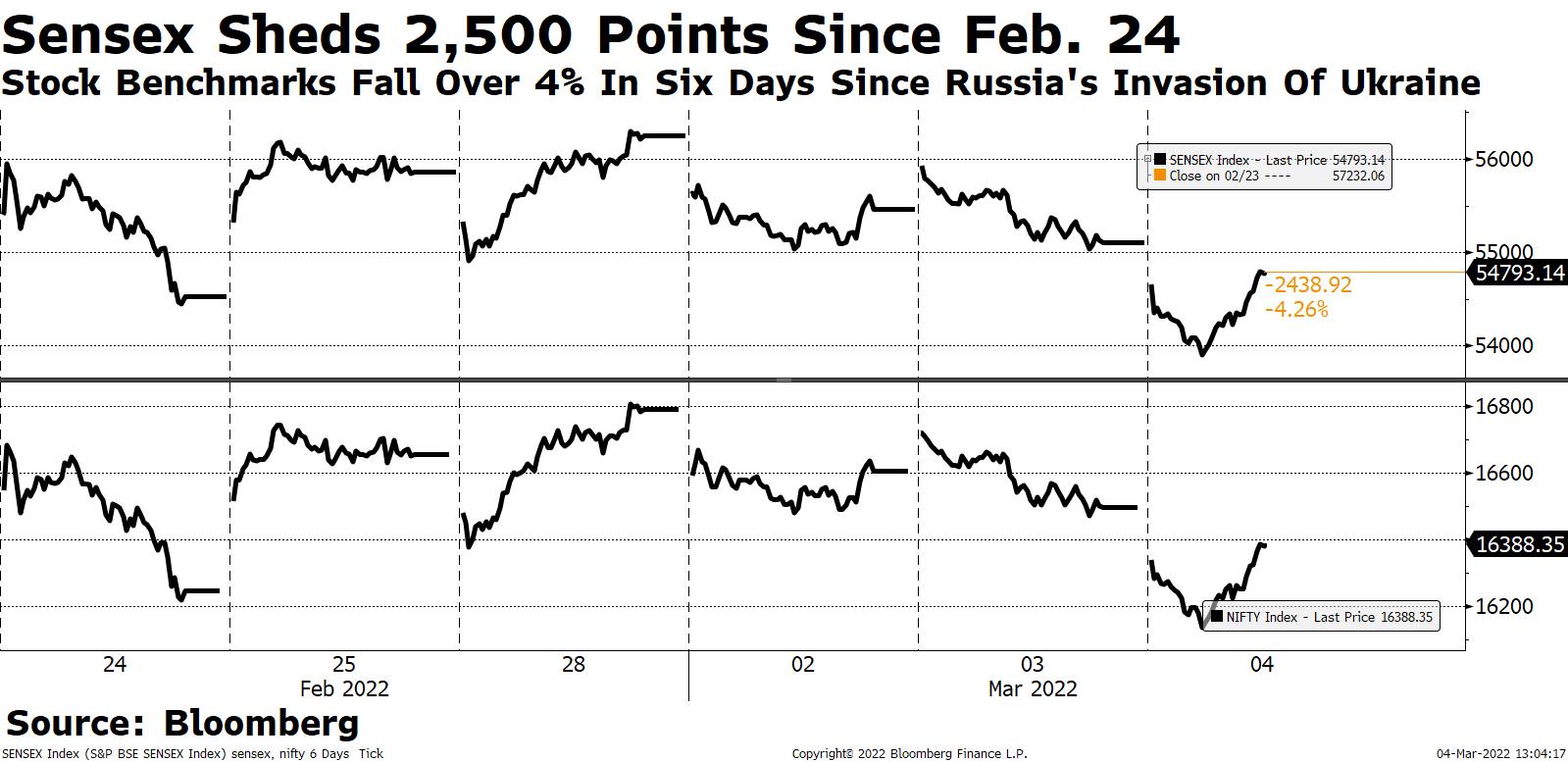
India's stock benchmarks have dropped 11% from their record over the past four months. Russia's invasion of Ukraine that caused crude and commodity prices to surge, too, contributed to the decline.
Still, according to Morgan Stanley, India has fared better during the supply-led oil price rise than in the past.
Morgan Stanley measured India's relative stock prices to other emerging markets using oil price relative to copper and New York Fed's oil price dynamics report. “The tight association between these indicators and India's relative performance to EM appears to be breaking down in recent years.”
Morgan Stanley cited the reasons in detail:
Policy certainty: India's policy environment is among the strongest in the world driving the nation's idiosyncratic growth story and, more importantly, likely creating a new profit cycle. The rise in oil price is a threat but not strong enough in the context of the policy environment.
Declining oil intensity in GDP: Oil consumption as a share of GDP has fallen from nearly 1.8% to just over 0.6% in 2020. That's at all-time lows and is steadily declining, especially since 2014.
High relative real policy rate: India's relative real policy rate to the U.S. is at all time high. Monetary policy looks much better placed to handle the inflationary impact from an oil price rise, especially compared to history.
Rising share of FDI to FPI: India used to rely primarily on foreign portfolio flows to fund its current account deficit. FPI flows tend to react more aggressively to the effect of oil prices on shares. But since 2014, external funding has shifted dramatically to FDI, which is more stable and less sensitive to oil price fluctuations.
Domestic bid: The rising domestic bid on stocks since 2014 also means that FPI selling is now offset, unlike the past.
Calm in rupee and rates: The above factors probably explain why the rate and currency markets have been relatively stable compared to previous oil shocks. Thus, stocks have also reacted less violently.
Morgan Stanley, however, isn't sure if this relative insulation of stocks from oil prices is structural or just the market's assumption of a quick reversal.

-
Signature Play: The Classic Cocktail Is Dead. Or Is It?

Classic cocktails are disappearing from India's cocktail menus. But they're still being ordered, taught to bartenders and borrowed from. So, who's really having the last drink?
-
A New Samvat Wishlist: Inclusive Prosperity And Human Development
India has strengthened its economic foundations through infrastructure, digital access and enterprise. Its next growth chapter must deepen productivity, create better livelihoods and widen participation in prosperity.
-
Love, Sex Aur Dhokha: The Audacious Plot To Spy On Jensen Huang
A Taipei dinner, a Singapore chip buyer and a suspected Chinese asset: inside the alleged spy operation that got close to NVIDIA's Jensen Huang.
-
Ten Things I Learnt This Samvat
Patience can be a trap. Cheap stocks can stay cheap. Leverage can wipe you out. What did Samvat 2082 teach us? Niraj Shah writes on 10 lessons from the year gone by.
-
Talking Points This Week: Tech Nerves, FII Buying, And A Faraway Banking Shock
The global markets are not shining this Diwali. The exception in the large markets is, India.
-
Midterm Rally Lasted A Day. The Hard Reality Of A Divided US May Last Two Years | Opinion
Between a contested AI boom, a debt ceiling that arrives in 2027 and a president with every incentive to act alone, the next two years may prove more volatile than the first day's rally suggests.
-
Blue Wave Will Derail the AI Trade but Won't Dismantle the AI Era | Unhedged Position
The Democrats' sweep of the US Congress will see politics collide with economic forces both over the long and short term.
-
It's Time To Take The GST Council's Bet On Trust Global
Payment records can prove India's services exports, and clear, proportionate rules can bring foreign digital sellers into the tax net.
-
Opinion | India at 38: From Innovation Overperformer to Innovation Powerhouse
India now has 453 VC-backed deep science startups, 18 of them late-stage, after 117 percent growth since 2020. Laurus Labs, at USD 9.3 billion, is the most valuable deep science company in any middle-income economy outside China.









