Monsoon Session: BJP’s Divide & Rule Policy Will Hurt Opposition
.jpg?downsize=1010:568 "Monsoon Session: BJP’s Divide & Rule Policy Will Hurt Opposition")
The upcoming monsoon session of Parliament will be a litmus test for the durability and viability of a united opposition front to take on Modi's BJP in the run-up to the 2019 Lok Sabha election.
The BJP has already drawn blood with JD(U)'s Nitish Kumar breaking away from the fledgling 18-party opposition front to support the NDA candidate for president Ram Nath Kovind. And the government shrewdly scripted poor optics for the opposition from the very beginning of the session by rescheduling the opening day from 12 July to 17 July, the day of the presidential election when the JD(U) will cross the floor to vote with the BJP.
Oppositionvs Resurgent BJP
- While Cong and RJD have struck conciliatory tone over Nitish's decision to back Kovind,unity of 18 opposition parties seems to be in danger.
- Oppositionwants Nitish to take a united stand on vice presidential candidate.
- After CBIraids, questions are being raised over Nitish's silence – he has neither calledLalu nor issued a statement.
- Pressure ismounting on other leaders from the opposition as they are being targeted byprobe agencies.
- BJP is in resurgent mode after victory in UP assembly polls with presidential election expectedto give an additional boost.
Challenge for the Opposition
Although the opposition has an armoury full of issues to corner the government with and has filed notices for adjournment motions and discussions on all of them, its spirits are somewhat low as it grapples with the enormity of the challenges ahead.
For four weeks, it will have to be on its toes to keep its flanks together as a resurgent BJP uses every trick in the book to drive a wedge wherever it spots a chink.
The next big tussle is over the vice presidential election, which will also take place during the monsoon session, on 5 August. Once again, the man in the middle is Nitish Kumar who is being wooed by both the BJP and the opposition.
After a sharp and bitter exchange of words with Nitish Kumar over his decision to back Kovind instead of the opposition nominee Meira Kumar, the Congress and RJD have struck a conciliatory tone. They want Nitish back in the opposition fold for the vice presidential poll and Sonia Gandhi has deputed her most trusted troubleshooter Ahmed Patel for the job.
Also Read: Yes, Nitish Kumar Blundered By Backing the NDA on Kovind
Nitish's Maun Vrat
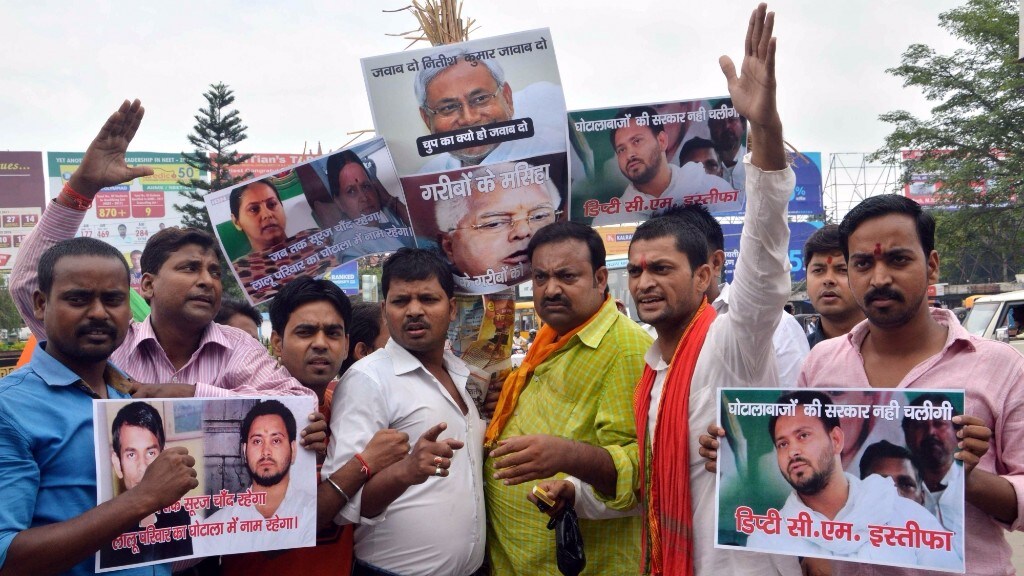
From the other side, the BJP is putting relentless pressure on Nitish to break the grand alliance in Bihar and dump Lalu. A series of CBI raids on Lalu and his family and registration of cases against the RJD boss, his son Tejashwi who is Nitish's deputy chief minister and his daughter Misa who is a Rajya Sabha MP are making things hot for the Bihar CM who prides himself on his Mr Clean image.
Nitish is silent but his silence says a lot. While opposition leaders like Sonia Gandhi and Mamata Banerjee have telephoned Lalu to show solidarity, Nitish has neither called, nor issued a statement. Nor has he indicated which side he will support in the vice presidential contest.
Also Read: Nitish Kumar Won't Join NDA – Definitely Not After CBI Raided Lalu
There are plenty of misgivings among opposition leaders about Nitish's loyalty and commitment to a united opposition front to take on Modi. Ironically, it was Nitish who had first mooted the idea of an anti-Modi front.
Building Pressure
But Nitish is not the only weak link in the fledgling 18-party opposition front. Several smaller regional players are also susceptible to pressure from the ruling dispensation and it will be quite a task to keep them within the opposition fold as issues come up for discussion in Parliament.
For instance, there are differing views on GST. Significantly, even the Congress is divided internally on this tax reform with a section wanting to oppose it along with Mamata Banerjee's Trinamool Congress while others feel that a more measured stand is necessary since GST was a UPA proposal.
The BJP has crafted an unholy strategy of divide and rule. Strong-arm tactics are reserved for the Congress, Lalu and Mamata. All three are genetically wired to oppose saffron. Consequently, the pressure on them is the most intense, both political and investigative through agencies like the CBI.
With the others, the BJP is blowing hot and cold. Cases are hanging over the heads of BSP's Mayawati and SP's Akhilesh Yadav like the proverbial Damocles sword but are not being pursued with any intensity for the moment.
The CBI is going after AIADMK's Sasikala and her family with a vengeance while other party leaders perceived as soft on the BJP, like O Paneerselvam, are being handled with kid gloves. Anti-corruption investigations are on against DMK leaders like the Maran brothers and Karunanidhi's daughter Kanimozhi but they wane and wax depending on the BJP's political needs.
Also Read: Day After CBI Raided Lalu, ED Raids Daughter Misa in New Delhi
BJP in Resurgent Mode
Parliament is the apex theatre for national politics. This is where parties take positions and draw battlelines. The monsoon session will sound the bugle for the next general election which is less than two years away. The BJP is undoubtedly in resurgent mode after its stupendous victory in the UP assembly polls. And the presidential election on the opening day of Parliament will give it an additional boost.
But paradoxically, this resurgence is driving opposition parties into a frightened huddle as they contemplate the possibility of not just a Congress-mukt Bharat but an Opposition-mukt Bharat. This is the only reason bitter rivals like the BSP and SP have recently been seen on the same forum.
Nitish's desertion for the presidential polls has frayed the Opposition's bid for unity in a desperate attempt to survive the onslaught from the BJP. The monsoon session will indicate whether the damage is beyond repair.
Also Read: Wage Code, Factories Bill to Be Pushed in Monsoon Session
(The writer is a Delhi-based senior journalist. This is an opinion piece and the views expressed above are the author's own. The Quint neither endorses nor is responsible for the same.)

-
Getting To Work Costs Women More | The Reason Why

It is not just about women paying more than men. It is about women paying much more in cities than in villages.
-
AI Bias In Investing Cannot Be Eliminated, But It Can Be Governed
Framing is a particularly important example as identical financial information presented in terms of gains rather than losses can lead an LLM to reach a different assessment.
-
Joining The Dots | Dark Skies, Steady Diya: Why Hope Holds This Diwali
With war, a weak rupee and foreign outflows weighing on sentiment, policymakers at the NDTV World Summit and market veterans at NDTV Profit Ignite: Diwali Edition offered the same advice: stay invested and filter out the noise.
-
The Curious Case of Equitas Small Finance Bank And A CEO Who Quit For Stock
PN Vasudevan believes persistent investor concerns over a perceived conflict of interest had become a governance overhang on Equitas Small Finance Bank's stock, even as the lender improved profitability and asset quality.
-
Talking Points This Week: AI Cash Burn, A Tiger Comeback And An India That Still Finds Its Own Path
India is not immune to higher oil or tighter global liquidity, yet its earnings base is broader, its domestic policy levers are still available.
-
Foreign Investors Own Half Of HDFC Bank and ICICI Bank. An LTCG Cut Could Matter Most Here
Foreign portfolio investors have US$115 billion parked in HDFC Bank, ICICI Bank. If the government cuts long-term capital gains tax, Jefferies says returning foreign money could land here first.
-
'Never Seen This Level Of Negativity': Sandeep Tandon Says The Next Rally May Be Closer Than You Think
Veteran investor Sandeep Tandon says foreign selling is easing, large-caps are due a comeback and mid-caps are crowded, while he turns positive on gold, power and pharma this Diwali.
-
Indians Stay With Family, Not In Hotels | The Reason Why
India still lacks enough clean, reliable and affordable hotels for budget-conscious travellers.
-
The Economic Imperative: Analysing The Material Driving Force Behind India-Canada Strategic Reset
This economic complementarity is further reinforced by deep institutional investment ties and talent mobility, which form the bedrock of the bilateral framework.
-
Medicine Pricing: Where Must Profit Stop?
India must confront excessive margins, hidden incentives and regulatory gaps that threaten the integrity of medicine.










