Monetary Policy: MPC Begins New Financial Year With A Status Quo On Rates

- MPC keeps repo rate unchanged at 6 percent
- MPC maintains neutral stance on monetary policy
- MPC votes for status quo with a vote of 5-1
- CPI inflation forecast reduced marginally 4.7-5.1 percent in H1 and 4.4 percent in H2
- GDP growth forecast for FY19 pegged at 7.4 percent
The monetary policy committee left interest rates unchanged at its first meeting of the new financial year, indicating that the economy is finely balanced between a pick-up in growth and a rise in inflation. The MPC has also maintained a neutral stance on monetary policy.
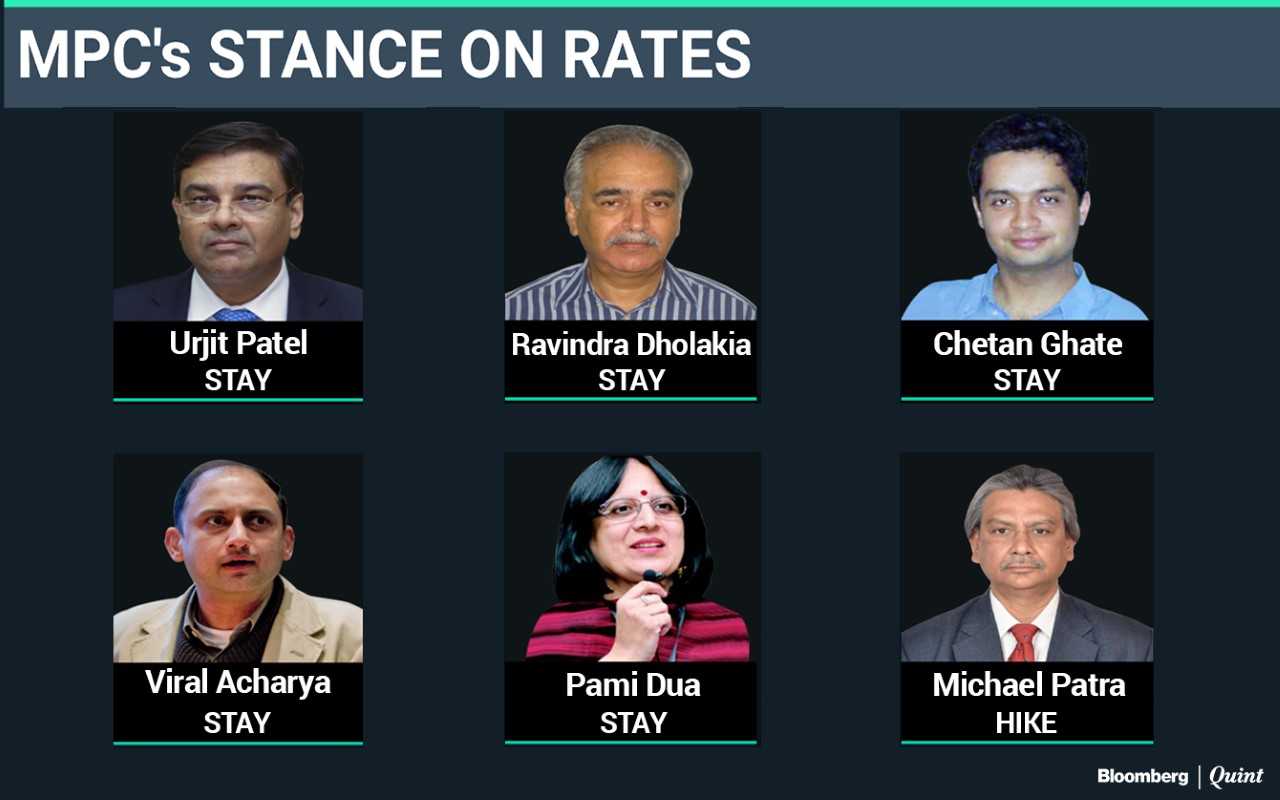
Following the MPC's review, the benchmark repo rate remains unchanged at 6 percent. The reverse repo rate has been retained at 5.75 percent. The decision was taken by a vote of 5-1 with Michael Patra voting for a 25 basis point hike in rates. The decision was in line with market expectations. All of the 42 economists polled by Bloomberg News forecast a status quo on rates.
The MPC decided to keep the policy repo rate on hold and continue with the neutral stance. The MPC reiterates its commitment to achieving the medium-term target for headline inflation of 4 percent on a durable basis.MPC Statement
Inflation Forecast Cut
The MPC's decision comes against the backdrop of moderate inflation, even though upside risks have increased. Consumer price inflation in February came in lower than expected at 4.4 percent. For the March quarter, inflation is expected to be below the RBI's 5.1 percent estimate for average inflation. For 2018-19, the MPC has reduced its inflation forecast marginally. It now expects CPI inflation in the first half of the year at 4.7-5.1 percent, and inflation in the second half of the year is seen at 4.4 percent.
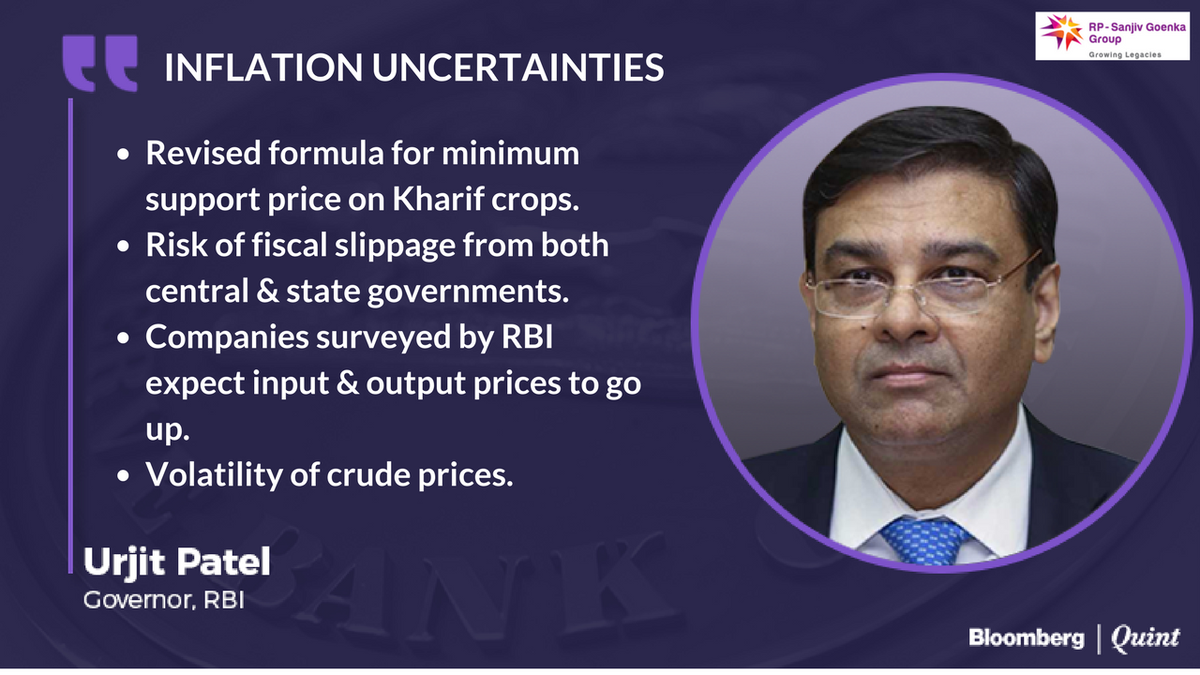
Excluding the impact of house rent allowance revisions, CPI inflation is projected at 4.4-4.7 percent in the first half of 2018-19 and 4.4 percent in the second half, said the MPC. The committee, however, continued to caution on upside risks emerging from several factors including strengthening aggregate demand, fiscal slippage and global crude oil prices.
Growth Seen Strengthening
Growth, meantime, is recovering along expected lines. The MPC, in February, projected gross value added growth at 7.2 percent in the financial year 2018-19. In its latest review, the MPC forecast GDP growth of 7.4 percent in 2018-19. Risks to this forecast are evenly balanced.
The MPC notes that growth has been recovering and the output gap is closing. This is also reflected in a pick-up in credit offtake in recent months. The large mobilisation of resources from the primary capital market should support investment activity further. While the domestic cyclical recovery is underway, the long-term growth potential is also expected to be reinforced by various structural reforms introduced in the recent past.MPC Statement
Along with the monetary policy review, the RBI also put out its twice-a-year monetary policy report detailing its view on various aspects of the economy.
RBI On Inflation
- Inflation expected at 5.1 percent in Q1 FY19, moderating to 4.7 percent in Q2 and 4.4 percent in Q3 & Q4
- Inflation expected to firm up in Q1 2018-19 before moderating
- Inflation expectation of urban households remain elevated
RBI On Growth
- Real GDP growth expected to strengthen to 7.4 percent in 2018-19
- Economic activity expected to accelerate with strengthening of investment activity, supported by consumption demand and robust credit growth
- Aggregate demand expected to improve supported by GST implementation, recapitalisation of banks, resolution of distressed assets
- Pick up in global trade could help reduce the negative drag from exports
- Pick-up in investment rate could signal a turning point in the cyclical component of growth
RBI On Fiscal Concerns
- Key risk to inflation outlook is the risk of fiscal slippage in a scenario of rising aggregate demand
- Fiscal risks could also engender a broader weakening of macro-financial conditions

-
Indians Stay With Family, Not In Hotels | The Reason Why

India still lacks enough clean, reliable and affordable hotels for budget-conscious travellers.
-
The Economic Imperative: Analysing The Material Driving Force Behind India-Canada Strategic Reset
This economic complementarity is further reinforced by deep institutional investment ties and talent mobility, which form the bedrock of the bilateral framework.
-
Medicine Pricing: Where Must Profit Stop?
India must confront excessive margins, hidden incentives and regulatory gaps that threaten the integrity of medicine.
-
Why Amazon And Flipkart Are Struggling To Beat Meesho In India's Smaller Cities
With 274 million users and lowest-cost logistics, Meesho is defending its value commerce crown against giants like Amazon and Flipkart.
-
High US Salaries, No Green Card Certainty: The Financial Calculation Facing Indian H-1B Families
The suspension of PERM processing at eight technology employers does not cancel existing H-1B visas. What it does is force a question many Indian families have been avoiding: is the US salary worth tying your career and family plans to one employer?
-
Swiggy vs Eternal: Food Delivery's Two Rivals Are No Longer In The Same Race
Eternal is building a private AI assistant, dark.ai. Swiggy is still working out how to make Instamart pay, with an operating loss of Rs 895 crore in the July-September quarter while Blinkit stayed profitable.
-
Where You Live Shapes How You Get To Work | The Reason Why
Two-wheelers are the most popular way to get to work in India, accounting for nearly 43% of workplace commutes.
-
Unhedged Position: Can India See An Indonesia-Style Time Correction?
The Nifty is trading below levels it first clocked in 2024. Is there, then, as I have suggested in the headline, potential that the current time correction drags on painfully for the next three-five, even ten years?
-
Navigating Friction And Energy Realities: An Analysis Of Marco Rubio's October Visit To India
Occurring at a critical juncture marked by stalled trade negotiations and escalating geopolitical pressures over global energy supplies, the visit offers a profound window into modern US-India relations.
-
India Exports Capital. Why Not Export Trusteeship?
The big question, then, is whether India can build an institution that global borrowers, investors, banks, and lawyers can trust, even without an Indian connection.










