India Can No Longer Spend Its Way To Higher Growth

Government spending, the Indian economy's biggest growth driver for the last two years, will no longer drive the nascent recovery seen after disruptions of a cash purge and a nationwide sales tax.
That's because the government's hands are tied by fiscal constraints as it attempts to rein in its budget deficit, Crisil said in its annual outlook for 2018-19. “The ability of central budgets to prop up growth is declining with each passing year.”
Instead, Crisil said, it hinges on the success of the bad loan clean-up, implementation of reforms and global momentum.
Prime Minister Narendra Modi's increasing thrust on building infrastructure from ports to highways helped Asia's third-largest economy as private investments fell to multi-year lows. Yet, his decision to withdraw 86 percent of the currency in circulation and a chaotic rollout of the Goods and Services Tax hurt the economy as the GDP growth slowed to its slowest pace in three years in the quarter ended June. It has since rebounded, growing for two straight quarters.
The economy picked pace in October-December growing at 7.2 percent. Government spending rose, but more significant was the 6.8 percent growth in the non-farm and non-government sectors. Private investments also saw a sharp 12 percent uptick, showing green shoots.
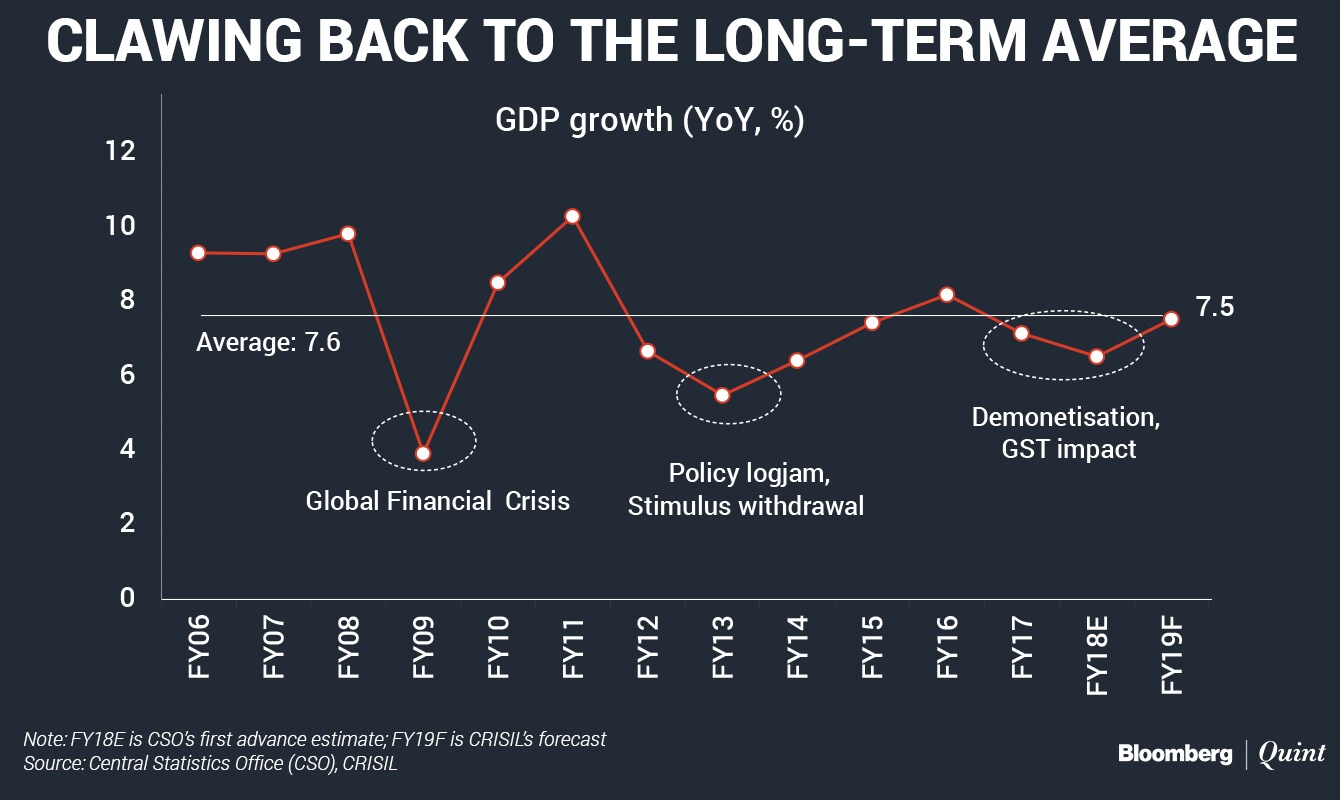
But the volatility in tax collections from GST meant that India missed its fiscal deficit of 3.2 percent of the GDP this year. And even as the Modi government pushed back the 3 percent fiscal deficit target to 2021 from 2019 earlier, it has limited headroom to prop up the economy in the final year of its first term.
The driving factors will be outside the budget. “The waning impact of demonetisation and the ironing out of GST creases will support domestic activity,” Crisil said in its report. Initial forecasts from the meteorological department have also ruled out a weak summer monsoon which augurs well for farm production. And banks' ability to lend and support the recovery will be enhanced from the mega recapitalisation plan announced by the government. Strengthening global growth, improving exports and credit offtake will also play a role in the recovery, Crisil added.
Crisil expects India to grow at 7.5 percent in 2018-19. While that's an improvement over the last two years, it is still lower than the average growth seen in the past 13 years. Besides, it is coming on a weak base in this fiscal.
The extent of the pick-up depends on four key factors, according to Crisil.
NPA Resolution
Asset quality issues have plagued the Indian banking sector for a long time, limiting its ability to extend credit. No meaningful and sustainable economic recovery is plausible without the resolution of these assets, Crisil noted.
The scenario may improve with faster resolution of stressed accounts under the new Insolvency and Bankruptcy Code, Crisil said, adding that while Indian banks will have to take haircuts as deep as 60 percent or more, the resolutions would be “watershed” for the sector.
Once the health of the banking system improves, the lending cycle will begin again, which is a requisite for growth step-up, the report said.
Rural Boost
The government's focus on demand and job creation through spending on rural and labour-intensive sectors is likely to support growth next fiscal, Crisil said. This would also push demand in the consumer sectors.
Implementation Of Reforms
The sustainability of India's economic recovery also depends on the effective implementation of reforms such as GST, the Real Estate Regulation and Development Act (RERA) and revamping the Ujwal Discom Assurance Yojana (UDAY), Crisil said.
While the rating agency expects these reforms to be “transformative” in the long run, the near-term efficacy and impact remains muddled.
Rising Global Growth
India did not benefit from the global recovery in 2017, saddled with the twin shocks of demonetisation and GST. Global growth, however, is still gathering pace and the momentum is expected to continue next year too. This should buoy Indian exports, Crisil said, even as issues such as poor infrastructure, high cost of capital and labour productivity keeps export growth subdued.
What Could Derail Growth
- Inability to resolve GST-related issues
- Financial stress in the system leading to a cut in capital expenditure by government
- Rate hikes by central banks across the globe
- Geopolitical events
- Higher crude oil prices

-
Indians Stay With Family, Not In Hotels | The Reason Why

India still lacks enough clean, reliable and affordable hotels for budget-conscious travellers.
-
The Economic Imperative: Analysing The Material Driving Force Behind India-Canada Strategic Reset
This economic complementarity is further reinforced by deep institutional investment ties and talent mobility, which form the bedrock of the bilateral framework.
-
Medicine Pricing: Where Must Profit Stop?
India must confront excessive margins, hidden incentives and regulatory gaps that threaten the integrity of medicine.
-
Why Amazon And Flipkart Are Struggling To Beat Meesho In India's Smaller Cities
With 274 million users and lowest-cost logistics, Meesho is defending its value commerce crown against giants like Amazon and Flipkart.
-
High US Salaries, No Green Card Certainty: The Financial Calculation Facing Indian H-1B Families
The suspension of PERM processing at eight technology employers does not cancel existing H-1B visas. What it does is force a question many Indian families have been avoiding: is the US salary worth tying your career and family plans to one employer?
-
Swiggy vs Eternal: Food Delivery's Two Rivals Are No Longer In The Same Race
Eternal is building a private AI assistant, dark.ai. Swiggy is still working out how to make Instamart pay, with an operating loss of Rs 895 crore in the July-September quarter while Blinkit stayed profitable.
-
Where You Live Shapes How You Get To Work | The Reason Why
Two-wheelers are the most popular way to get to work in India, accounting for nearly 43% of workplace commutes.
-
Unhedged Position: Can India See An Indonesia-Style Time Correction?
The Nifty is trading below levels it first clocked in 2024. Is there, then, as I have suggested in the headline, potential that the current time correction drags on painfully for the next three-five, even ten years?
-
Navigating Friction And Energy Realities: An Analysis Of Marco Rubio's October Visit To India
Occurring at a critical juncture marked by stalled trade negotiations and escalating geopolitical pressures over global energy supplies, the visit offers a profound window into modern US-India relations.
-
India Exports Capital. Why Not Export Trusteeship?
The big question, then, is whether India can build an institution that global borrowers, investors, banks, and lawyers can trust, even without an Indian connection.










