Modi Meets Top Global, Indian Oil Chiefs, Talks Investment
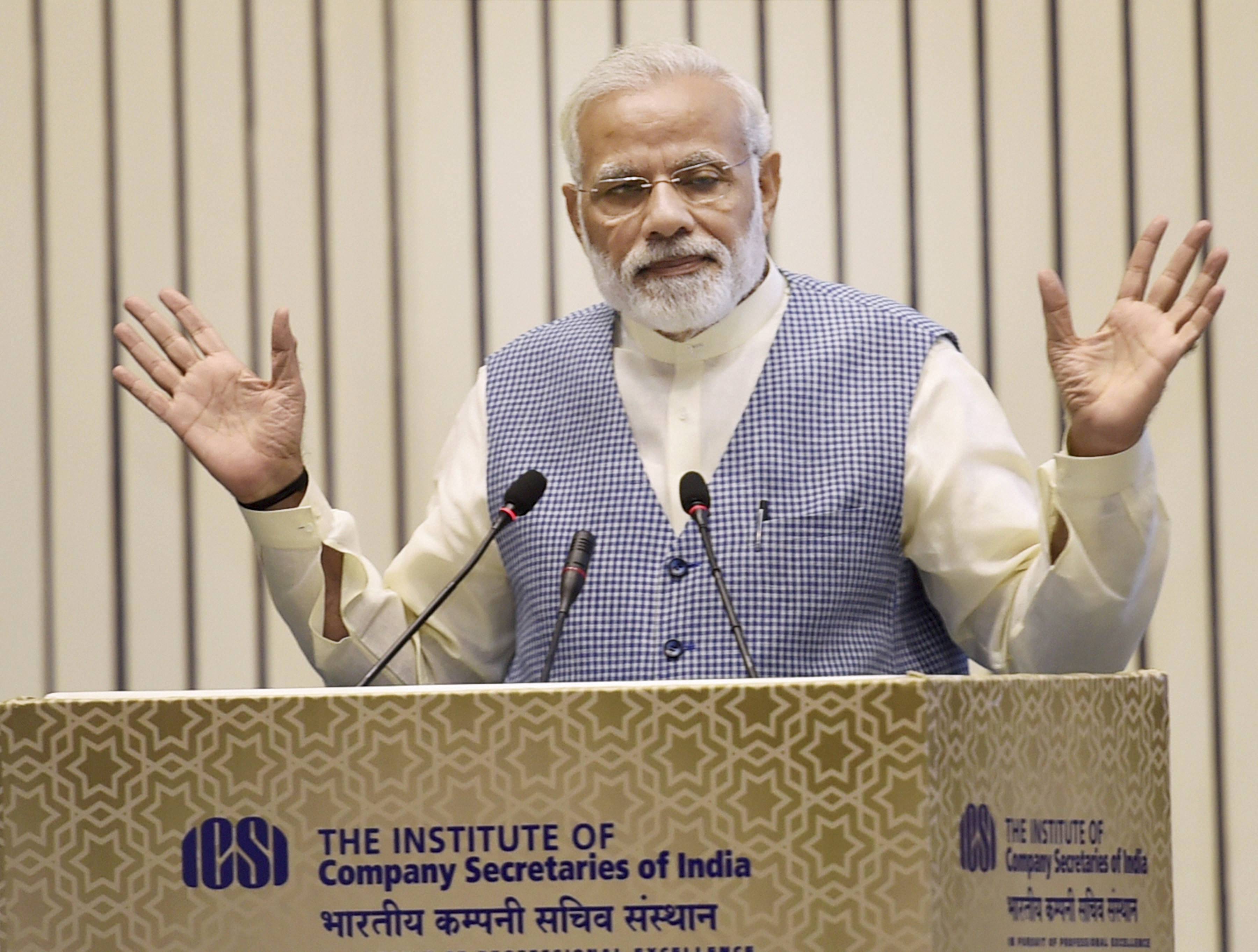
Prime Minister Narendra Modi brainstormed with chief executives of top global and Indian companies, including U.K.'s BP, Russia's Rosneft, Saudi Aramco and Reliance Industries Ltd., on ways to revive investment in oil and gas exploration and production.
Modi met BP Plc Chief Executive Officer Bob Dudley, Rosneft Chief Executive Officer Igor Sechin, Royal Dutch Shell's Project and Technology Director Harry Brekelmens, Saudi Aramco CEO Amin H Naseer, Exxon Mobil President for Gas and Power Rob Franklin, Reliance Industries' Chairman Mukesh Ambani, and Vedanta Resources head Anil Agarwal for over two hours to discuss the global oil and gas scenario.
The Niti Aayog made a short presentation on the status, the likely scenario of demand and supply by 2030 and current government policies.
This is the second meeting Prime Minister had with CEOs of oil majors.
His first meeting was in January 2016 where suggestions for reforming natural gas prices were made. More than a year later, the government allowed higher natural gas price for yet-to-be-produced fields in difficult areas like deep sea.
The government is looking at private investment to raise domestic oil and gas production, which has stagnated for the last few years while fuel demand has been rising by 5-6 percent annually.
India is dependent on imports to meet its 80 per cent of the demand and more than half of its natural gas requirements.
The prime minister in 2015 had set a target of reducing India's oil dependence by 10 per cent to 67 percent (based on import dependence of 77 percent in 2014-15) by 2022.
Import dependence has only increased since then and the government is now looking for ways to raise domestic output.
Organization of the Petroleum Exporting Countries Secretary General Mohammed Barkindo and Oil Minister Dharmendra Pradhan also attended the meeting. Former oil secretaries Vivek Rae and Vijay Kelkar were also invited for the meeting.
Pradhan told the gathering that the liberalised India offers around USD 300 billion investment opportunity in the next 10 years in the oil and gas sector.
“We want investors, both domestic and global, who can bring in the best technology and capital,” he said.
The government is devising policies to increase share of gas in the energy basket to 15 per cent from 7 percent.
We are planning a gas trading exchange and making sure there is open access to the gas grid. Global experience in this area would be useful.Dharmendra Pradhan, Oil Minister
According to Pradhan, in the last 40 months, the government has taken several policy initiatives in the energy sector in line with the prime minister's vision of energy access, efficiency, sustainability and security.
Also present at the meeting were Oil & Natural Gas Corporation Ltd. Chairman and Managing Director Shashi Shanker, Indian Oil Corporation Ltd. Chairman Sanjiv Singh, GAIL India Ltd. head B C Tripathi, Hindustan Petroleum Corporation Ltd. Chairman Mukesh Kumar Suran, Oil India Ltd. Chairman Utpal Bora and Bharat Petroleum Corporation Ltd. Chairman D Rajkumar.
Also Read: India Increases Natural Gas Prices For First Time In Three Years

-
The Economic Imperative: Analysing The Material Driving Force Behind India-Canada Strategic Reset

This economic complementarity is further reinforced by deep institutional investment ties and talent mobility, which form the bedrock of the bilateral framework.
-
Medicine Pricing: Where Must Profit Stop?
India must confront excessive margins, hidden incentives and regulatory gaps that threaten the integrity of medicine.
-
Why Amazon And Flipkart Are Struggling To Beat Meesho In India's Smaller Cities
With 274 million users and lowest-cost logistics, Meesho is defending its value commerce crown against giants like Amazon and Flipkart.
-
High US Salaries, No Green Card Certainty: The Financial Calculation Facing Indian H-1B Families
The suspension of PERM processing at eight technology employers does not cancel existing H-1B visas. What it does is force a question many Indian families have been avoiding: is the US salary worth tying your career and family plans to one employer?
-
Swiggy vs Eternal: Food Delivery's Two Rivals Are No Longer In The Same Race
Eternal is building a private AI assistant, dark.ai. Swiggy is still working out how to make Instamart pay, with an operating loss of Rs 895 crore in the July-September quarter while Blinkit stayed profitable.
-
Where You Live Shapes How You Get To Work | The Reason Why
Two-wheelers are the most popular way to get to work in India, accounting for nearly 43% of workplace commutes.
-
Unhedged Position: Can India See An Indonesia-Style Time Correction?
The Nifty is trading below levels it first clocked in 2024. Is there, then, as I have suggested in the headline, potential that the current time correction drags on painfully for the next three-five, even ten years?
-
Navigating Friction And Energy Realities: An Analysis Of Marco Rubio's October Visit To India
Occurring at a critical juncture marked by stalled trade negotiations and escalating geopolitical pressures over global energy supplies, the visit offers a profound window into modern US-India relations.
-
India Exports Capital. Why Not Export Trusteeship?
The big question, then, is whether India can build an institution that global borrowers, investors, banks, and lawyers can trust, even without an Indian connection.
-
France's Economy & Politics Are In Crisis | The Reason Why
Let's look at how the French economy and politics evolved under Nicolas Sarkozy, Franois Hollande and Emmanuel Macron.










