Mission 272 Accomplished, Now Great Expectations for Modi
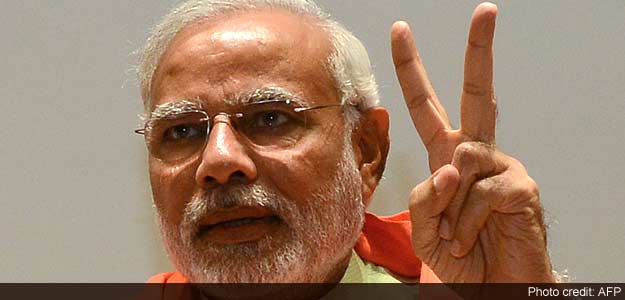
About a year ago Narendra Modi sat down with some of India's best and brightest to mount a "shock and awe" election campaign that one strategist likened to a one-sided U.S. military operation against Saddam Hussein's forces in the Gulf.
From an unmarked office in Gandhinagar, the capital of Gujarat, the young men and women, some on sabbaticals from firms like JP Morgan and Deutsche Bank, worked on turning a fragmented parliamentary election involving 543 seats into a presidential-style referendum on candidate Modi.
In doing so, Mr Modi, 63, adopted the language of a youthful country eager for change, using everything from holograms to WhatsApp.
The modern approach worked: just an hour into the counting of votes on Friday, it was clear that Mr Modi has led his BJP to a stunning victory with the strongest mandate any Indian government has enjoyed for 30 years.
By midday, the BJP and its allies were leading the count in 329 parliamentary seats, far ahead of the 272 majority required to rule. Even on its own, the BJP had crossed the halfway mark.
In recent years, Gujarat, the state Mr Modi has governed since 2001, has been compared with Guangdong province, the spearhead of China's economic revival.
Since Mr Modi took control, Gujarat has led the nation in GDP growth. It accounts for 16 per cent of industrial output and 22 per cent of exports, despite having 5 per cent of its population.
Under his stewardship, farmers and industry have been assured uninterrupted power and bureaucratic controls slashed.
A central government-ordered study last month said it had the best land acquisition policies in place, among all of India's 29 states in terms of ease of doing business.
Land, by far, has been the single biggest hurdle around the country, holding up 90 per cent of infrastructure projects.
Gujarat's highways are India's fastest, a far cry from the potholed roads in the northern belt, and its ports are among the busiest.
But repeating that success nationally presents significant challenges in a country with a complex federal structure, a bureaucracy more wedded to socialist controls than reform and a growing gap between rich and poor among its 1.2 billion people.
India must create 10 million jobs a year, four times the pace of the last 5 years, to absorb youth into the workforce.
And unlike China, India is not centralised. Mr Modi will have a fight on his hands to gain full cooperation from many state governments, which he needs to implement his agenda nationwide.
Some have said the pace of development in Gujarat has caused environmental damage and threatened small communities, and that crony capitalism flourished under Mr Modi's unquestioned rule.
Critics also say it lags behind other states in social indicators such as mortality rates.
But the criticisms have failed to stick.
Mr Modi, was the only face of the campaign. He has covered 300,000 km since being named the BJP's prime ministerial candidate in September, addressing 457 meetings. When he could not show up, he appeared as a hologram.
"He has become a purveyor of dreams," said Sanjay Gupta, a former state bureaucrat who quit to go into business and start a chain of hotels. "It's hard to see how he can meet all the pent-up aspirations without re-engineering the system."
The son of a railway station tea-seller, Modi has humble roots which he reminds voters are in contrast to the privileged upbringing of the Nehru-Gandhi dynasty and its scion Rahul Gandhi, who led the campaign for the ruling Congress party.
Critics question his handling of 2002's communal riots in Gujarat, in which more than a thousand people were killed, most of them Muslims. A Supreme Court inquiry has said there is no evidence that he fuelled the violence.
"Modi is set to govern all of India, the 150 million Muslims included, and there is reason to be cautious," said Ruchir Sharma, head of emerging markets at Morgan Stanley.
Copyright: Thomson Reuters 2014

-
Getting To Work Costs Women More | The Reason Why

It is not just about women paying more than men. It is about women paying much more in cities than in villages.
-
AI Bias In Investing Cannot Be Eliminated, But It Can Be Governed
Framing is a particularly important example as identical financial information presented in terms of gains rather than losses can lead an LLM to reach a different assessment.
-
Joining The Dots | Dark Skies, Steady Diya: Why Hope Holds This Diwali
With war, a weak rupee and foreign outflows weighing on sentiment, policymakers at the NDTV World Summit and market veterans at NDTV Profit Ignite: Diwali Edition offered the same advice: stay invested and filter out the noise.
-
The Curious Case of Equitas Small Finance Bank And A CEO Who Quit For Stock
PN Vasudevan believes persistent investor concerns over a perceived conflict of interest had become a governance overhang on Equitas Small Finance Bank's stock, even as the lender improved profitability and asset quality.
-
Talking Points This Week: AI Cash Burn, A Tiger Comeback And An India That Still Finds Its Own Path
India is not immune to higher oil or tighter global liquidity, yet its earnings base is broader, its domestic policy levers are still available.
-
Foreign Investors Own Half Of HDFC Bank and ICICI Bank. An LTCG Cut Could Matter Most Here
Foreign portfolio investors have US$115 billion parked in HDFC Bank, ICICI Bank. If the government cuts long-term capital gains tax, Jefferies says returning foreign money could land here first.
-
'Never Seen This Level Of Negativity': Sandeep Tandon Says The Next Rally May Be Closer Than You Think
Veteran investor Sandeep Tandon says foreign selling is easing, large-caps are due a comeback and mid-caps are crowded, while he turns positive on gold, power and pharma this Diwali.
-
Indians Stay With Family, Not In Hotels | The Reason Why
India still lacks enough clean, reliable and affordable hotels for budget-conscious travellers.
-
The Economic Imperative: Analysing The Material Driving Force Behind India-Canada Strategic Reset
This economic complementarity is further reinforced by deep institutional investment ties and talent mobility, which form the bedrock of the bilateral framework.
-
Medicine Pricing: Where Must Profit Stop?
India must confront excessive margins, hidden incentives and regulatory gaps that threaten the integrity of medicine.










