Microsoft's Satya Nadella Once Turned Down Green Card For H-1B Visa. Here's Why
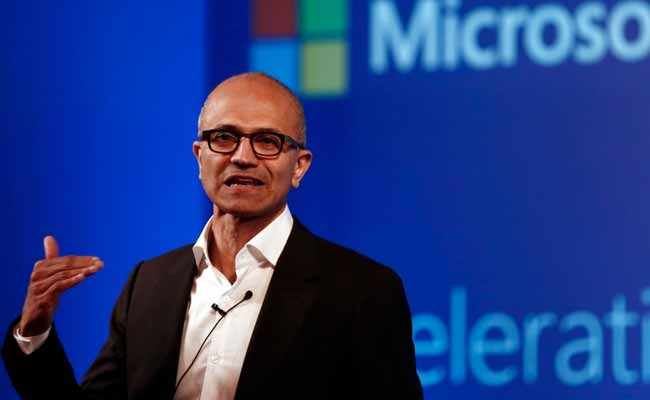
Orlando: With his permanent residency coming in the way of his newly wed wife joining him in the US, Satya Nadella surrendered his Green Card and applied for a H-1B visa, a move which gave him instant notoriety around the Microsoft Campus in Redmond, the Indian-born CEO has revealed. At one point of time, early in his career, even with a Green Card in his hand, Mr Nadella seriously contemplated leaving his job at the Microsoft and returning to India. This was because his wife Anu was not able to join him in Seattle, due to an existing US law, which stated that if a Green Card holder married, his or her spouse's visa would be rejected. The law continues even today.
"So why would I give up the coveted green card for temporary status?" Mr Nadella writes in his book 'Hit Refresh', which officially releases in the US on Tuesday.
He married Anu in 1993. Following the wedding, Mr Nadella intended to bring his wife over to the US to live with him.
"Well, the H-1B enables spouses to come to the US while their husbands and wives are working here. Such is the perverse logic of this immigration law. There was nothing I could do about it. Anu was my priority. And that made my decision a simple one," Mr Nadella explains in his book.
Mr Nadella says he went back to the US embassy in Delhi in June of 1994 and told a clerk that he wanted to give back his green card and apply for an H-1B visa. "'Why?' the dumbfounded clerk asked. I said something about the crazy immigration policy and he shook his head and pushed a new form to me," Mr Nadella writes.
"The next morning, I returned to apply for a H-1B application. Miraculously, it all worked. Anu joined me (for good) in Seattle, where we would start a family and build a life together," he says.
"What I didn't expect was the instant notoriety around campus," writes Mr Nadella. "'Hey, there goes the guy who gave up his green card.'"
He says every other day someone would call him and ask for advice.
Mr Nadella says that much later, one of his colleagues, Kunal Bahl, did quit Microsoft when his H-1B ran out and his green card had not yet arrived.
"He returned to India and then founded Snapdeal, which today is worth more than $1 billion and employs five thousand people. Ironically, online, cloud-based companies like Snapdeal would play an important role in my future and that of Microsoft. And the lessons I learned in my former country continue to shape my present," he says.
Giving an insight into his childhood, Mr Nadella says that by 12th grade, his dream was to play cricket for Hyderabad and eventually work for a bank.
Mr Nadella was a student of Hyderabad Public School (HPS).
"By 12th grade if you had asked me about my dream it was to attend a small college, play cricket for Hyderabad, and eventually work for a bank. That was it. Being an engineer and going to the West never occurred to me," he says.
Mr Nadella says his mother was happy with those plans but dad advised him to get out of Hyderabad.
He writes that the list of alumni from the Hyderabad Public School speaks for itself.
"Shantanu Narayen, the CEO of Adobe; Ajay Singh Banga, the CEO of MasterCard; Syed B Ali, head of Cavium Networks; Prem Watsa, founder of Fairfax Financial Holdings in Toronto; parliament leaders, film stars, athletes, academics, and writers - all came from this small, out-of-the-way school," he adds.

-
AI Bias In Investing Cannot Be Eliminated, But It Can Be Governed

Framing is a particularly important example as identical financial information presented in terms of gains rather than losses can lead an LLM to reach a different assessment.
-
Joining The Dots | Dark Skies, Steady Diya: Why Hope Holds This Diwali
With war, a weak rupee and foreign outflows weighing on sentiment, policymakers at the NDTV World Summit and market veterans at NDTV Profit Ignite: Diwali Edition offered the same advice: stay invested and filter out the noise.
-
The Curious Case of Equitas Small Finance Bank And A CEO Who Quit For Stock
PN Vasudevan believes persistent investor concerns over a perceived conflict of interest had become a governance overhang on Equitas Small Finance Bank's stock, even as the lender improved profitability and asset quality.
-
Talking Points This Week: AI Cash Burn, A Tiger Comeback And An India That Still Finds Its Own Path
India is not immune to higher oil or tighter global liquidity, yet its earnings base is broader, its domestic policy levers are still available.
-
Foreign Investors Own Half Of HDFC Bank and ICICI Bank. An LTCG Cut Could Matter Most Here
Foreign portfolio investors have US$115 billion parked in HDFC Bank, ICICI Bank. If the government cuts long-term capital gains tax, Jefferies says returning foreign money could land here first.
-
'Never Seen This Level Of Negativity': Sandeep Tandon Says The Next Rally May Be Closer Than You Think
Veteran investor Sandeep Tandon says foreign selling is easing, large-caps are due a comeback and mid-caps are crowded, while he turns positive on gold, power and pharma this Diwali.
-
Indians Stay With Family, Not In Hotels | The Reason Why
India still lacks enough clean, reliable and affordable hotels for budget-conscious travellers.
-
The Economic Imperative: Analysing The Material Driving Force Behind India-Canada Strategic Reset
This economic complementarity is further reinforced by deep institutional investment ties and talent mobility, which form the bedrock of the bilateral framework.
-
Medicine Pricing: Where Must Profit Stop?
India must confront excessive margins, hidden incentives and regulatory gaps that threaten the integrity of medicine.
-
Why Amazon And Flipkart Are Struggling To Beat Meesho In India's Smaller Cities
With 274 million users and lowest-cost logistics, Meesho is defending its value commerce crown against giants like Amazon and Flipkart.










