Meta Is The Hottest Tech Stock In The Market Right Now
(Bloomberg) -- A leaner Meta Platforms Inc. is impressing Wall Street, with analysts turning more bullish as cost cuts coupled with stabilizing advertising trends make the Facebook owner's stock look more durable in a looming economic slowdown.
The shares have surged 140% from a seven-year low in November as Meta started cutting thousands of jobs in light of falling sales. The company announced further layoffs last month and pledged to be more efficient, adding kindling to the rally.
More than two dozen brokerages have increased their price targets on the stock since the second round of job cuts was announced. Analysts also have pushed up Meta's 2023 earnings per share estimate by 15% over the past three months, according to data compiled by Bloomberg. Morgan Stanley's Brian Nowak in March restored his buy-equivalent rating after sitting on the sidelines for less than five months.
While the ad business has slowed, it's at least satabilized, bulls say. And in another positive sign for earnings, changes in Apple Inc.'s privacy policy that make it harder to target iPhone users with ads have now been in place long enough that they're no longer affecting Meta's year-over-year growth rate.
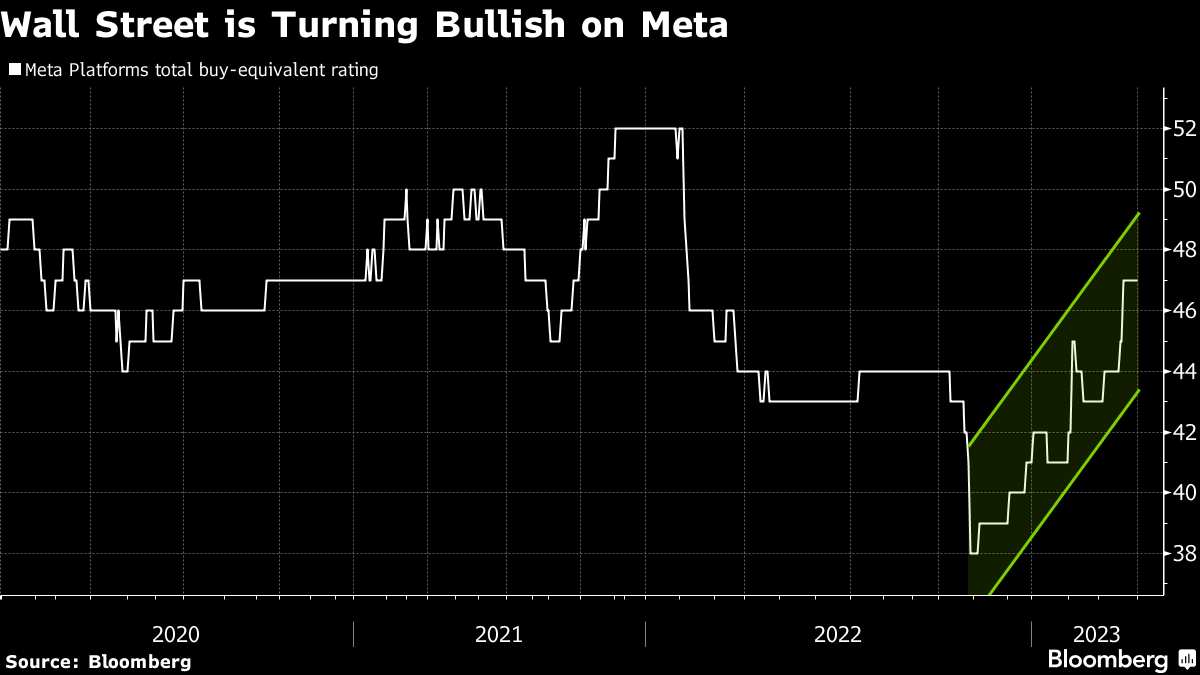
“The catalyst for Meta's recent rally is likely traced to both extensive cost-cutting measures and adjusting to the negative effects of Apple's privacy changes which significantly hurt ad revenue,” said Mike Akins, founding partner at ETF Action, the index provider of Amplify's MVPS ETF. “To a large extent, Meta's recent surge is simply recovering from being oversold.”
Because analyst earnings estimates are rising along with the stock price, Meta's shares are still much cheaper than its big tech peers and the Nasdaq 100 Index. Trading at 17 times forward earnings, Meta is below its historical 10-year average of 26 times, according to Bloomberg data. In contrast, Amazon.com Inc. trades at 36 times, Microsoft Corp.'s price-earnings ratio is 28, Apple is at 26 and the tech-heavy gauge sells for 24 times.
Morgan Stanley's Nowak called Meta the most durable megacap if consumer spending weakens, since the company's cost reductions have been bolder than at peers such as Alphabet Inc.
Concern about inflation and a potential recession have squeezed ad budgets at businesses, crimping the primary revenue stream for companies like Meta, Google parent Alphabet and Snap Inc. But some analysts, such as Guggenheim's Michael Morris, are also seeing more stability in overall advertising demand.
Still, some investors may be unwilling to pay up now for Meta after the blistering rally since November, especially because there may well be a recession in the offing. Even if Meta's ad business holds up better than rivals', if the downturn is steep enough, all media stocks will suffer.
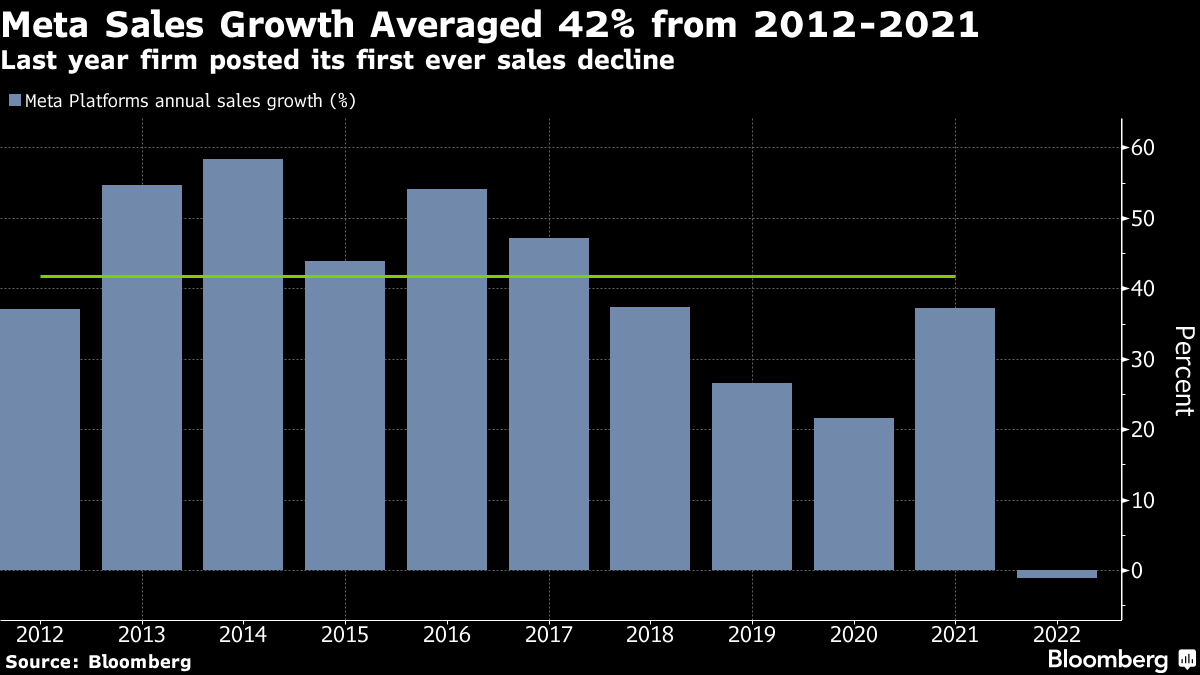
Until the beginning of last year, Meta averaged revenue growth of 42% over the decade since 2012, according to Bloomberg data. The company shocked investors by reporting its first ever sales decline last year. Now with trends stabilizing, its sales are set rise by 4.7% this year, with growth more than doubling to about 11% in 2024.
While that's a much slower cadence than investors are used to, Meta under Chief Executive Officer Mark Zuckerberg has managed to resume growing.
“In many respects what Mark Zuckerberg has done in the last couple of months is: begin to look at running the company like a regular company as opposed to a tech company with top-line growth that can cover a lot of mistakes, because they really didn't have that anymore,” aid Mark Stoeckle, chief executive officer of Adams Funds, which owns the stock.
Tech Chart of the Day
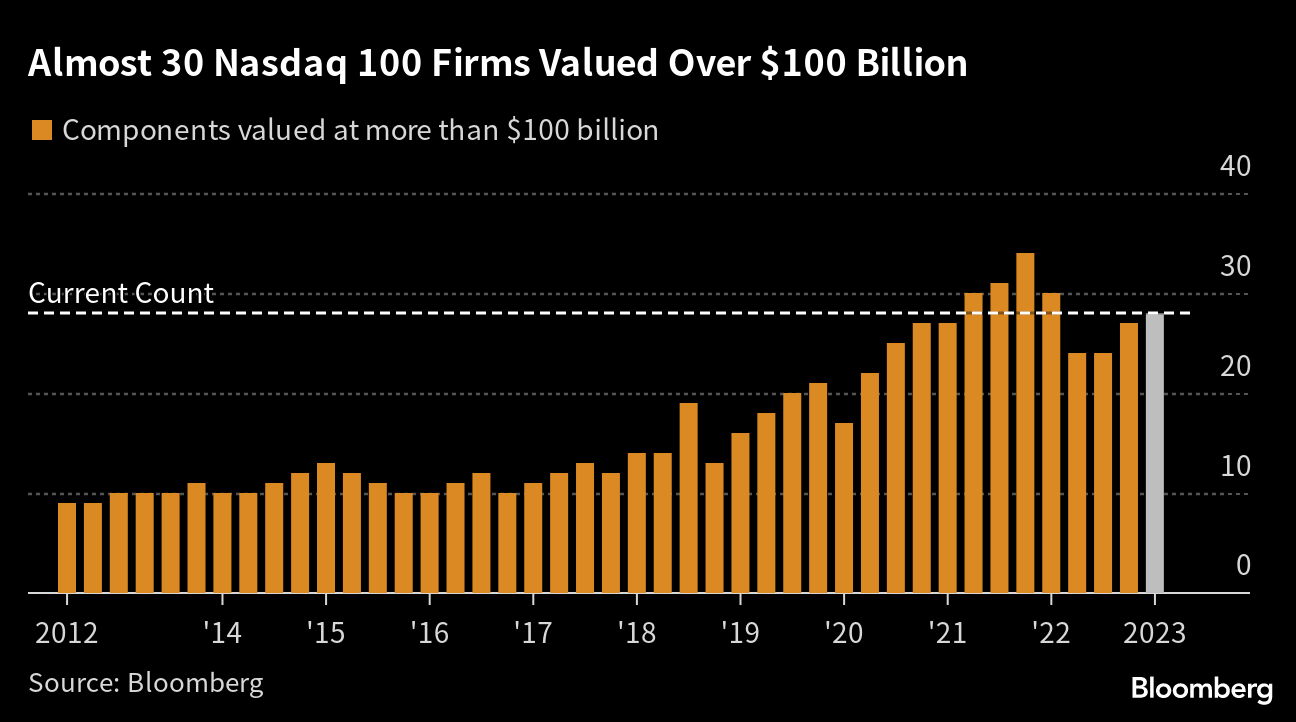
The Nasdaq 100 has rallied 20% this year, adding $2.6 trillion in combined market value. As a result, there are now 28 companies in the benchmark with equity capitalizations of more than $100 billion, with the tally rising for a second consecutive quarter. The number is still down from 34 at the end of 2021.
Top Tech Stories
- Micron Technology Inc., the US chipmaker that's facing a cybersecurity review by the Chinese government, said that the investigation isn't affecting its ability to deliver products.
- Apple Inc. is eliminating a small number of roles within its corporate retail teams, according to people with knowledge of the matter, marking its first known internal job cuts since it embarked on a belt-tightening effort last year.
- Rogers Communications Inc. has finally gained control of Shaw Communications Inc., emerging from two years of legal battles, family intrigue and government lobbying to complete one of Canada's biggest-ever corporate takeovers. Chief Executive Officer Tony Staffieri doesn't want to look back.
- SenseTime Group Inc. rose the most in two months after speculation spread among investors that China's most valuable specialist AI company was preparing to launch a challenger to artificial intelligence phenomenon ChatGPT.
- Walmart Inc.'s Indian payments business will expand into online shopping on a government-backed e-commerce network, the biggest international company yet to support the effort to boost e-retailing in the country.
- Japan is poised to sharply raise its chip-gear spending in an attempt to boost its position in the global semiconductor market, as it tightens exports amid a US-led push to limit China's tech ambitions.
--With assistance from Tom Contiliano.
More stories like this are available on bloomberg.com
©2023 Bloomberg L.P.

-
The Economic Imperative: Analysing The Material Driving Force Behind India-Canada Strategic Reset

This economic complementarity is further reinforced by deep institutional investment ties and talent mobility, which form the bedrock of the bilateral framework.
-
Medicine Pricing: Where Must Profit Stop?
India must confront excessive margins, hidden incentives and regulatory gaps that threaten the integrity of medicine.
-
Why Amazon And Flipkart Are Struggling To Beat Meesho In India's Smaller Cities
With 274 million users and lowest-cost logistics, Meesho is defending its value commerce crown against giants like Amazon and Flipkart.
-
High US Salaries, No Green Card Certainty: The Financial Calculation Facing Indian H-1B Families
The suspension of PERM processing at eight technology employers does not cancel existing H-1B visas. What it does is force a question many Indian families have been avoiding: is the US salary worth tying your career and family plans to one employer?
-
Swiggy vs Eternal: Food Delivery's Two Rivals Are No Longer In The Same Race
Eternal is building a private AI assistant, dark.ai. Swiggy is still working out how to make Instamart pay, with an operating loss of Rs 895 crore in the July-September quarter while Blinkit stayed profitable.
-
Where You Live Shapes How You Get To Work | The Reason Why
Two-wheelers are the most popular way to get to work in India, accounting for nearly 43% of workplace commutes.
-
Unhedged Position: Can India See An Indonesia-Style Time Correction?
The Nifty is trading below levels it first clocked in 2024. Is there, then, as I have suggested in the headline, potential that the current time correction drags on painfully for the next three-five, even ten years?
-
Navigating Friction And Energy Realities: An Analysis Of Marco Rubio's October Visit To India
Occurring at a critical juncture marked by stalled trade negotiations and escalating geopolitical pressures over global energy supplies, the visit offers a profound window into modern US-India relations.
-
India Exports Capital. Why Not Export Trusteeship?
The big question, then, is whether India can build an institution that global borrowers, investors, banks, and lawyers can trust, even without an Indian connection.
-
France's Economy & Politics Are In Crisis | The Reason Why
Let's look at how the French economy and politics evolved under Nicolas Sarkozy, Franois Hollande and Emmanuel Macron.










