World’s Biggest Market for Sub-$100 Million IPOs Booms in India

(Bloomberg) -- Small is beautiful in India's market for initial public offerings after the disappointment of hyped mega-share sales.
From finance startup Paytm to the nation's largest insurer, investors have lost money from those IPOs in the past two years. They've turned to companies offering up to just $100 million in stock sales, as India hosted 92 such listings this year, the most in the world, according to data compiled by Bloomberg.
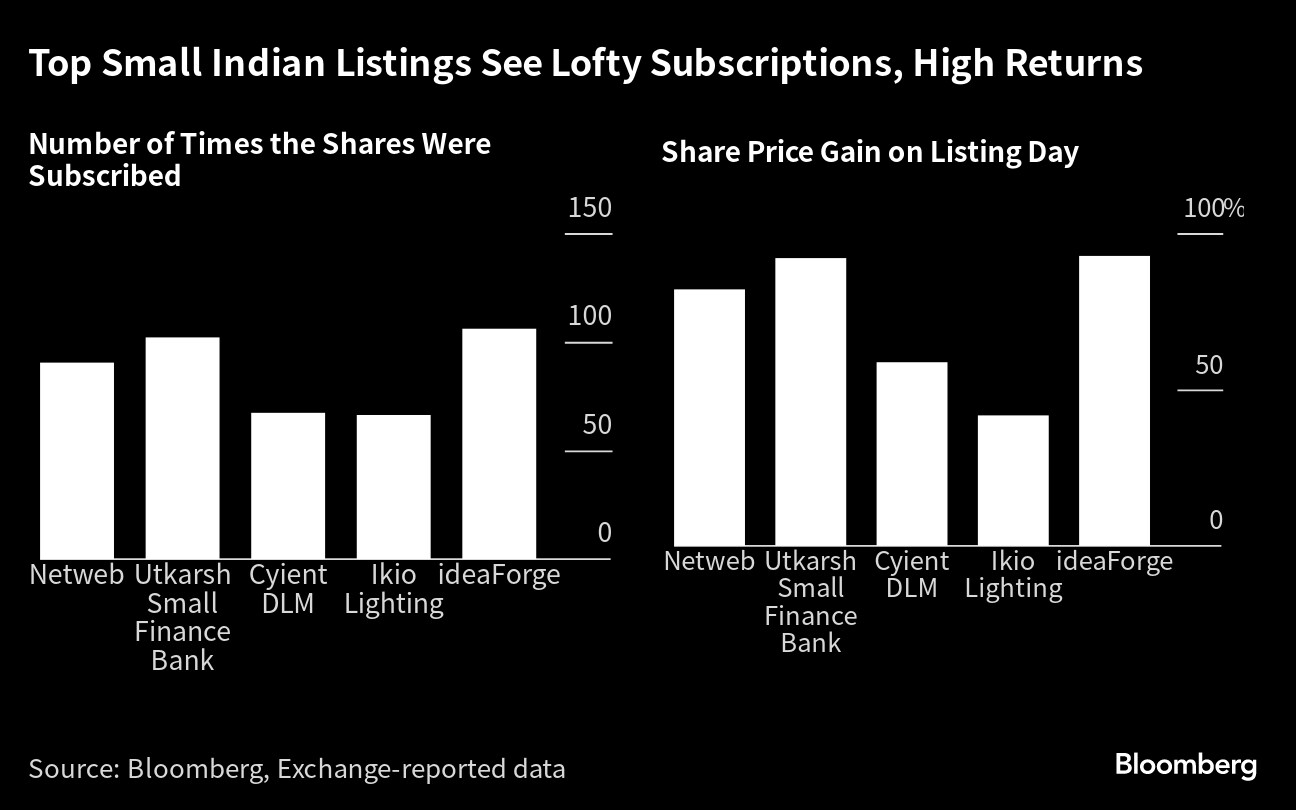
Small firms are selling shares for their financing needs after interest rates surged, as they take advantage of a five-month market rally. While such listings tend to be saddled with poor trading liquidity and have lax disclosure rules, retail investors are ignoring those concerns, bidding more than 100 times what's on offer for some IPOs.
“IPOs are a product of a bull run in stocks,” said Abhishek Sharma, managing director at GYR Capital Advisors. “Greater retail and institutional investor participation is providing tailwinds to these companies.”
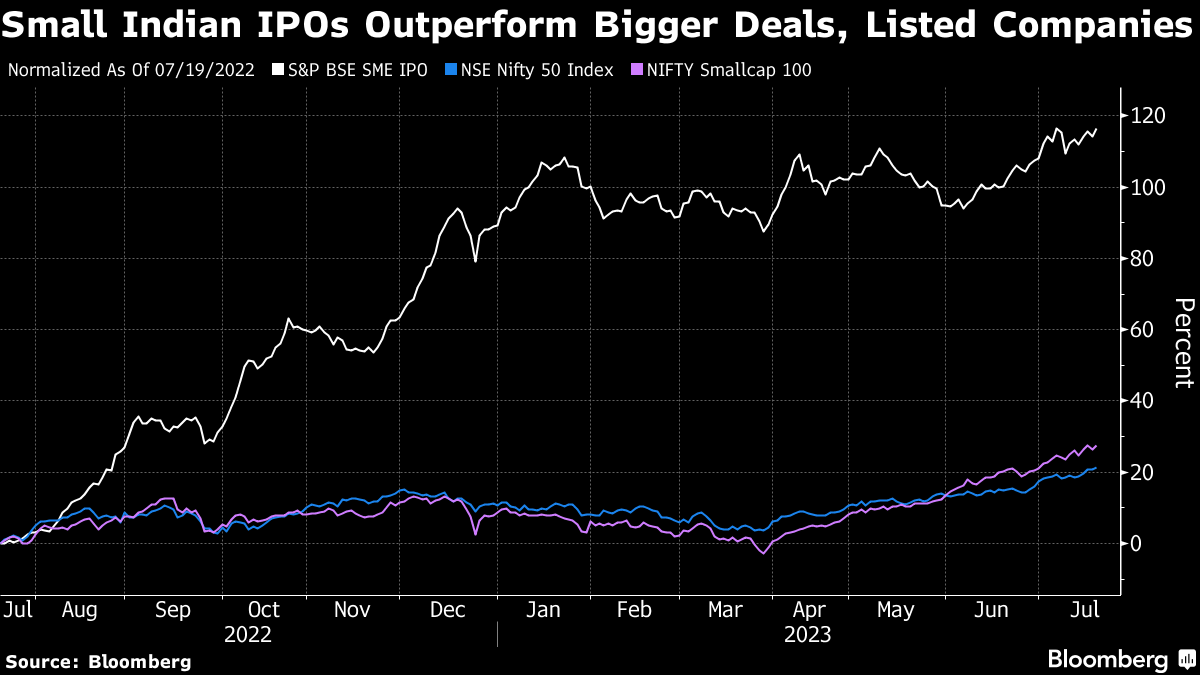
India's major equity benchmarks have hit record levels, as earnings and the economy grow despite the highest interest rates since 2018. The SME IPO index is outperforming, surging 26% this year compared to a 9% gain in the benchmark Nifty 50.
Most offerings by small and medium-sized enterprises in recent months were oversubscribed. Dronemaker ideaForge Technology Ltd.'s IPO received 106 times more bids than sought, while mid-sized Utkarsh Small Finance Bank got bids as much as 102 times.
The SME IPO boom followed the dismal performance of insurer Life Insurance Corporation of India Ltd. and delivery startup Delhivery Ltd, the two biggest share sales of 2022. They are down about 33% and 18%, respectively, from their sale prices. Payments application Paytm's parent One 97 Communications Ltd. is also trading more than 60% below its offer price.
“I am trying to add small companies to my portfolio” after avoiding the earlier IPOs due to high valuations, said Swetabh Sonal, an independent trader based in North India.
“Small companies have unlimited potential in fueling the Indian economy's vibrancy and we are undertaking efforts, including working closely with various governments, industry bodies, to reach out to such companies for potential listings,” BSE Ltd. said in an emailed response to queries.
For now, the higher returns from small IPOs are masking corporate governance concerns and the lack of research. Companies listed on the two SME exchanges are required to report earnings on semi-annual basis, have negligible institutional ownership and aren't tracked by brokerages.
Lingerie-maker Ashapura Intimates Fashion Ltd., which listed in early 2013, saw its shares surged 800% in more than four years. It was suspended in 2020, and subsequently filed for liquidation. Nureca Ltd., an Indian wellness products provider, gained 61% on its debut in 2021. More than two years later, the stock is down more than 80% from its peak.
“SME IPOs are far more riskier than the big ones because this space is little researched, there is very few institutional ownership, there are no foreign investors and no mutual funds,” said Gajendra Kothari, MD & CEO of Etica Wealth Pvt Ltd., which manages assets more than 16 billion rupees.
--With assistance from Filipe Pacheco.
More stories like this are available on bloomberg.com
©2023 Bloomberg L.P.

-
Signature Play: The Classic Cocktail Is Dead. Or Is It?

Classic cocktails are disappearing from India's cocktail menus. But they're still being ordered, taught to bartenders and borrowed from. So, who's really having the last drink?
-
A New Samvat Wishlist: Inclusive Prosperity And Human Development
India has strengthened its economic foundations through infrastructure, digital access and enterprise. Its next growth chapter must deepen productivity, create better livelihoods and widen participation in prosperity.
-
Love, Sex Aur Dhokha: The Audacious Plot To Spy On Jensen Huang
A Taipei dinner, a Singapore chip buyer and a suspected Chinese asset: inside the alleged spy operation that got close to NVIDIA's Jensen Huang.
-
Ten Things I Learnt This Samvat
Patience can be a trap. Cheap stocks can stay cheap. Leverage can wipe you out. What did Samvat 2082 teach us? Niraj Shah writes on 10 lessons from the year gone by.
-
Talking Points This Week: Tech Nerves, FII Buying, And A Faraway Banking Shock
The global markets are not shining this Diwali. The exception in the large markets is, India.
-
Midterm Rally Lasted A Day. The Hard Reality Of A Divided US May Last Two Years | Opinion
Between a contested AI boom, a debt ceiling that arrives in 2027 and a president with every incentive to act alone, the next two years may prove more volatile than the first day's rally suggests.
-
Blue Wave Will Derail the AI Trade but Won't Dismantle the AI Era | Unhedged Position
The Democrats' sweep of the US Congress will see politics collide with economic forces both over the long and short term.
-
It's Time To Take The GST Council's Bet On Trust Global
Payment records can prove India's services exports, and clear, proportionate rules can bring foreign digital sellers into the tax net.
-
Opinion | India at 38: From Innovation Overperformer to Innovation Powerhouse
India now has 453 VC-backed deep science startups, 18 of them late-stage, after 117 percent growth since 2020. Laurus Labs, at USD 9.3 billion, is the most valuable deep science company in any middle-income economy outside China.









