Markets Drop After US President Donald Trump Cancels North Korea Meet
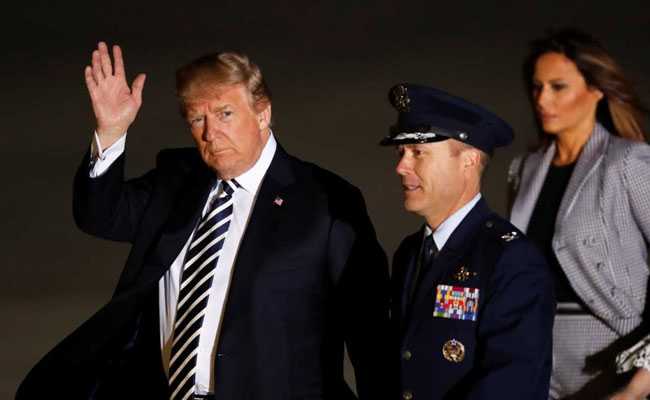
US stocks dropped on Thursday after President Donald Trump cancelled a planned summit with North Korean leader Kim Jong Un, while a slide in oil prices and bank stocks also weighed as investors grappled with fresh US protectionist plans. Trump said he canceled a June 12 summit "based on the tremendous anger and open hostility" in Kim's recent statement. The move came after North Korean media reported earlier that the country had blown up tunnels at its nuclear test site, which had raised the possibility of the summit.
Donald Trump on Wednesday ordered a national security probe into car and truck imports that could lead to new tariffs, with China calling the move an "abuse" of the clauses and saying it would defend its interests.
Also Read: Donald Trump Tells Kim Jong Un That Singapore Summit Won't Take Place
The decision added to jitters over the prospects of trade negotiations with China, reignited after Trump called for "a different structure" to any trade deal.
"The markets are adjusting now with lots of uncertainties, with China, North Korea, (and the prospect of) a trade war that could spill over to other parts of the economy and the world," said Adam Sarhan, chief executive of 50 Park Investments in New York.
At 10:03 a.m. EDT the Dow Jones Industrial Average was down 129.77 points, or 0.52 percent, at 24,757.04, the S&P 500 was down 13.55 points, or 0.50 percent, at 2,719.74 and the Nasdaq Composite was down 31.17 points, or 0.42 percent, at 7,394.79.
Nine of the 11 major S&P sectors were in the red, with the technology sector's 0.5 percent decline weighing the most. The decline accelerated after the North Korea-U.S. summit cancellation.
Shares of European and Asian automakers skidded on the possibility of import tariffs, while U.S. automakers gained.
Ford was up 1.3 percent and General Motors gained 0.8 percent. U.S.-listed shares of Fiat fell 2.3 percent, while those of Ferrari dipped 0.6 percent.
Energy stocks declined as oil prices recorded their largest one-day drop in two weeks on rising expectations that OPEC could wind down an output deal that has been in place since the start of 2017 due to concerns about supplies from Venezuela and Iran.
Financials stocks dropped after the minutes from the Federal Reserve's latest meeting tempered expectations of faster interest rate hikes.
Best Buy Co tumbled 6.3 percent as investors focused on slowing online sales growth over the better-than-expected quarterly comparable sales.
Declining issues outnumbered advancers for a 1.81-to-1 ratio on the NYSE. Declining issues outnumbered advancers for a 1.89-to-1 ratio on the Nasdaq.
The S&P index recorded 13 new 52-week highs and no new lows, while the Nasdaq recorded 48 new highs and 23 new lows.
(This story has not been edited by NDTV staff and is auto-generated from a syndicated feed.)

-
Indians Are Travelling, But Not Every Journey Is A Holiday | The Week In Whys

Pilgrims, patients and working women are the real travellers, and the system hasn't quite caught up with them.
-
Getting To Work Costs Women More | The Reason Why
It is not just about women paying more than men. It is about women paying much more in cities than in villages.
-
AI Bias In Investing Cannot Be Eliminated, But It Can Be Governed
Framing is a particularly important example as identical financial information presented in terms of gains rather than losses can lead an LLM to reach a different assessment.
-
Joining The Dots | Dark Skies, Steady Diya: Why Hope Holds This Diwali
With war, a weak rupee and foreign outflows weighing on sentiment, policymakers at the NDTV World Summit and market veterans at NDTV Profit Ignite: Diwali Edition offered the same advice: stay invested and filter out the noise.
-
The Curious Case of Equitas Small Finance Bank And A CEO Who Quit For Stock
PN Vasudevan believes persistent investor concerns over a perceived conflict of interest had become a governance overhang on Equitas Small Finance Bank's stock, even as the lender improved profitability and asset quality.
-
Talking Points This Week: AI Cash Burn, A Tiger Comeback And An India That Still Finds Its Own Path
India is not immune to higher oil or tighter global liquidity, yet its earnings base is broader, its domestic policy levers are still available.
-
Foreign Investors Own Half Of HDFC Bank and ICICI Bank. An LTCG Cut Could Matter Most Here
Foreign portfolio investors have US$115 billion parked in HDFC Bank, ICICI Bank. If the government cuts long-term capital gains tax, Jefferies says returning foreign money could land here first.
-
'Never Seen This Level Of Negativity': Sandeep Tandon Says The Next Rally May Be Closer Than You Think
Veteran investor Sandeep Tandon says foreign selling is easing, large-caps are due a comeback and mid-caps are crowded, while he turns positive on gold, power and pharma this Diwali.
-
Indians Stay With Family, Not In Hotels | The Reason Why
India still lacks enough clean, reliable and affordable hotels for budget-conscious travellers.
-
The Economic Imperative: Analysing The Material Driving Force Behind India-Canada Strategic Reset
This economic complementarity is further reinforced by deep institutional investment ties and talent mobility, which form the bedrock of the bilateral framework.










