Market Is at Odds With Fed on Whether Bank Reserves Are Scarce
(Bloomberg) -- The Federal Reserve and some market participants are out of sync on whether reserves in the banking system — a key determinant for the central bank to continue its quantitative tightening — have already reached the appropriate level of scarcity.
Bank reserves totaled $3.26 trillion in the week through Oct. 25, Fed data show.
“At $3.3 trillion of reserves, I think it's hard to make a case that reserves are scarce at this point,” Fed Chairman Jerome Powell said during a press conference Wednesday after the bank announced its decision to hold rates steady.
Yet right before Powell spoke, Matthew Hornbach, global head of macro strategy at Morgan Stanley & Co., said on Bloomberg Television that reserves may have already reached the minimum level that banks need to conduct their business.
Theoretically, a drop in reserves to the level of scarcity would push the Fed to consider halting its sale of assets from its balance sheet, a part of so-called QT that it's used to combat inflation.
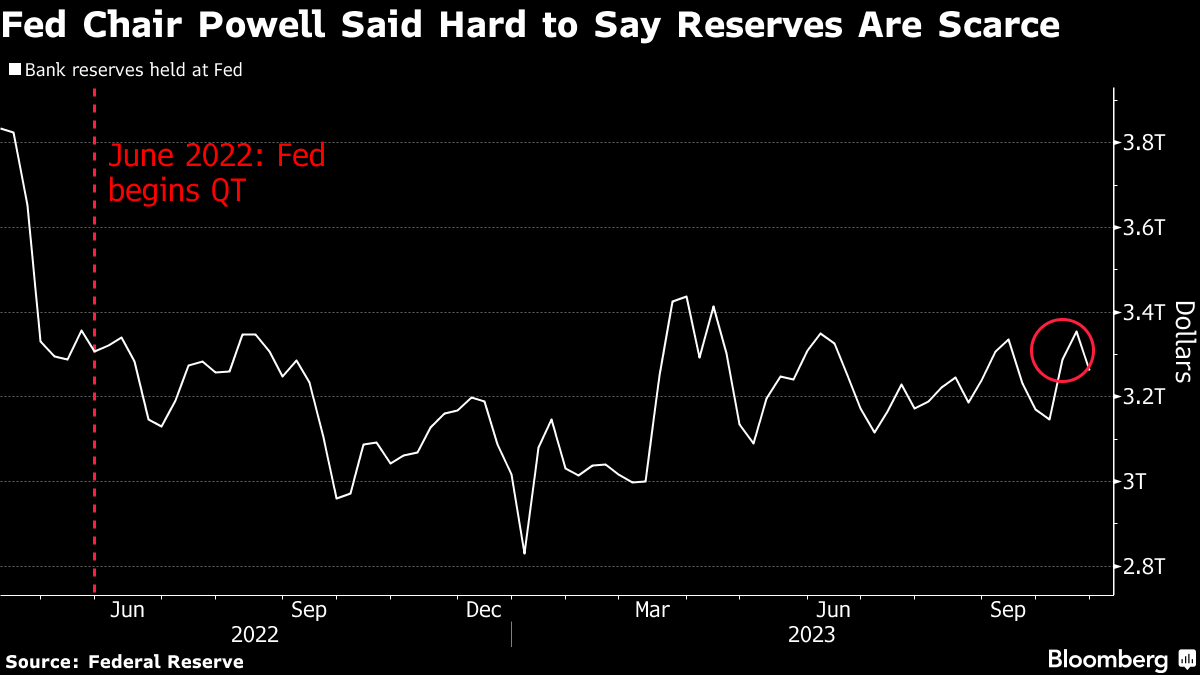
Scarcity has caused problems in the past, most notably in September 2019, when the Treasury increased borrowing and the Fed stopped buying as many Treasuries for its balance sheet. Balances dropped by nearly $166 billion to $3.14 trillion in the week through Sept. 20 in 2019, Fed data show.
Wall Street strategists have estimated the banking system's aggregate lowest comfortable level of reserves is somewhere around $2.5 trillion.
But lenders are still jittery following the failures of Silicon Valley Bank and Signature Bank earlier this year.
The Fed's August survey of financial officers showed that roughly 79% of respondents said their institutions preferred to hold additional reserves above the lowest comfortable level. Almost half of those respondents also reported increased borrowing from Federal Home Loan Banks as the result of the industry turmoil in March.
In the 18 months since the central bank started hiking interest rates, cash has been flowing out of the banking system in search of higher-yielding alternatives. The Fed has pledged to keep interest rates at current levels for longer than the market earlier anticipated, and deposits are continuing to leave, raising the risk that bank reserves will be siphoned off.
Fed policymakers have said the banking system's lowest comfortable level of reserves is roughly 8% of gross domestic product, which includes a small buffer above the level in September 2019.
However, strategists including Bank of America's Mark Cabana and Katie Craig have said recent bank liquidity preferences may imply scarcity closer to when reserves are about 10% of GDP — which means QT might end once balances at the overnight reverse repo facility, or RRP, reach zero near the end of 2024.
More stories like this are available on bloomberg.com
©2023 Bloomberg L.P.

-
Talking Points This Week: Leadership Shock At Nvidia, Earnings Strength, And The Fog Over Hormuz

The Anthropic IPO pricing and first trading day, Nvidia's upcoming earnings, and any fresh signals from Iran will set the tone for the following week.
-
Signature Play: The Classic Cocktail Is Dead. Or Is It?
Classic cocktails are disappearing from India's cocktail menus. But they're still being ordered, taught to bartenders and borrowed from. So, who's really having the last drink?
-
A New Samvat Wishlist: Inclusive Prosperity And Human Development
India has strengthened its economic foundations through infrastructure, digital access and enterprise. Its next growth chapter must deepen productivity, create better livelihoods and widen participation in prosperity.
-
Love, Sex Aur Dhokha: The Audacious Plot To Spy On Jensen Huang
A Taipei dinner, a Singapore chip buyer and a suspected Chinese asset: inside the alleged spy operation that got close to NVIDIA's Jensen Huang.
-
Ten Things I Learnt This Samvat
Patience can be a trap. Cheap stocks can stay cheap. Leverage can wipe you out. What did Samvat 2082 teach us? Niraj Shah writes on 10 lessons from the year gone by.
-
Talking Points This Week: Tech Nerves, FII Buying, And A Faraway Banking Shock
The global markets are not shining this Diwali. The exception in the large markets is, India.
-
Midterm Rally Lasted A Day. The Hard Reality Of A Divided US May Last Two Years | Opinion
Between a contested AI boom, a debt ceiling that arrives in 2027 and a president with every incentive to act alone, the next two years may prove more volatile than the first day's rally suggests.
-
Blue Wave Will Derail the AI Trade but Won't Dismantle the AI Era | Unhedged Position
The Democrats' sweep of the US Congress will see politics collide with economic forces both over the long and short term.
-
It's Time To Take The GST Council's Bet On Trust Global
Payment records can prove India's services exports, and clear, proportionate rules can bring foreign digital sellers into the tax net.
-
Opinion | India at 38: From Innovation Overperformer to Innovation Powerhouse
India now has 453 VC-backed deep science startups, 18 of them late-stage, after 117 percent growth since 2020. Laurus Labs, at USD 9.3 billion, is the most valuable deep science company in any middle-income economy outside China.









