Lenders Wary Of Dragging Anil Ambani’s RCom To Insolvency

Lenders to Anil Dhirubhai Ambani Group's (ADAG) flagship company Reliance Communications Ltd. will treat insolvency as a last option, three people close to the development have confirmed.
Instead, lenders in the RCom case would prefer that the company complete the sale of a majority stake in its tower business to Canadian investor Brookfield Asset Management and sale of some part of the spectrum it controls presently, the people quoted above said.
Avoiding an insolvency process is an effort to minimise current provisioning requirements said one senior banker involved in the case, who is one of the three people quoted above.
In an emailed reply, RCom lender State Bank of India, said it would not respond to queries on individual accounts. RCom did not respond to a query sent on email.
As per norms issued by the Reserve Bank of India, banks have to provide for 50 percent of the secured exposure and 100 percent of unsecured exposure, if a case is admitted under the Insolvency and Bankruptcy Code, 2016.
Several banks are already dealing with provisions against 12 large insolvency accounts, which formed the RBI's first list of stressed accounts released in June. They are likely to face further pressure due to a second list released by the regulator last month, due to which more accounts are expected to see insolvency action, and hence further provisioning, in December. Adding RCom to this list could prove detrimental to the finances of public sector banks which have the maximum exposure against the telecom company.
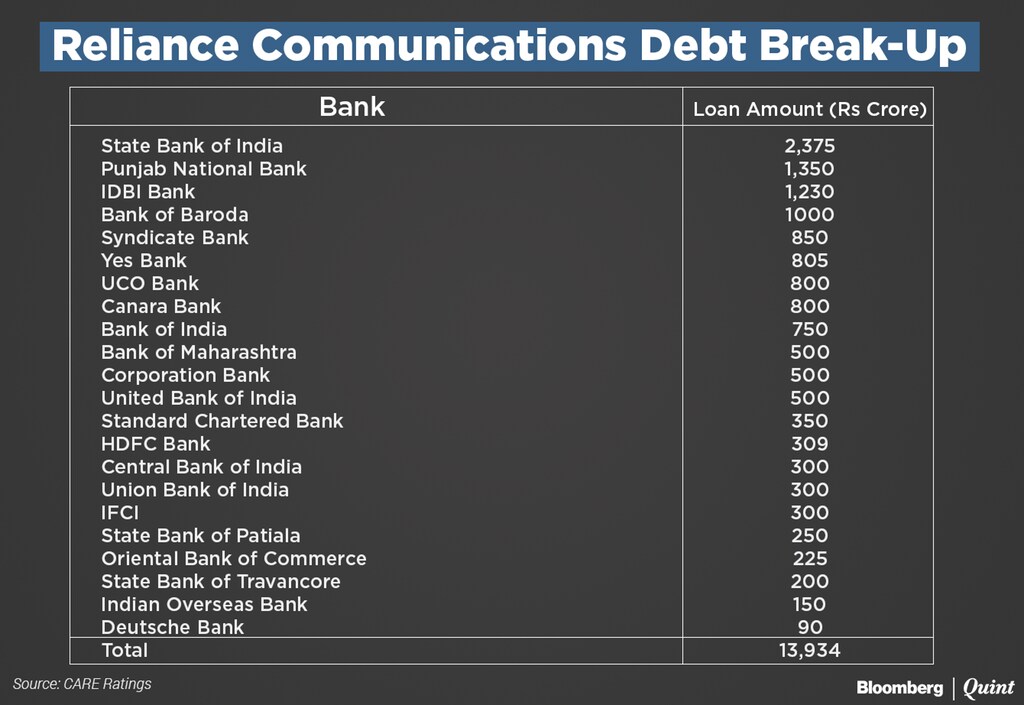
About 17 domestic banks and a clutch of international banks have a combined exposure of over Rs 45,000 crore to RCom as per a report published by rating agency Care Ratings Ltd. in May 2017.
Their hopes of any loan recovery were dashed on Sunday when the ADAG company said that it had mutually ended merger talks with Aircel Ltd, after a year, due to “legal uncertainties” and “intervention by vested interests”. This is a setback for RCom's lenders who invoked the strategic debt restructuring (SDR) scheme in June 2017, hoping that the Aircel merger deal would help in deleveraging.
The news will also impact the Brookefield deal. In an interview with Mint newspaper, Punit Garg, executive director at RCom, said that the deal with Brookfield is currently being reworked to reflect the loss of Aircel's tenancies, which were earlier part of the deal. This could mean that the Rs 11,000 crore valuation which the Canadian investor had initially agreed to, may be revised downward. The Brookfield deal was first announced in December 2016.
Insolvency May Be Unavoidable?
The banks may want to prevent insolvency proceedings but RCom is already facing one such petition filed by Ericsson India, an unsecured creditor, looking to recover about Rs 491.41 crore. The next hearing in the matter is slated for Friday, October 6, 2017. If admitted by the National Company Law Tribunal, this would lead to all lenders being pulled into the resolution process.
Under the IBC, the admission of an insolvency case is followed by the appointment of an interim resolution professional and the creation of a committee of creditors in which a creditor has votes proportionate to the percentage of debt. The resolution professional is tasked with the job of identifying creditors and arriving at a resolution plan, which must then be approved by the committee and finally the NCLT.
What If SDR Prevails?
With the merger talks with Aircel having failed, RCom's debt resolution plan is currently on thin ice. Domestic lenders had approved the SDR scheme, under the condition that the Aircel merger and the Brookfield sales be completed.
The SDR gave bankers time till December 2017, following which they would have to convert debt to equity representing at least a 51 percent stake in RCom, thereby taking operational control. In turn, RCom got a standstill on interest servicing, principal repayment and asset classification till December 2018, meaning that till such time, the domestic lenders would not tag the account as a non-performing asset.
According to two of the three people quoted above, the idea behind invoking SDR was that the once the sales had been completed, the remaining businesses of RCom could become sustainable and could be restructured easily. If the sales are not inked in time, the lenders would be responsible for finding buyers and completing them.
Since Sunday the company has elevated four executives and expanded its board. On Monday RCom elevated its President of Telecom Business Punit Garg as executive director and Chief Financial Officer Manikantan V as director.
It also elevated Suresh Rangachar and Gurdeep Singh as directors on the boards of its subsidiary companies.
Also Read: Reliance Comm-Aircel Merger Fail Adds To Telecom Sector's Agony: Brokerages

-
The Economic Imperative: Analysing The Material Driving Force Behind India-Canada Strategic Reset

This economic complementarity is further reinforced by deep institutional investment ties and talent mobility, which form the bedrock of the bilateral framework.
-
Medicine Pricing: Where Must Profit Stop?
India must confront excessive margins, hidden incentives and regulatory gaps that threaten the integrity of medicine.
-
Why Amazon And Flipkart Are Struggling To Beat Meesho In India's Smaller Cities
With 274 million users and lowest-cost logistics, Meesho is defending its value commerce crown against giants like Amazon and Flipkart.
-
High US Salaries, No Green Card Certainty: The Financial Calculation Facing Indian H-1B Families
The suspension of PERM processing at eight technology employers does not cancel existing H-1B visas. What it does is force a question many Indian families have been avoiding: is the US salary worth tying your career and family plans to one employer?
-
Swiggy vs Eternal: Food Delivery's Two Rivals Are No Longer In The Same Race
Eternal is building a private AI assistant, dark.ai. Swiggy is still working out how to make Instamart pay, with an operating loss of Rs 895 crore in the July-September quarter while Blinkit stayed profitable.
-
Where You Live Shapes How You Get To Work | The Reason Why
Two-wheelers are the most popular way to get to work in India, accounting for nearly 43% of workplace commutes.
-
Unhedged Position: Can India See An Indonesia-Style Time Correction?
The Nifty is trading below levels it first clocked in 2024. Is there, then, as I have suggested in the headline, potential that the current time correction drags on painfully for the next three-five, even ten years?
-
Navigating Friction And Energy Realities: An Analysis Of Marco Rubio's October Visit To India
Occurring at a critical juncture marked by stalled trade negotiations and escalating geopolitical pressures over global energy supplies, the visit offers a profound window into modern US-India relations.
-
India Exports Capital. Why Not Export Trusteeship?
The big question, then, is whether India can build an institution that global borrowers, investors, banks, and lawyers can trust, even without an Indian connection.
-
France's Economy & Politics Are In Crisis | The Reason Why
Let's look at how the French economy and politics evolved under Nicolas Sarkozy, Franois Hollande and Emmanuel Macron.










