Knowing The Digital Entertainment Consumer
Every time a new medium or platform emerges, it triggers a similar conversation. Who is the new consumer? How is he/she different? What kind of unique content does he/she want? Is this model scalable? Is there money to be made?
No new medium can exist in isolation. Invariably it is an extension of an older idea – an innovation on communication technology – something new that joins existing dots – that creates a new habit and a new user base. It has been said, “to know your future, you must know your past”. The same truth applies to media, entertainment, content and consumers,
Here is a super-quick walk down memory lane to get some perspective.
- Till the late 1980s it was print, Bollywood (and regional language equivalents), Doordarshan and All India Radio that pretty much dominated our mind-space with regard to entertainment.
- In the 1990s, satellite television exploded in India and the internet in the rest of the world. The 2000s saw the rise of FM radio, the growth of multiplexes, 24/7 news channels, mobile telephony and foreign money infused into Bollywood.
- The 2000s also saw the growth of the internet and social media in India, albeit in a very mobile avatar.
The 2010s have seen further growth of television, multiple content genres including new sports leagues in a big way, smartphones connectivity, online video consumption, e-commerce, e-wallets and now we're poised on the brink of over-the-top content or OTT. Netflix and Amazon are here, all the major broadcasters and content companies have their OTT platforms, YouTube dabbles with a subscription strategy, telecom companies have built giant captive bases that they can call ‘audiences' and the government itself is pushing for a cashless digital India.
Who Is The New Digital Entertainment Consumer?
I have this little infographic I call ‘Overlapping Universes'.
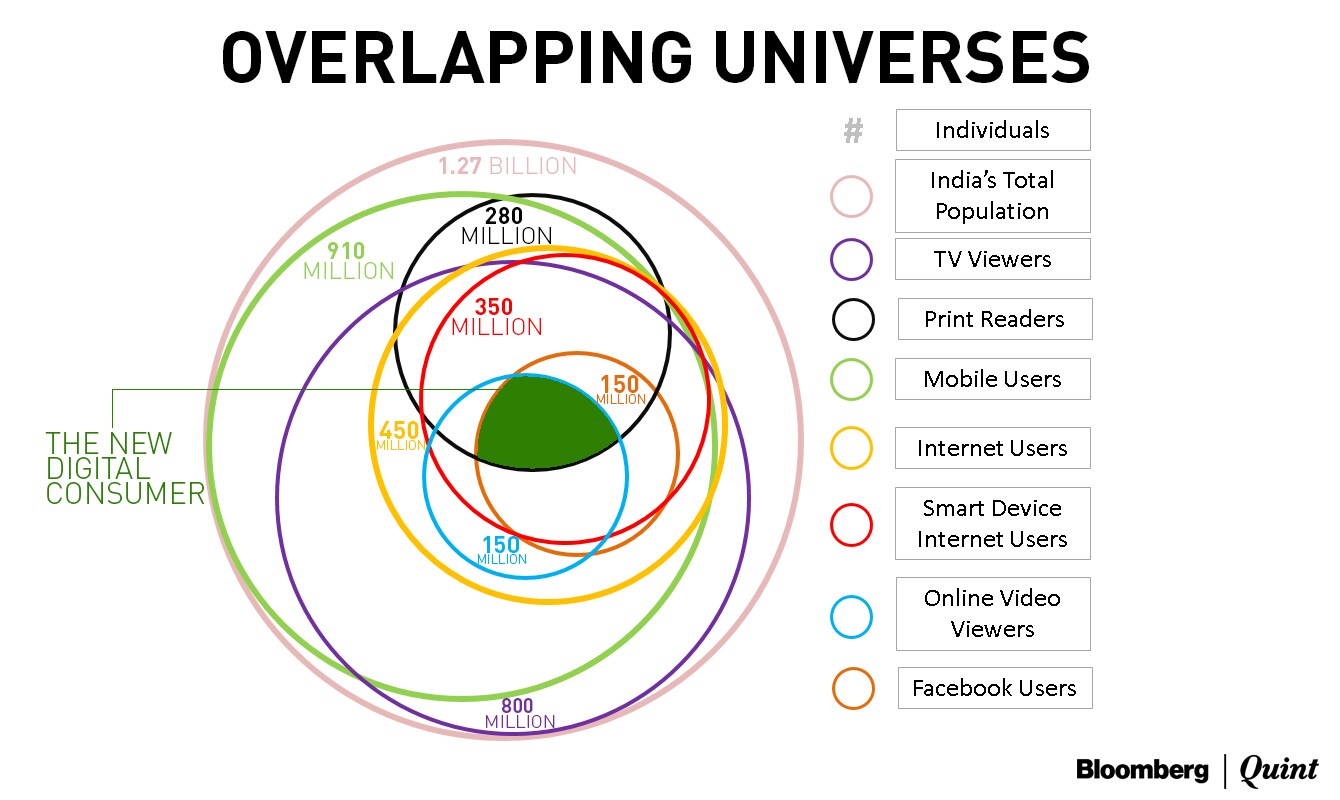
It gives a unique view of the world we live in and reiterates the fact that as an audience, we consume multiple media, new and old, simultaneously. Adoption of a new idea takes time and usually starts with young people. The digital consumer was much younger a few years ago – classic early adopters – but the spread of cheaper smartphones and social media has pushed the average age of the consumer higher.
The New Digital Consumer is between the ages of 19 and 34, male and female, with a spill of 10 years both up and down. Kids today start very early and I know a lot of super savvy Facebook grandparents. These consumers have – or in the case of kids, have access to – smartphones and 3G/4G/WiFi connectivity.
- They come from households that earn more than Rs 10 lakh per annum.
- They primarily live in big and small urban centers of India.
- They used to be heavy consumers of television having grown up in the last 16 years of the post Kaun Banega Crorepati and K-soap satellite TV boom.
- They enjoy Indian cinema and most definitely support ‘smarter' cinema along with the star-studded mainstream fare.
- They consume the new sports leagues, the men among them avidly watch the news.
- The older women, while still hooked to their favourite soap operas and talent shows, have grown to have very specific choices.
- They are active on social media, especially Facebook, Twitter, and WhatsApp.
- As a household, they currently spend about Rs 500-2,000 per month on entertainment between television, movies, gaming and sport, and run up a bill of about Rs 500-1,000 per month on telecom and WiFi charges.
There were 25 million cable and satellite homes in 2000; today there are 165 million cable and satellite homes. The New Digital Consumer is a subset of and resides in 25 million of these homes - households that already spend about Rs 2,000 per month for entertainment, telecom, and the internet.
My hypothesis is that these 100 million consumers from these 25 million households are the front-runners and early adopters of the new digital universe. They have gradually acclimatised to all things digital over the past 10 years and are now poised for the great leap forward. I believe they will very easily spend an additional $10 or Rs 600 per month, on average, to add to their entertainment consumption. Since numerous services are ad-based video on demand (AVoD), the bulk of this additional money will go to subscription video on demand (SVoD), edutainment, and gaming.
At a reasonable estimate, it is about $250 million per month and an annual $3 billion industry waiting to happen.
And that is just the tip of the iceberg.
What will they spend this additional money for? Better quality OTT services – exclusive aggregated content, more original content, deeper movie libraries, live sport, gaming, premium edutainment for kids, stuff like this…
You compete not just in your entertainment category, but for the attention, time and money of your consumer from other categories as well, non-entertainment included. The 25 million households are under 10 percent of the total population. As connectivity improves and data charges drop, the headroom for growth is phenomenal, especially if the new content offering is premium, yet popular.

My big punt is on local, original, high-quality dramatic fiction content. While Indian cinema in many ways evolved into ‘smarter' stories, Indian television – for the most part – remains mass and lowest common denominator. India also missed the evolutionary step of premium subscription television channels. That's why we don't have the Indian equivalent of HBO, Showtime, etc. The content need-gap is glaring. The customer is ready, willing and able to pay. A content creator's paradise is imminent. Let the storytelling begin!
Sameer Nair is Group CEO of Balaji Telefilms.
The views expressed here are those of the author's and do not necessarily represent the views of Bloomberg Quint or its editorial team.

-
Talking Points This Week: Leadership Shock At Nvidia, Earnings Strength, And The Fog Over Hormuz

The Anthropic IPO pricing and first trading day, Nvidia's upcoming earnings, and any fresh signals from Iran will set the tone for the following week.
-
Signature Play: The Classic Cocktail Is Dead. Or Is It?
Classic cocktails are disappearing from India's cocktail menus. But they're still being ordered, taught to bartenders and borrowed from. So, who's really having the last drink?
-
A New Samvat Wishlist: Inclusive Prosperity And Human Development
India has strengthened its economic foundations through infrastructure, digital access and enterprise. Its next growth chapter must deepen productivity, create better livelihoods and widen participation in prosperity.
-
Love, Sex Aur Dhokha: The Audacious Plot To Spy On Jensen Huang
A Taipei dinner, a Singapore chip buyer and a suspected Chinese asset: inside the alleged spy operation that got close to NVIDIA's Jensen Huang.
-
Ten Things I Learnt This Samvat
Patience can be a trap. Cheap stocks can stay cheap. Leverage can wipe you out. What did Samvat 2082 teach us? Niraj Shah writes on 10 lessons from the year gone by.
-
Talking Points This Week: Tech Nerves, FII Buying, And A Faraway Banking Shock
The global markets are not shining this Diwali. The exception in the large markets is, India.
-
Midterm Rally Lasted A Day. The Hard Reality Of A Divided US May Last Two Years | Opinion
Between a contested AI boom, a debt ceiling that arrives in 2027 and a president with every incentive to act alone, the next two years may prove more volatile than the first day's rally suggests.
-
Blue Wave Will Derail the AI Trade but Won't Dismantle the AI Era | Unhedged Position
The Democrats' sweep of the US Congress will see politics collide with economic forces both over the long and short term.
-
It's Time To Take The GST Council's Bet On Trust Global
Payment records can prove India's services exports, and clear, proportionate rules can bring foreign digital sellers into the tax net.
-
Opinion | India at 38: From Innovation Overperformer to Innovation Powerhouse
India now has 453 VC-backed deep science startups, 18 of them late-stage, after 117 percent growth since 2020. Laurus Labs, at USD 9.3 billion, is the most valuable deep science company in any middle-income economy outside China.









