Kalyani Group Ready To Roll Out Missiles Under ‘Make In India’ Plan
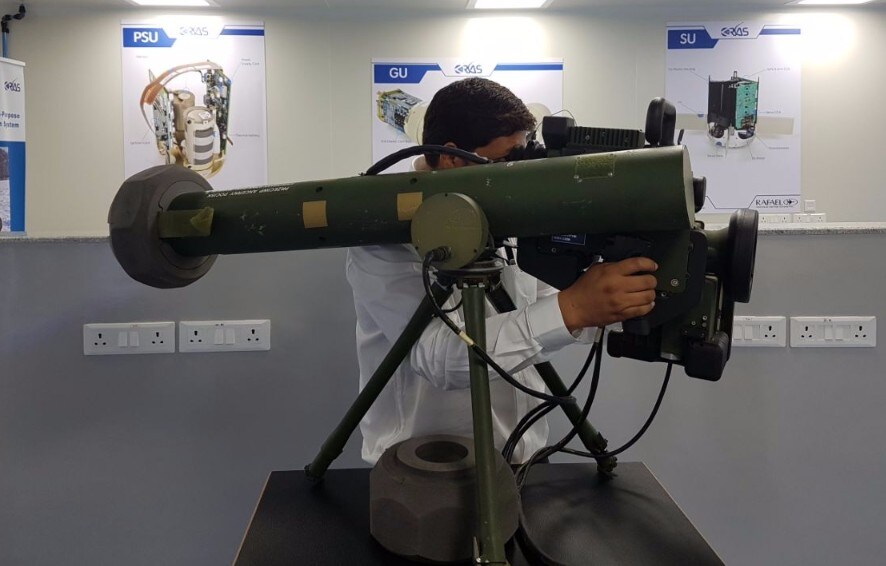
Kalyani Group's joint venture with Israel's Rafael Advanced Defense Systems Ltd. is one of the first to be off the block and ready to manufacture anti-tank guided missiles under Prime Minister Narendra Modi's ‘Make in India' initiative.
“We will be able to supply missiles to the Indian Army within weeks of getting the orders from the government,” Baba Kalyani, chairman of the $2.5-billion engineering-to-forging Kalyani Group, told reporters at the launch of the joint venture's new facility in Hyderabad. All field trials for the missile have been completed and it will have close to 90 percent localised content, he said.
The facility can manufacture and integrate Spike anti-tank guided missile systems and Spice glider bombs in India. The order, which awaits final approvals, includes supplying thousands of missiles valued at around $1 billion over next couple of years, said Kalyani.

India, the world's biggest importer of arms and defence equipment, is looking to boost local manufacturing by pushing domestic private companies to tie up with overseas peers for technology. The process to procure the anti-tank guided missiles began in 2010. Rafael was shortlisted in 2014. The final push came during Prime Minister Narendra Modi's visit to Israel in July.
The Kalyani Strategic Systems Ltd. and Rafael will supply the Indian Army 321 Spike ATGM launchers, 8,356 missiles, 15 training simulators and associated accessories.
“Both partners have invested around Rs 60-70 crore to build the facility. We would be investing another Rs 60-70 crore as we scale operations,” said Kalyani.
The deal involves transfer of technology to state-owned Bharat Dynamics Ltd. and option to produce additional missile launchers and missiles. The public sector company will integrate ammunition with the missile.
“We have already invested close to $70 million as preparation for this order,” said Yoav Har-Even, president and chief executive officer of Rafael Advanced Defense Systems. The company has been developing and training small and medium enterprises around Hyderabad to supply to the Kalyani-Rafael facility.
This is Kalyani Group's second partnership with an Israeli company. It struck the first one with BF Elbit Advanced Systems Pvt. for artillery guns.
The army is looking to equip all its infantry and mechanised infantry battalions and replace the current second generation French-made Milan anti-tank guided missiles.
Export Hub
Rafael Advanced Defense is looking at making this an export hub for the anti-tank guided missiles to south east Asian countries, depending on the government nod's, said Kalyani.
(BloombergQuint was invited to the launch of missile manufacturing facility at Hyderabad by the Kalyani Group)

-
The Economic Imperative: Analysing The Material Driving Force Behind India-Canada Strategic Reset

This economic complementarity is further reinforced by deep institutional investment ties and talent mobility, which form the bedrock of the bilateral framework.
-
Medicine Pricing: Where Must Profit Stop?
India must confront excessive margins, hidden incentives and regulatory gaps that threaten the integrity of medicine.
-
Why Amazon And Flipkart Are Struggling To Beat Meesho In India's Smaller Cities
With 274 million users and lowest-cost logistics, Meesho is defending its value commerce crown against giants like Amazon and Flipkart.
-
High US Salaries, No Green Card Certainty: The Financial Calculation Facing Indian H-1B Families
The suspension of PERM processing at eight technology employers does not cancel existing H-1B visas. What it does is force a question many Indian families have been avoiding: is the US salary worth tying your career and family plans to one employer?
-
Swiggy vs Eternal: Food Delivery's Two Rivals Are No Longer In The Same Race
Eternal is building a private AI assistant, dark.ai. Swiggy is still working out how to make Instamart pay, with an operating loss of Rs 895 crore in the July-September quarter while Blinkit stayed profitable.
-
Where You Live Shapes How You Get To Work | The Reason Why
Two-wheelers are the most popular way to get to work in India, accounting for nearly 43% of workplace commutes.
-
Unhedged Position: Can India See An Indonesia-Style Time Correction?
The Nifty is trading below levels it first clocked in 2024. Is there, then, as I have suggested in the headline, potential that the current time correction drags on painfully for the next three-five, even ten years?
-
Navigating Friction And Energy Realities: An Analysis Of Marco Rubio's October Visit To India
Occurring at a critical juncture marked by stalled trade negotiations and escalating geopolitical pressures over global energy supplies, the visit offers a profound window into modern US-India relations.
-
India Exports Capital. Why Not Export Trusteeship?
The big question, then, is whether India can build an institution that global borrowers, investors, banks, and lawyers can trust, even without an Indian connection.
-
France's Economy & Politics Are In Crisis | The Reason Why
Let's look at how the French economy and politics evolved under Nicolas Sarkozy, Franois Hollande and Emmanuel Macron.










