JSW Steel Sees Stable Input Costs, Margin Improvement In Coming Quarters
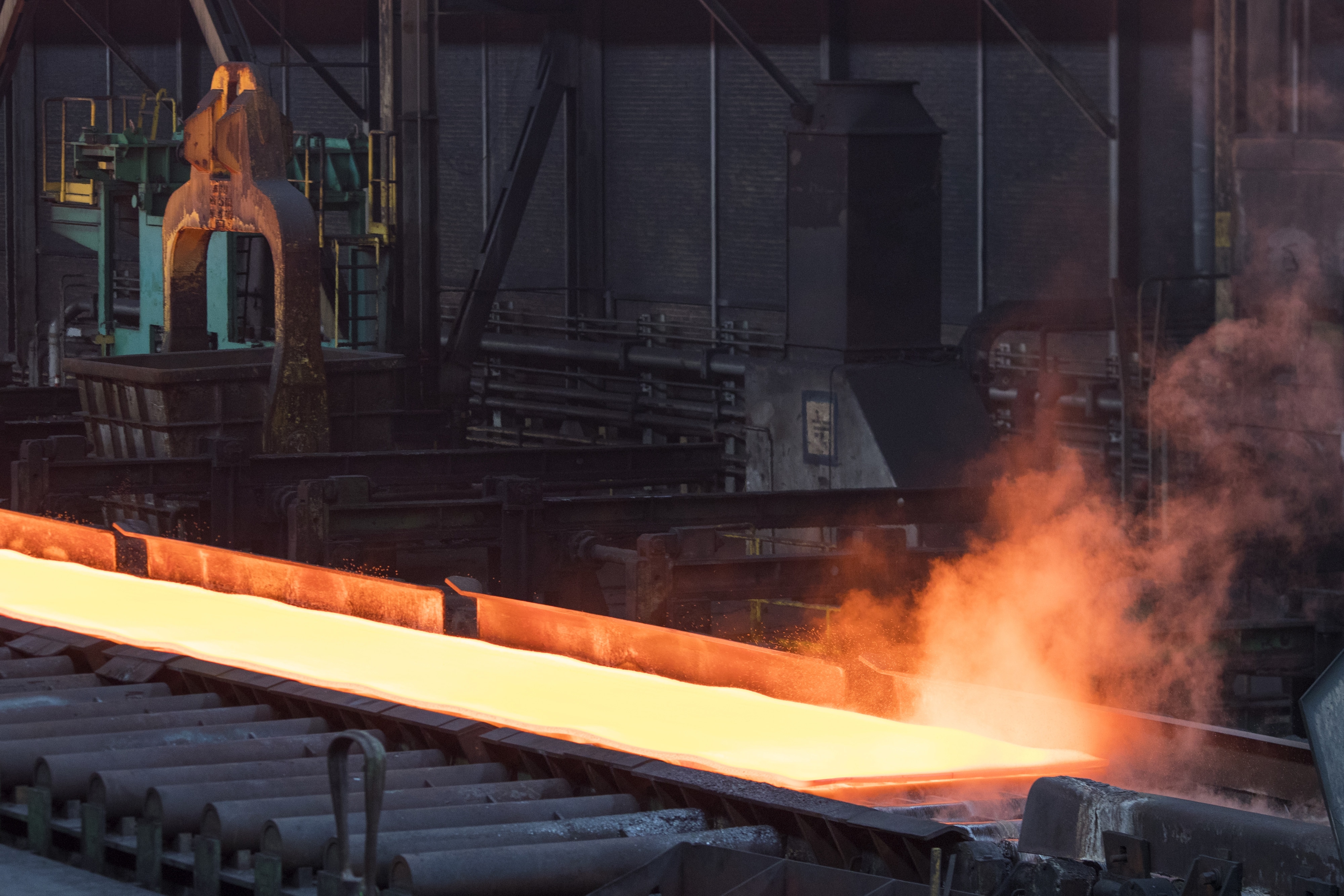
Input costs for the steel industry are expected to stabilise in the coming quarters, which will lead to an improvement in prices or realisations and profit margin in the second half of the current financial year, Seshagiri Rao, joint managing director and chief financial officer at JSW Steel Ltd., told BloombergQuint. The demand picture for steel looks robust at the moment, he said.
In the second quarter, realisation was flat because the surge in the international prices of steel could not be passed on in India at the same pace since imports went up substantially, Rao said.
What the government needs to look after, which we have also brought to their attention is why are these imports coming when the domestic prices are already lower.Seshagiri Rao, Joint MD and Group CFO, JSW Steel
Rao also described hurdles in implementing the Insolvency and Bankruptcy Code in order to resolve stressed assets.
In IBC, if a new investor wants to come in - either JSW Steel or someone else, the alignment of various acts in order to ensure that it is attractive for the investor is essential.Seshagiri Rao, Joint MD and Group CFO, JSW Steel
Watch the full interview here:
Here are edited excerpts of the interview:
Therefore, if imports are moderated as requested and input prices and margins stabilise, JSW Steel will perform better in the second half than the first half of the current financial year, he added.
The second quarter was impacted by higher input costs and higher imports. Can you tell us what the picture for next two quarters will look like?
The global steel industry's outlook has been very positive, particularly taking into account the developments in China and also in the advanced economies. In the first nine months of calendar year 2017 steel demand is expected to be 7 percent higher and in China, it will be up 12.4 percent. So, there is a positive sentiment for the global steel industry outlook. That's why we are seeing some stabilisation in prices and also an upward bias in the overall steel prices.
The investment sentiment is improving. Globally, infrastructure investment is coming up again because of higher commodity prices. Taking that into account, with regards to India, as far as steel demand is concerned, we have grown by 4 percent which is higher than last year. The second half of the financial year is generally better than the first half. So, steel prices should be better than first half in the second half and demand should pick up too. Taking all these factors into account, JSW Steel is likely to do well in the second half.
Input prices have increased and imports have increased as well. Do you think pricing might improve in the second half?
Commodity prices rose across the globe. Iron ore which was at $40 per tonne went up to $80, even though some correction has happened helping it stabilise at $60. So, the extra iron ore cost is getting absorbed. Coking coal prices which were below $100 went above $200, then came down to $180, and stabilised at those levels. So, in the second quarter of this financial year, we had to absorb the higher raw material prices.
At the same time, there was a surge in the international prices of steel. But the same pace increase in steel prices could not be passed on in India because of a substantial increase in steel product imports. Sequentially, it went up by 58 percent.
That is why, the realisation was flat on a quarter-on-quarter basis, and we have seen some pressure in the last quarter. Going forward, I am not seeing an increase in input prices. Steel price margins are stable. Because the demand is robust, I expect the margins to improve in the second half over the first half.
Do you expect the prices of iron ore and coking coal to flatten? Do you expect the import pressure to continue in the next few quarters?
As far as raw material prices are concerned, I don't expect them to further rise over the current prices. Because of two reasons. One is, China has already peaked in steel production. Therefore, there is more supply of iron ore coming in the market and at the same time, coking coal is also coming in market. So, I don't see an increase in iron ore and coking coal prices at the current levels.
At the same time, we have been bringing it to the attention of the government, that in the last quarter there was a significant increase in the imports of steel production into India. So, it has to be looked at why the imports are coming when the domestic prices are at a lower level than the landed cost of imports for some of the products. We expect some moderation for imports. Some of the imports, which came in the second quarter, were booked when the prices of steel international were lower. So, in my view, the imports in India should moderate going forward.
Hence, I expect the second half, in terms of margin, demand, moderation of imports, to be better than the first half.
By how much do you expect the realisation to improve in the coming quarters?
As far as JSW Steel is concerned, there are two-three factors which have to be taken in to account for why the second half will be better for JSW Steel.
Some of the quarterly or half yearly contracts which were there in the first half, they will get repriced in the second half. That's why the realisation would be reset for those contracts, particularly the original equipment manufacturer customers in the auto and appliances sector.
Second, the exports that we have booked on the old prices, they get repriced in the second half.
The third is, as far as domestic prices are concerned, the discount of imports at international prices and an increase in the scope of domestic prices also takes place.
Taking these three factors into account, I expect the realisation to go up. It is very difficult to say how much it could go up. But generally, I can talk about margin improvement in the second half over the first half.
Would this be restricted to JSW individually or do you think that the realisation could improve for the industry?
For the industry, whatever results that have come for the Indian steel companies, more or less they are on the same trend. So, the realisation is flat for some of the steel companies which have announced results. I expect the same trend will continue. One factor is important that our exports are 26 percent of our sales. Therefore, that has to be factored in while looking at other steel companies with regard to repricing of their exports realisation in the second half.
You mentioned that input cost pressure will be stable in the third quarter. What about the quarters ahead?
Cyclical volatility is inherent in the steel sector. So companies have to absorb the cyclical nature to be sustainable in their profitability and in the future of outlook. As far as JSW Steel is concerned, 60 percent of our product mix is our value-added products and special products. Therefore, we are reducing the cyclicality and thereby, maintain our profitability.
We would like to increase that proportion. Thereby, the commodity grade steel proportion is reduced in our overall product mix. That is how we are working out. That's why, we are spending large amount of capex in increasing our downstream products like cold rolling, galvanizing, galvalume and colour coated. These are the products on which we are focusing more. So, it not only has lesser cyclicality but it is also possible to export the product at attractive realisation.
How would the next six odd months look like, in terms of capacity expansion and the mining scenario?
Mining is looking up which is a positive scenario. If we look at either coal or iron ore, the mining activity is improving. As regards to Karnataka, where our major plant is located, there is a cap of 30 million tonne per annum on production. We are expecting a judgement from the honorable Supreme Court that the cap may be relaxed. If that is relaxed, then more iron ore will be available which could give a lot of benefits to JSW Steel and other steel companies which are dependent on Karnataka iron ore mining, This will not only reduce the cost of iron ore but the availability will enable many companies to increase their production and expand their capacities. So, this is how we are looking at it.
More and more mines are coming up for auction in the next few years, which will enable more and more capacity for the steel industry to come in to meet the increasing demand. One important aspect is that today the installed capacity of the steel industry in India is 130 million tonnes. Last year, we produced 97 million tonnes and in this year, it is expected to be 104 million tonnes. So, 130 minus 104, the balance left is only 26 million tonnes.
Generally, the industry works at 80-90 percent capacity utilisation. So, there is no effective capacity to meet our growing demand unless investments happen in the sector to meet the 5-7 percent growth in demand. We are very positive about growth in demand and more investment in the segment to create more capacities.
Speaking of capacities where are you in the process of being able to participate in the insolvency processes that several distressed steel assets are undergoing?
Inorganic growth is part of our growth strategy. So, when we became 18 million tonnes from 1.6 million tonne over a period of 15 years, we acquired stressed companies which we turned around. We have a track record in turning around these stressed companies. In a similar breath, we are evaluating various opportunities that are available in India.
When you talk about Insolvency and Bankruptcy Code, it is a very good framework which is lead by the Government of India, Reserve Bank of India and the banks. Under that framework, hopefully, some solutions will come in. We are evaluating opportunities that are there today. So, we will look at it.
In IBC, if a new investor wants to come in - either JSW Steel or someone else, the alignment of various acts in order to ensure that it is attractive for the investor is essential. Either you look at Income Tax Act, 1961 or Securities and Exchange Board of India guidelines or Companies Act, 2013 or the Stamp Act in India, there is inconsistency relative to the pre-IBC and post-IBC scenario.
In pre-IBC times, when Sick Industrial Companies (Special Provisions) Act, (SICA) or Board for Industrial and Financial Reconstruction (BIFR) or any other processes were there all the acts provided exemptions for any such schemes. But when IBC came in, appropriate amendments were not done. That is one limitation I believe.
Any restructuring or resolution plan will involve capital reduction, capital change, variation of shareholders rights, de-listing, merger, demerger or slum sale, so many things can happen as part of restructuring. In SEBI's Section 3 (II) guidelines of the de-listing regulations, it provides exemption for a scheme under BIFR and SICA but not under IBC or NCLT. It is very essential that the amendment is done. Otherwise, there is a problem with regards to any scheme that will come in which is not consistent with the SEBI regulations.
Same problem with the income tax act, look at Section 50, 56, 72, 79, 150-JB. There are various sections which have provisions relating to the old act, but in the IBC there are no amendments that have not been done in income tax act. Any scheme that is given involving waiver or write-back of loans or any restructuring of companies or issue of share settlers as per the market price, when these things happen, there is a huge tax liability that will come in under income tax act. Same with the Stamp Act.
In my view, it is essential that somebody looks at these aspects and aligns these acts which will be good for the investors so that it is not an incentive for an existing management to ensure that it (the deal) is not attractive to the new investors to come in. At the same time, the banks would get better proposals, if these are looked at and quick amendments to these acts are made.
Have you had a chance to express your interest in both Bhushan Steel and Monnet Steel asset?
Steel industry is a cyclical industry. So, if a cyclical industry has to be sustainable, then it is very essential for capital allocation to be important. We are able to create capacity of 18 million ton with an investment of Rs 60,000 crores i.e Rs 3000-3500 crores per million ton. So, I am hearing a lot of noise in the market that companies will bid aggressively for the steel companies to acquire capacities which, in my view, is not so.
Today, if anybody invests a large sum of money for acquiring a million tonne, then it is not sustainable in long term. So, you need to be aware as the investors know who is an existing or the new player. Then if an acquisition has to be done then it has to be at a sustainable price. It has to give returns to shareholders. From that point of view, the assets have large amount of debt.
In my view, it involves significant haircuts by the banks in order to ensure that these assets are nursed back to normalcy and the acquirer is be able to give a good resolution plan. It is essential that the haircuts be significant in these cases.
What will be the capacity expansion plan over the next 2-5 years for JSW Steel? How much that will be organic and inorganic and what kind of additional capital are you going to put to work to support these plans?
We have announced a capex plan of Rs 26,800 crore for a period of three years, including the current financial year. On completion of Rs 26,800 crore capex which is organic growth, it will take us from current 18 million tonnes to 23 million tonnes. Similarly, our downstream capacities will go up to the extent of 45 percent of total capacity. As a part of this capex, a lot of cost saving initiatives or expenditure we're incurring like pipeline conveyors, water reservoirs... So, all this will take us to 23 million tons. We are creating very efficient capacity as part of this organic growth.
In addition to inorganic growth, we have environmental clearance at Vijayanagar to expand our plan to 16 million ton from 12 million ton. So, another 4-million-ton brown field expansion is possible, subject to improvement in the availability of iron ore in Karnataka. This is how we are looking at the organic growth story. In addition to new green field projects, either in Odisha or Jharkhand. There we are working to acquire iron ore mines in the auction and also on acquiring the land. That is a medium term plan to set up greenfield projects as part of our organic growth story.
How much powder you are keeping dry for the inorganic strategy? I am sure you interested in Bhushan Steel and Monnet Steel, how much money are you willing to put to it?
We have a strong balance sheet. Last year, we had a net profit of Rs 3,500 crores and we have EBITDA of Rs 12,200 crores. Our first half results are quite strong. Taking in to account our financial numbers, we have adequate cash generation within the company to plan our organic and inorganic growth. That is how we are planning to do it.
Two important financial policies are important for us. In that we said that we will have debt-equity ratio of 1.75:1 and debt to EBITDA is 3.75:1. So, within this two ratios we will craft our organic and inorganic growth story and accordingly we will raise the resources for it.

-
One Battle After Another: India's Corporate Dynasties Battle For Control

2026 could go down as Corporate India's year of succession wars, governance battles and family fault lines.
-
Rs 50-Lakh Gold In Bank Locker, Rs 3 Lakh Of Protection: The Gap Most Families Don't Know About
The RBI ties a bank's liability to the annual locker rent and families who want to insure their jewellery face a separate question about how to prove what was inside.
-
The More Food Turns Into Fuel, The Harder It Is To Read Agricultural Markets | The Reason Why
A policy designed to reduce dependence on imported fuel can create new pressures elsewhere in the food economy.
-
Your iPhone Costs 12 Grams Of Gold, A Car About 100. What Does Your Life Weigh?
Measured in rupees, almost everything looks more expensive than it did a generation ago. Measured in grams of gold, a lot of it has become cheaper.
-
Gold Is Rs 22,000 Cheaper Than A Month Ago. Should You Buy Amid The Wedding Season?
Gold's potential slide to $3,500 could save around Rs 4,700 per 10 grams, but a soft inflation print could just as easily push prices back up. One way to split the risk is to buy in parts, some now and the rest after the Fed's Dec. 9 decision.
-
AI Agents Are Gaining Power. Who Governs Them?
Artificial intelligence agents promise to transform productivity by moving machines from assisting decisions to executing them. But as organisations delegate greater authority to these AI-agents, they must first establish who controls that authority and who remains accountable when things go wrong.
-
Why Swapping Your Old Gold Can Trigger A Rs 5 Lakh Tax Bill, And How You Can Avoid It Legally
Swapping old gold for new is taxed as a sale and a fresh purchase. Getting your own gold remade can cut most of that bill, though it has its own costs.
-
The AI Trade is Done. The Real Opportunity for Investors Starts in 2027 | Unhedged Position
As pureplay AI stocks plunge and circular, capex-led financing unwinds, 2027 is set to be a year of reckoning for AI companies. Yet the bust clears the way for a better opportunity for investors in 2027 -- shifting the spotlight from AI builders to the companies using AI.
-
Leadership As Mission: Why The Age Of AI Demands More Human Leadership
Debjani Ghosh examines how AI is changing leadership, arguing that its success must be measured by its impact on people and the accountability of those guiding its use.
-
We May Need Another Tukaram Mundhe To Fight Air Pollution | The Reason Why
Developers may install basic measures such as sprinklers and green nets, resume work, and continue violating rules when this equipment stops working.









