JioMart Vs Udaan: Mukesh Ambani Faces A Challenger, Shows Kotak's Gurugram Survey
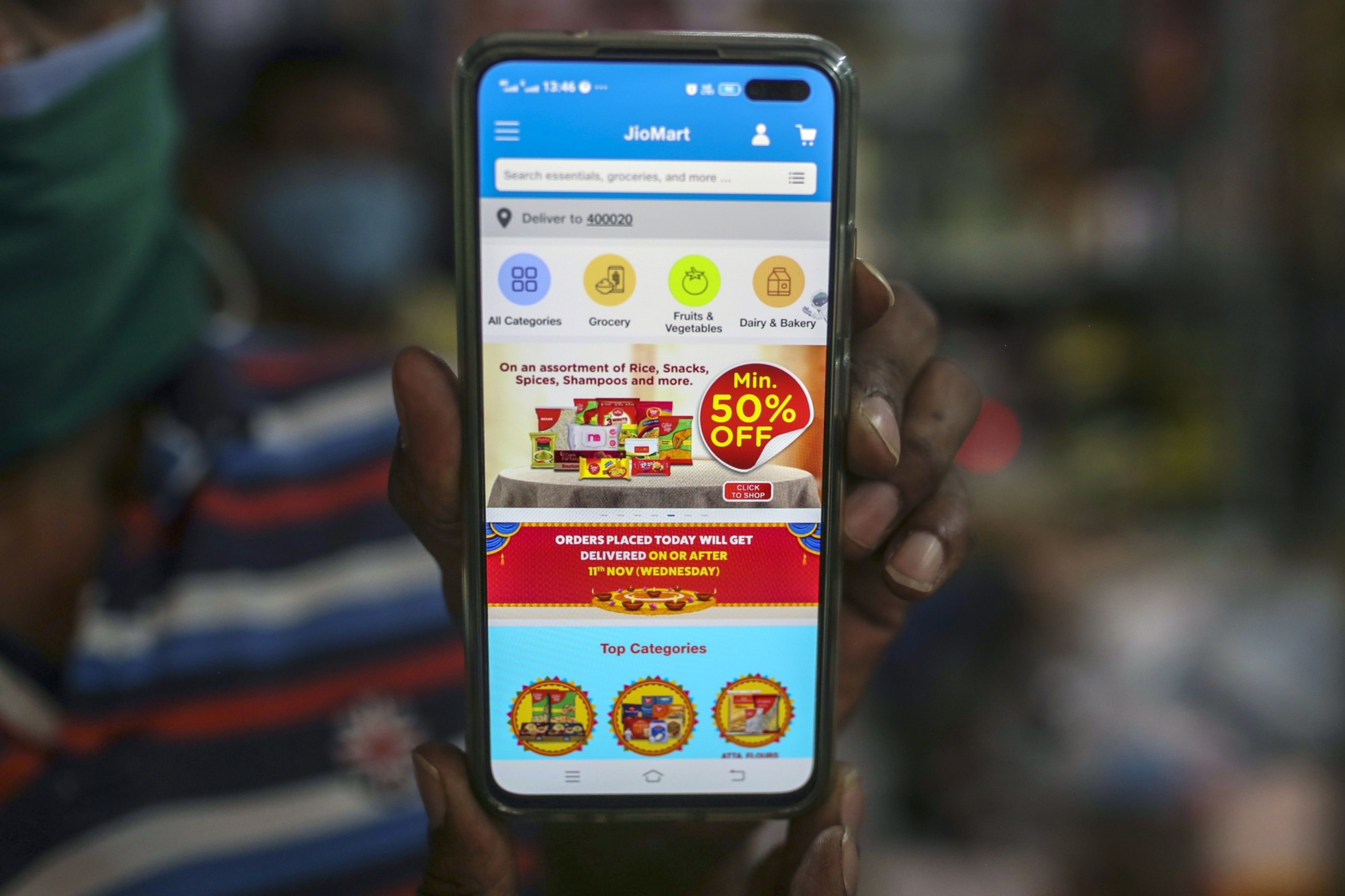
Reliance Industries Ltd.'s online grocery portal is building its turf as a supplier to mom-and-pop stores. But it faces a tough challenger: Udaan.
JioMart has captured a 26% market share after partnering kirana stores for about six months in Gurugram, according to Kotak Institutional Equities. The billionaire Mukesh Ambani-owned e-commerce venture, it said, has edged past Udaan, which has a 12% share despite being in the region for 14 months.
General trade, or retailers fed by bulk dealers and stockists, still dominates with a 40% share in the north Indian city. The rest is catered to by online giants including Amazon India Pvt. and Flipkart Group.
Gurugram underscores the shift underway in India's $900-billion retail market. While online retailers are vying for a bigger slice, mom-and-pop stores accuse them of predatory pricing and unfair practices. Distributors, still the biggest channel for supplying salt to shampoos to all corners of India, are pushing back against the likes of JioMart and Udaan that are digitising the supply chain.
Kotak surveyed 301 retailers in Gurugram. Of which, 100 were JioMart's partners.
Udaan Has More Partners
The five-year-old Udaan has a first-mover advantage and is proving to be a “strong challenger” to JioMart's business-to-business network scale-up, the report said.
Nearly 45% of retailers surveyed has Udaan as a distribution partner compared to around 33% for JioMart, according to the Kotak survey.
JioMart, launched in May last year, engages with small retailers in two ways:
Acting as a distributor by supplying products to retailers.
Using the small-store network to fulfill orders consumers place on JioMart portal.
The two services are bundled. To get orders from JioMart users, a retailer needs to buy inventory from the platform.
In Gurugram, the headline margin offered by JioMart, Udaan and other distributors is similar, although JioMart seems to be offering better promotional schemes and credit terms, the report said. About 55% indicated that traditional distributors offered “no discounts” on products.
Retailers, in general, earn a profit margin of 7-15% depending on the product.
JioMart's retailers get an additional average delivery charge of Rs 27 per order. That gives it an edge as most retailers deal with more than 10 distributors. And food and groceries account for 71% of the sales at kiranas.
JioMart's Challenges
Analysts at Kotak said JioMart has improved its service levels but there's enough headroom to improve.
Just 44% partners in Gurugram were satisfied with JioMart as a distributor. That, according to the brokerage, is way less than 98%, 100% and 83% satisfaction levels in Mumbai, Bengaluru and Ahmedabad, respectively. JioMart has 20-25% market share in distribution in Bengaluru, Mumbai and Ahmedabad.
Kotak conducted surveys in Mumbai in December 2020, Bengaluru in February and Ahmedabad in May.
JioMart has three lakh partner stores in 200 cities. It's targeting to onboard one crore merchant partners over the next three years.
Still, about 59% of the retailers in Gurugram said that the JioMart tie-up didn't benefit their business.
JioMart, according to the survey, promised a mix of discounts and deals, timely delivery and wide product range, and better quality products. But slow delivery and inconsistency with product availability and brands were its key pain points.
Another major impediment is infrequent engagement.
According to the survey, 44% of the retailers said JioMart representatives visited once in two weeks. Some even said that the frequency is once a month when salespeople of others distributors come to stores every week.
Many retailers were unaware of JioMart's B2B distribution services. The non-partner retailers cited “don't know how to tie up” and “sales representatives don't visit or take orders” as the reasons.
Retailers prefer Udaan because of cheaper prices, doorstep and timely delivery and online ordering.
Udaan and Reliance Industries Ltd., the parent of retail venture, have yet to respond to BloombergQuint's emailed queries.
Pushing private labels is a key part of JioMart's distribution strategy. According to the survey, about 28% retailers stock JioMart's own products in Gurugram. That compares with 37% of Mumbai, 100% in Bengaluru and 75% of Ahmedabad.
Almost none stocks private labels or Amazon and Metro Cash & Carry India Pvt.
Customer orders through JioMart are also patchy.
About 60% of Gurugram respondents said they didn't receive any orders from JioMart after the distribution tie-up. “This indicates either B2C order density was low in the areas surveyed or in fact JioMart was fulfilling a majority of the orders itself,” the report said.
On an average, three of 23 daily orders received by kiranas were from JioMart, implying the online portal contributes just 13% of their total orders.
JioMart also found it hard to sell its point-of-sale devices and its strategy around PoS machines remains unclear, Kotak said. “Only 3% of the retailers were aware of the PoS machine. None of the retailers have returned the Jio PoS devices back to the company after using it for some time and 97% have not used it even once.”
Kotak's experience was similar in Ahmedabad and Bengaluru. This implies that JioMart is either taking back its devices or has paused the initiative.
The survey highlighted that high charges and low battery performance were key reasons to stop the use of Jio PoS devices. In Gurugram, Kotak said, the deposit amount for PoS is higher at Rs 3,500 against Rs 3,000 in other locations surveyed earlier.
“Instead, Reliance Partner app has replaced the PoS. About 82% of partner shops use an app that enables quick order placement,” the report said.
JioMart has also started extending invites to select users for shopping over WhatsApp.

-
Getting To Work Costs Women More | The Reason Why

It is not just about women paying more than men. It is about women paying much more in cities than in villages.
-
AI Bias In Investing Cannot Be Eliminated, But It Can Be Governed
Framing is a particularly important example as identical financial information presented in terms of gains rather than losses can lead an LLM to reach a different assessment.
-
Joining The Dots | Dark Skies, Steady Diya: Why Hope Holds This Diwali
With war, a weak rupee and foreign outflows weighing on sentiment, policymakers at the NDTV World Summit and market veterans at NDTV Profit Ignite: Diwali Edition offered the same advice: stay invested and filter out the noise.
-
The Curious Case of Equitas Small Finance Bank And A CEO Who Quit For Stock
PN Vasudevan believes persistent investor concerns over a perceived conflict of interest had become a governance overhang on Equitas Small Finance Bank's stock, even as the lender improved profitability and asset quality.
-
Talking Points This Week: AI Cash Burn, A Tiger Comeback And An India That Still Finds Its Own Path
India is not immune to higher oil or tighter global liquidity, yet its earnings base is broader, its domestic policy levers are still available.
-
Foreign Investors Own Half Of HDFC Bank and ICICI Bank. An LTCG Cut Could Matter Most Here
Foreign portfolio investors have US$115 billion parked in HDFC Bank, ICICI Bank. If the government cuts long-term capital gains tax, Jefferies says returning foreign money could land here first.
-
'Never Seen This Level Of Negativity': Sandeep Tandon Says The Next Rally May Be Closer Than You Think
Veteran investor Sandeep Tandon says foreign selling is easing, large-caps are due a comeback and mid-caps are crowded, while he turns positive on gold, power and pharma this Diwali.
-
Indians Stay With Family, Not In Hotels | The Reason Why
India still lacks enough clean, reliable and affordable hotels for budget-conscious travellers.
-
The Economic Imperative: Analysing The Material Driving Force Behind India-Canada Strategic Reset
This economic complementarity is further reinforced by deep institutional investment ties and talent mobility, which form the bedrock of the bilateral framework.
-
Medicine Pricing: Where Must Profit Stop?
India must confront excessive margins, hidden incentives and regulatory gaps that threaten the integrity of medicine.










