Japan Prime Minister Abe's Upcoming Growth Strategy: Report
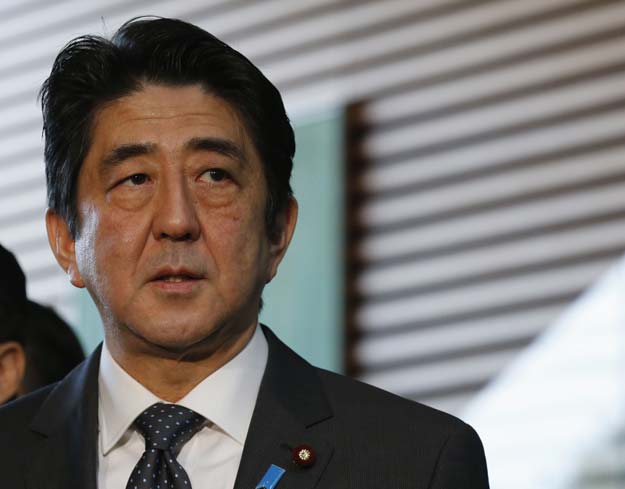
Following are key economic policy proposals that Japanese Prime Minister Shinzo Abe is expected to unveil on Tuesday. They are from draft outlines of macroeconomic policies and "growth strategy" structural reforms.
TAX:
- Aims to cut the effective corporate tax rate below 30 percent over several years from the next fiscal year. Aims to secure "permanent sources" to fund the tax cut, such as by broadening the tax base, in order to maintain the goal of achieving a primary budget surplus in the fiscal year 2020/21.
Specific plans will be decided by the end of this year.
GPIF:
- Implements review of the basic portfolio of the $1.26 trillion Government Pension Investment Fund, the world's biggest pension fund, in order to ensure long-term health of pension finances while responding to changes in economic and investment environment.
Abe's government is pushing GPIF to buy more stocks and invest less in government bonds; asset allocations are to be worked out in the coming months.
TRADE:
- Pledges a sustained commitment to quickly conclude an ambitious 12-nation Trans-Pacific Economic Partnership. The multilateral talks are stuck as Japan and the United States, by far the dominant economies in the TPP, remain at odds over issues such as access to Japan's market for farm products.
LABOUR:
- Pledges to end compulsory overtime allowance for workers earning more than a certain amount a year, suggests the line should be drawn at 10 million yen ($98,000). The change, which the government will aim to implement at the next regular session of parliament in January, would affect less than 4 percent of Japan's workers and is still subject to further debate at the Ministry of Health, Labour and Welfare council, where labour unions have a strong voice.
- Pledges expansion of a controversial foreign trainee programme, including the period of stay of workers and revision of the range of workplaces available to them. Stresses the trainee programme "is not an immigration policy".
'WOMENOMICS':
- Targets raising the proportion of women corporate managers to 30 percent by 2020 from last year's 7.5 percent. Requires listed companies to disclose their women-in-management ratios. Targets expanding places at Japan's day-care centres by 400,000 by 2017 and adding after-school programmes for an extra 10,000 school-age children.
- Pledges to consider changes to tax and pension regulations, which now give preferential treatment to women who stay at home over working women.
POPULATION:
- Pledges to stabilise Japan's declining population at around 100 million - representing more than a 20 percent fall - over the next 50 years. Experts say this will be difficult without allowing more immigration.
PRIVATE-SECTOR, FOREIGN INVESTMENT:
- Targets opening up $30 billion in public infrastructure projects such as airports to management by private investors. Targets tripling the value of projects financed through public-private partnerships by 2022 from $39 billion in 2012.
- Targets doubling annual foreign direct investment to nearly $345 billion by 2020. Japan's inbound direct investment is the lowest among OECD countries at 3.5 percent of GDP.
CORPORATE GOVERNANCE:
- The Tokyo Stock Exchange will compile by mid-2015 a Corporate Governance Code to improve oversight of listed companies. The plan calls for banks to have at least one outside director; this is weaker than previous recommendations from within Abe's party to have multiple outside directors for all listed companies.
ENERGY:
- Pledges to reform the electricity market by 2020, ending monopoly control by utilities. Promotes import of US liquefied natural gas. Reiterates Abe's plan to restart nuclear power plants that pass tougher safety checks imposed after the 2011 Fukushima disaster.
CASINOS:
- Advances debate on legalisation of casino gambling, a high-profile attempt to attract investment and tourism. Says "integrated resorts" are expected to contribute to bolstering tourism, regional activity and industry. The draft adds they require consideration of policy measures to prevent crime and maintain safety. It says relevant ministries will continue the debate on the subject.
FUEL CELL VEHICLES AND HYDROGEN ENERGY:
- Vows to boost use of hydrogen energy, based on a government timeline for the next three decades compiled in June. The government plans to offer ample support such as subsidies and tax breaks to popularize fuel cell vehicle technology as Toyota Motor Corp and Honda Motor Co prepare to launch a hydrogen-powered car in the United States, Japan and Europe in 2015. It also aims to ease regulations on hydrogen fuelling stations and, by 2020, cut building costs by around half.
ROBOTICS:
- Promises a "robotic revolution" in a bid to boost productivity and offset a shrinking, ageing work force. By 2020, Abe wants a 20-fold increase in the use of robots in the service industry and a doubling in the robotic manufacturing industry. He is also aiming to host a Robot Olympics alongside the Tokyo Olympics in 2020 to showcase Japan's cutting-edge technology in the field.
AGRICULTURE
- Pledges to encourage agricultural co-operatives to self-reform over the next five years to spur growth. Will submit related legislation during the next regular parliament session.
- Pledges to increase the number of agricultural corporations to 50,000 by 2020, a four-fold increase from 2010.
- Aims to increase agricultural export to 5 trillion yen ($49.00 billion) by 2030.
($1 = 102.0500 Japanese Yen)
Copyright: Thomson Reuters 2014

-
We May Need Another Tukaram Mundhe To Fight Air Pollution | The Reason Why

Developers may install basic measures such as sprinklers and green nets, resume work, and continue violating rules when this equipment stops working.
-
Extracting Value From Battery Scrap Could Be Challenging For India | The Reason Why
A discarded lithium-ion battery still contains valuable materials such as lithium, nickel and cobalt. These can be recovered and reused. When such batteries are crushed and shredded, they produce a dark powder called black mass.
-
One El Nino, India Can Handle. Two Could Break The Granary
India's grain stocks can absorb one bad year, but a second El Nino could drain the buffer in two to three years, economists say.
-
India's Troika Of Good Luck | Joining The Dots
As Jensen Huang's exit drags Nvidia down, a cooling AI trade and resilient earnings have revived investor interest in India. A likely RBI rate hike looms.
-
Talking Points This Week: Leadership Shock At Nvidia, Earnings Strength, And The Fog Over Hormuz
The Anthropic IPO pricing and first trading day, Nvidia's upcoming earnings, and any fresh signals from Iran will set the tone for the following week.
-
Signature Play: The Classic Cocktail Is Dead. Or Is It?
Classic cocktails are disappearing from India's cocktail menus. But they're still being ordered, taught to bartenders and borrowed from. So, who's really having the last drink?
-
A New Samvat Wishlist: Inclusive Prosperity And Human Development
India has strengthened its economic foundations through infrastructure, digital access and enterprise. Its next growth chapter must deepen productivity, create better livelihoods and widen participation in prosperity.
-
Love, Sex Aur Dhokha: The Audacious Plot To Spy On Jensen Huang
A Taipei dinner, a Singapore chip buyer and a suspected Chinese asset: inside the alleged spy operation that got close to NVIDIA's Jensen Huang.
-
Ten Things I Learnt This Samvat
Patience can be a trap. Cheap stocks can stay cheap. Leverage can wipe you out. What did Samvat 2082 teach us? Niraj Shah writes on 10 lessons from the year gone by.
-
Talking Points This Week: Tech Nerves, FII Buying, And A Faraway Banking Shock
The global markets are not shining this Diwali. The exception in the large markets is, India.









