Jamie Dimon Warns US Banking Crisis Will Be Felt for Years
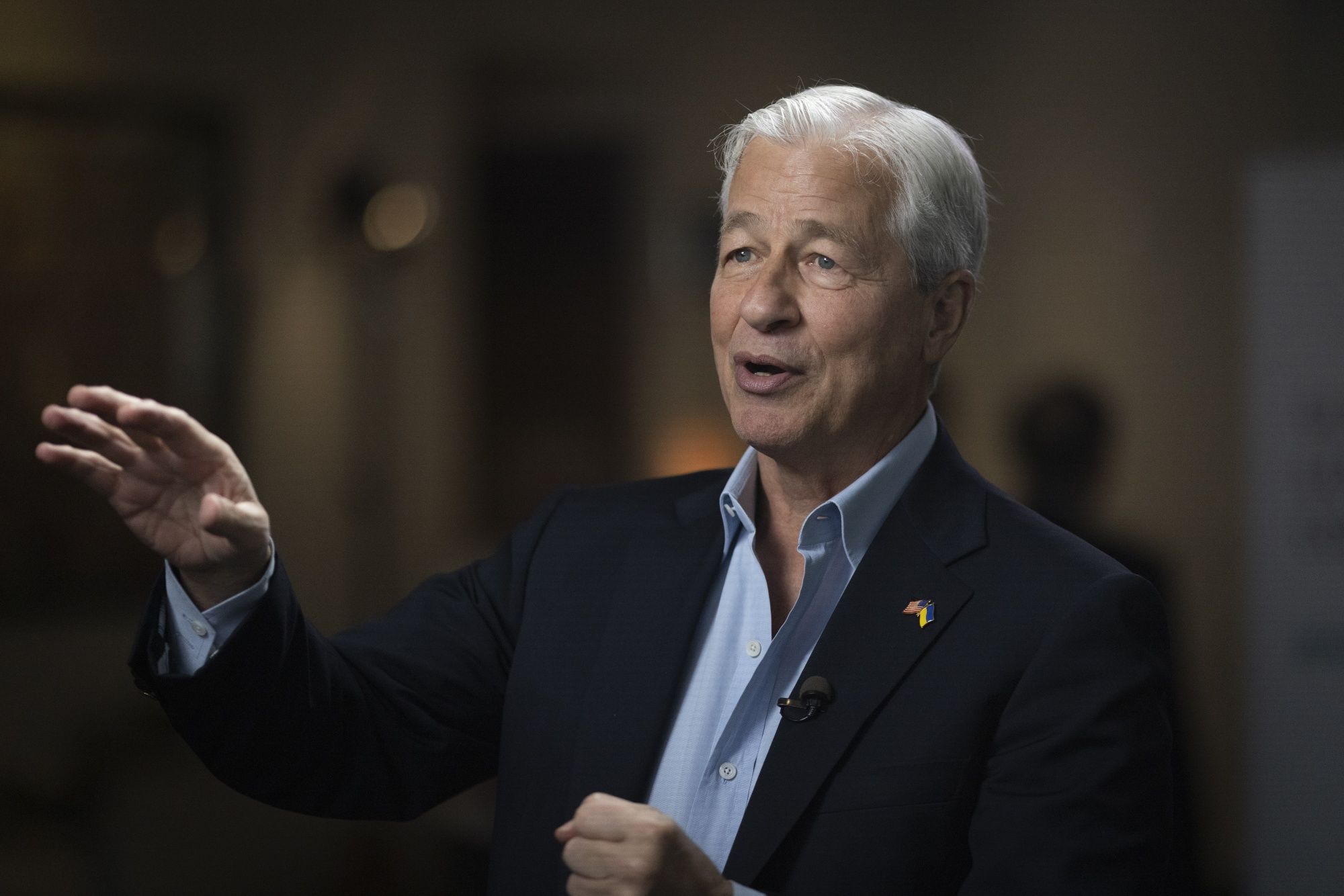
(Bloomberg) -- Silicon Valley Bank's blunders were encouraged by US regulation, went untested by the Federal Reserve and were “hiding in plain sight” until Wall Street and depositors grew alarmed.
That's JPMorgan Chase & Co. Chief Executive Officer Jamie Dimon's assessment of the US banking crisis that sent markets careening last month, an episode he predicts is “not yet over” and will be felt for years. He said US authorities shouldn't “overreact” with more rules.
In his wide-ranging annual letter to shareholders on Tuesday, Dimon described his firm's aspirations for using artificial intelligence and ChatGPT, weighed in on geopolitics, and provided updates on JPMorgan's activities in Ohio. This time, many of his sharpest remarks ripped at regulation, including capital rules that pushed banks to binge on low-interest assets that lost value as interest rates shot up.

“Ironically, banks were incented to own very safe government securities because they were considered highly liquid by regulators and carried very low capital requirements,” Dimon said. “Even worse,” he added, the Federal Reserve didn't stress-test banks on what would happen as rates jumped.
When Silicon Valley Bank's uninsured depositors realized it was losing money selling securities to keep up with withdrawal requests, they raced to pull their cash. Regulators then intervened and seized it.
“This is not to absolve bank management – it's just to make clear that this wasn't the finest hour for many players,” he said. “All of these colliding factors became critically important when the marketplace, rating agencies and depositors focused on them.”
Dimon, 67, has run JPMorgan since 2005 and is now the only big-bank CEO from the 2008 financial crisis still in command. As the industry's most prominent and vocal leader, his annual letter is parsed by bankers, traders and investors for his opinions but also signs of what's to come in the business.
Artificial intelligence is “extraordinary” and will be crucial to JPMorgan's future, Dimon wrote. The bank already has more than 300 use cases for the technology and is exploring ways to “augment and empower employees,” including with ChatGPT, the popular natural language processing tool.
While AI can be helpful in areas such as marketing and spotting risks, it's essential for heading off fraud and defending against attacks on the bank and markets, Dimon said. “Because you can be certain that the bad guys will be using it, too,” he said.
‘Free-Market Capitalist'
In a section unveiling JPMorgan's newly stated purpose — “make dreams possible for everyone, everywhere, every day” — Dimon wrote that “lest anyone think that I've become a little soft, rest assured your CEO is a red-blooded, patriotic, free-enterprise and free-market capitalist.”
He also called for governments to consider using eminent domain to accelerate investments in both renewable energy and fossil fuels.
“We simply are not getting the adequate investments fast enough for grid, solar, wind and pipeline initiatives,” he said, urging authorities to make it easier to get permits. “The window for action to avert the costliest impacts of global climate change is closing.”
JPMorgan is looking to ease the impact of rules that require it to hold more capital, exploring business lines that require little or none, Dimon said. That can include expanding in trading analytics or even travel. The bank is more rigorously evaluating the clients it does business with, he added.
Complex regulation is pushing banks out of the mortgage business by driving up the cost of making and servicing loans, while also increasing legal liability, Dimon wrote. JPMorgan is “hanging on,” but many banks have already gotten rid of much of this business, he said. Wells Fargo & Co. announced earlier this year that it's scaling back mortgage operations dramatically.
This year's letter spans 43 pages, one fewer than last time. Just over halfway through, Dimon assured readers the board isn't neglecting planning for his potential successor.
“It is on the agenda every time board members meet — both when they are with me and when I am not in the room,” he wrote. “You can rest assured that our board members are on the case and are very comfortable with where we are.”
More stories like this are available on bloomberg.com
©2023 Bloomberg L.P.

-
The Economic Imperative: Analysing The Material Driving Force Behind India-Canada Strategic Reset

This economic complementarity is further reinforced by deep institutional investment ties and talent mobility, which form the bedrock of the bilateral framework.
-
Medicine Pricing: Where Must Profit Stop?
India must confront excessive margins, hidden incentives and regulatory gaps that threaten the integrity of medicine.
-
Why Amazon And Flipkart Are Struggling To Beat Meesho In India's Smaller Cities
With 274 million users and lowest-cost logistics, Meesho is defending its value commerce crown against giants like Amazon and Flipkart.
-
High US Salaries, No Green Card Certainty: The Financial Calculation Facing Indian H-1B Families
The suspension of PERM processing at eight technology employers does not cancel existing H-1B visas. What it does is force a question many Indian families have been avoiding: is the US salary worth tying your career and family plans to one employer?
-
Swiggy vs Eternal: Food Delivery's Two Rivals Are No Longer In The Same Race
Eternal is building a private AI assistant, dark.ai. Swiggy is still working out how to make Instamart pay, with an operating loss of Rs 895 crore in the July-September quarter while Blinkit stayed profitable.
-
Where You Live Shapes How You Get To Work | The Reason Why
Two-wheelers are the most popular way to get to work in India, accounting for nearly 43% of workplace commutes.
-
Unhedged Position: Can India See An Indonesia-Style Time Correction?
The Nifty is trading below levels it first clocked in 2024. Is there, then, as I have suggested in the headline, potential that the current time correction drags on painfully for the next three-five, even ten years?
-
Navigating Friction And Energy Realities: An Analysis Of Marco Rubio's October Visit To India
Occurring at a critical juncture marked by stalled trade negotiations and escalating geopolitical pressures over global energy supplies, the visit offers a profound window into modern US-India relations.
-
India Exports Capital. Why Not Export Trusteeship?
The big question, then, is whether India can build an institution that global borrowers, investors, banks, and lawyers can trust, even without an Indian connection.
-
France's Economy & Politics Are In Crisis | The Reason Why
Let's look at how the French economy and politics evolved under Nicolas Sarkozy, Franois Hollande and Emmanuel Macron.










