Israeli start-up seeks to end international roaming charges
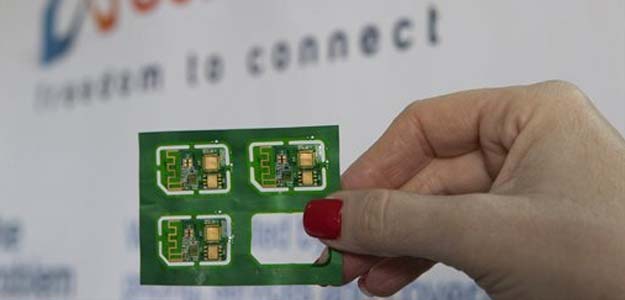
An Israeli startup is trying to combat a common fear for international travelers: getting socked with hundreds or thousands of dollars in unexpected roaming charges for using cellphones away from home.
Cell Buddy aims to turn any smartphone into a local one. Travelers can choose from an array of calling and data plans with carriers in dozens of countries. As a result, they pay local rates - not the pricey fees charged by their wireless carriers at home.
Here's how it will work once the service starts next year: Customers use a universal SIM card provided by Cell Buddy. Travelers turn on their phones and launch a Cell Buddy app once they reach their destination. The app finds local carriers and lets travelers compare prices, data packages, download speeds and other factors. Travelers are assigned a local phone number and can continue to use their regular phone number back home, at regular prices, using the same SIM card.
One major caveat: Cell Buddy's SIM works only with unlocked phones, making it difficult for American travelers who have phones still tied to two-year service contracts. Those phones are locked and won't accept other SIM cards. In addition, Verizon and Sprint use the CDMA cellular standard, and some phones won't work with the more common GSM networks elsewhere.
Cell Buddy's service eliminates the need to order a roaming plan ahead of time, stand in line at the airport to buy a local SIM card or physically switch the cards. Most importantly, it eliminates roaming charges to the home carrier.
Profit margins on roaming charges are immense. Avi Weiss, editor of Israel-based Telecom News, estimated the global roaming market at $50 billion a year. Although many companies are beginning to offer ways to avoid that, Weiss said few customers are aware of their options.
"When they come back to their homeland, they get a bill shock," Weiss said.
Cell Buddy is not the first company to take aim at roaming charges. In October, U.S. carrier T-Mobile eliminated texting and data fees in more than 100 countries and capped charges for many international voice calls at 20 cents a minute. British carrier 3 has also begun to cap roaming charges.
Several companies sell global SIM cards with pre-paid service, and Canadian company Roamly makes a pay-as-you go SIM card "overlay" that promises savings of up to 80 percent through partnerships with carriers in some 200 countries.
Unlike the others, Cell Buddy makes no money from actual phone usage. Cell Buddy's founder and chairman, Ofir Paz, said he is simply a middleman who connects users with the carrier best suited to their needs - much the way services such as eBay connect customers with merchants.
"I think the big idea over here is that for the first time we created a marketplace," he said. "We let customers and operators meet, and from one hand, these operators can publish their plans and on the other hand, the customers can purchase plans in a very simple and straightforward way."
To use the service, Cell Buddy charges $60 a year or $5 per day. Although travelers can avoid that by shopping for plans themselves, Paz believes the convenience and low rates make the fees reasonable.
"We're giving everyone ... the freedom to choose a carrier easily," he said.
Weiss said Cell Buddy offers a promising product, but faces many competitors. He also said that roaming fees will likely come down over the long term, as T-Mobile has started to do. The European Union, for instance, is seeking to eliminate roaming charges in the 28-nation bloc by 2016.
"Cell Buddy's solution is very nice, but it will work only a short period," he said. "In the long run, there will be no roaming."
Cell Buddy is in the final stages of testing and hopes to launch the service by the middle of next year. Cell Buddy does not have deals with mobile carriers directly. Instead, it has partnerships with SIM card resellers that, in turn, have such deals. The service will initially work in at least 60 countries, including the U.S., India, China and several others in Europe, Africa and Asia.
Recon Analytics analyst Roger Entner said Cell Buddy's product seems promising from a technical standpoint, thanks to its ease of use and elimination of multiple SIM cards.
"What they are offering seems to be very frictionless," he said. "The less friction you have, the better."
But he questioned the company's ability to set itself apart and attract customers. "How are you going to get people on board?" he said. "They are a middleman for the middleman."
Paz said Cell Buddy is focusing on corporate customers and has already been approached by a number of large companies with frequent travelers. He would not name any. Paz said he plans on turning to the consumer market in 2015.
Entner said the focus on the cost-conscious companies with lots of business travelers, as opposed to the general consumer market, would be a wise strategy.
If successful, Cell Buddy would join a long list of high-tech companies that have earned Israel the nickname "Startup Nation." Paz himself has founded two other successful startups, Peach Networks, an interactive TV company bought by Microsoft Corp. in 2000, and InspireMD, a medical device company.

-
Getting To Work Costs Women More | The Reason Why

It is not just about women paying more than men. It is about women paying much more in cities than in villages.
-
AI Bias In Investing Cannot Be Eliminated, But It Can Be Governed
Framing is a particularly important example as identical financial information presented in terms of gains rather than losses can lead an LLM to reach a different assessment.
-
Joining The Dots | Dark Skies, Steady Diya: Why Hope Holds This Diwali
With war, a weak rupee and foreign outflows weighing on sentiment, policymakers at the NDTV World Summit and market veterans at NDTV Profit Ignite: Diwali Edition offered the same advice: stay invested and filter out the noise.
-
The Curious Case of Equitas Small Finance Bank And A CEO Who Quit For Stock
PN Vasudevan believes persistent investor concerns over a perceived conflict of interest had become a governance overhang on Equitas Small Finance Bank's stock, even as the lender improved profitability and asset quality.
-
Talking Points This Week: AI Cash Burn, A Tiger Comeback And An India That Still Finds Its Own Path
India is not immune to higher oil or tighter global liquidity, yet its earnings base is broader, its domestic policy levers are still available.
-
Foreign Investors Own Half Of HDFC Bank and ICICI Bank. An LTCG Cut Could Matter Most Here
Foreign portfolio investors have US$115 billion parked in HDFC Bank, ICICI Bank. If the government cuts long-term capital gains tax, Jefferies says returning foreign money could land here first.
-
'Never Seen This Level Of Negativity': Sandeep Tandon Says The Next Rally May Be Closer Than You Think
Veteran investor Sandeep Tandon says foreign selling is easing, large-caps are due a comeback and mid-caps are crowded, while he turns positive on gold, power and pharma this Diwali.
-
Indians Stay With Family, Not In Hotels | The Reason Why
India still lacks enough clean, reliable and affordable hotels for budget-conscious travellers.
-
The Economic Imperative: Analysing The Material Driving Force Behind India-Canada Strategic Reset
This economic complementarity is further reinforced by deep institutional investment ties and talent mobility, which form the bedrock of the bilateral framework.
-
Medicine Pricing: Where Must Profit Stop?
India must confront excessive margins, hidden incentives and regulatory gaps that threaten the integrity of medicine.










