Israel, Threatened By Hezbollah, Seeks Solution For Empty North
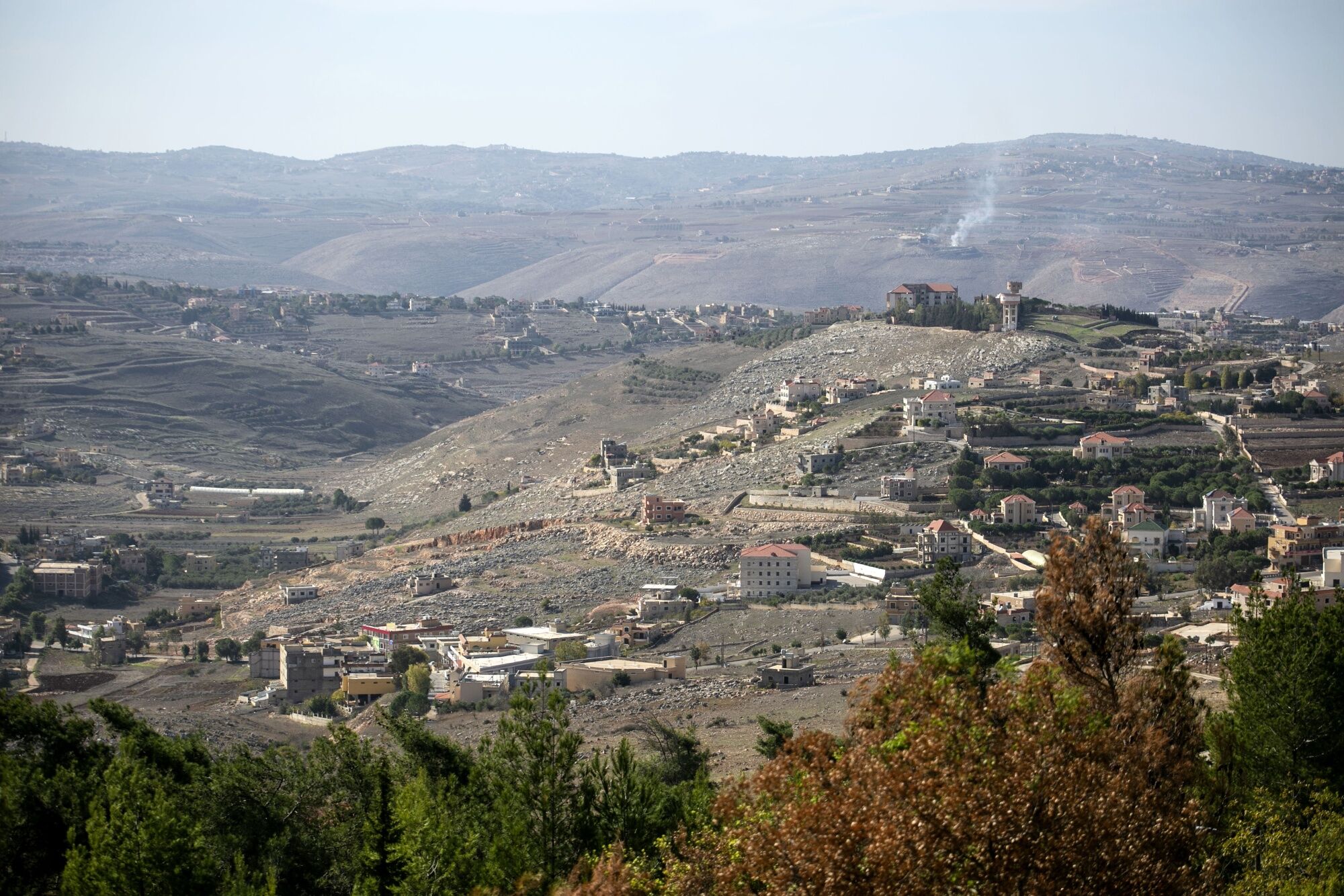
(Bloomberg) -- A winding road in northern Israel lined with vineyards leads to Kibbutz Menara atop the Ramim Ridge in the Naftali mountains where pomegranate and avocado trees grow.
It should be an idyllic scene.
Instead, gaping holes have been blown through the blackened walls of the community's double-story houses. A roof has collapsed and a twisted lump of melted metal denotes what was once a car. For the last few weeks, Islamist militant group Hezbollah has been firing anti-tank missiles into the kibbutz from the Lebanese village of Meiss El Jabal in the valley a few hundred yards below. Other villages in the region have also come under attack and the Israeli military has responded with strikes of its own.

While the world's attention focuses on a resumption in fighting between Israel and Hamas militants in the Gaza Strip in the south, this largely abandoned cooperative highlights an upcoming problem for the embattled Middle Eastern state: How to get the tens of thousands of people who have fled the region to return when an existential threat is in eyesight just across the border.
“Anyone who moves here will get injured. They have no actual security and no sense of security to come back,” Yoshiau, a bearded 27-year-old mechanical engineering student who's also a tank captain in the Israeli military and limited his identification to his first name in line with its rules, said in an interview at the kibbutz. “In order to allow the citizens to come back, we have to have a clear indication from our enemies in Lebanon, Hezbollah, that they have no intention of attacking people.”

The issue has bedeviled Israel since it fought Hezbollah in a 34-day war in 2006. Yet the sense of precarity that farmers and other inhabitants of Israeli villages that line the Lebanese border live with has reached unprecedented levels since Hamas militants poured out of Gaza into Israel on Oct. 7, killing about 1,200 people and abducting another 240.
The Israeli military hit back with air raids that reduced much of northern Gaza to rubble and a ground invasion that Hamas authorities in the Mediterranean strip say have killed more than 15,000 people. Fighting resumed Friday after a seven-day pause that allowed for the exchange of some Israeli hostages and Palestinian prisoners.

The US considers Hamas and Hezbollah terrorist organizations. Hezbollah is bigger and better-armed than Hamas, and they are both backed by Iran and share the aim of eradicating the Jewish state.
United Nations Security Council Resolution 1701, adopted after the 2006 war ended, required the establishment of a demilitarized zone between the Israeli border and the Litani River, about 29 kilometers (18 miles) to the north. It has been widely flouted and so far the international community has done little to enforce it, Eyal Hulata, a former national security adviser in the Israeli government, said in a press briefing on Thursday.
“Hezbollah has planned to do something very similar in the north for years” to the incursion carried out by Hamas, said Yoshiau, the tank captain, who left his wife and 18-month-old son at his home near the border with Gaza a few weeks ago to help guard the northern frontier. There was “an informal cease-fire” with Hezbollah during the temporary truce in the south, he said.
Hezbollah began firing volleys of mortars, rockets and anti-tank missiles at Israel on Oct. 7, the heaviest attacks it has staged since 2006. The military was placed on high alert and fully deployed along the 48-mile-long border.
The ongoing tension was evident on Thursday morning, the day that Bloomberg spoke to Yoshiau, with the military shooting down what it said was “a suspicious aerial target” that crossed from Lebanon into Israel. Cross-border hostilities resumed after the fighting in Gaza restarted.

For now, many of the 250 people who usually live in Kibbutz Menara have decamped to the town of Tiberias, an hour's drive south on the western shores of the Sea of Galilee, where the government is paying for their accommodation.
While the stronger military presence may deter Hezbollah from crossing the border or stepping up its attacks, it's unlikely to convince Israelis who live in the region to come home. Nor will it diminish the threat of Hezbollah's more advanced weaponry, which includes missiles that could strike as far afield as Eilat on Israel's southeastern tip.
The conundrum in the north has been put on the back burner while the military and the government mainly focusing on the war in the south, but the problem isn't going away and is of major concern to some of Israel's most prominent business leaders.
“People will not continue to be on the border with Hezbollah breathing over them and shooting at the fence or the houses with anti-tank missiles,” said Erel Margalit, founder and chief executive officer of Jerusalem Capital Partners, one of Israel's biggest venture capital firms. “Something is going to need to be done about that either diplomatically or militarily.”

The government has begun paying incentives to workers to return to their jobs in the north, topping up their salaries, according to Ron Tomer, president of the Manufacturers' Association of Israel, who says 70 of the group's member companies operate there.
That doesn't address the security question, or provide long-term clarity to those who live along the northern border as to whether they should return.
While Israel, concerned about the reaction of the international community, held back from preemptive ground invasions of both Gaza and Lebanon for years, the Hamas attack “changes that calculus” and once it achieves its aims in Gaza of eliminating Hamas and freeing the remaining hostages that may change, Hulata said.

“Doing what we need in Gaza is difficult enough. We don't need to find ourselves entangled on two fronts,” he said. “I would not propose to any Israeli government to wait again. I think we need to act before it happens to us and prevent another massacre of civilians in any part of Israel.”
Yoshiau, who passed corpses and cars riddled with bullet holes close to his home when driving north to join his unit on Oct. 7, sees no immediate alternative to Israel maintaining an enhanced military presence along the Lebanon border.
“There's no other option,” he said, even as he bemoaned missing key moments in his son's childhood. “We need to be here until we can bring back the sense of security.”
--With assistance from Ethan Bronner, Julius Domoney and Roy Katz.
More stories like this are available on bloomberg.com
©2023 Bloomberg L.P.

-
The Curious Case of Equitas Small Finance Bank And A CEO Who Quit For Stock

PN Vasudevan believes persistent investor concerns over a perceived conflict of interest had become a governance overhang on Equitas Small Finance Bank's stock, even as the lender improved profitability and asset quality.
-
Talking Points This Week: AI Cash Burn, A Tiger Comeback And An India That Still Finds Its Own Path
India is not immune to higher oil or tighter global liquidity, yet its earnings base is broader, its domestic policy levers are still available.
-
Foreign Investors Own Half Of HDFC Bank and ICICI Bank. An LTCG Cut Could Matter Most Here
Foreign portfolio investors have US$115 billion parked in HDFC Bank, ICICI Bank. If the government cuts long-term capital gains tax, Jefferies says returning foreign money could land here first.
-
'Never Seen This Level Of Negativity': Sandeep Tandon Says The Next Rally May Be Closer Than You Think
Veteran investor Sandeep Tandon says foreign selling is easing, large-caps are due a comeback and mid-caps are crowded, while he turns positive on gold, power and pharma this Diwali.
-
Indians Stay With Family, Not In Hotels | The Reason Why
India still lacks enough clean, reliable and affordable hotels for budget-conscious travellers.
-
The Economic Imperative: Analysing The Material Driving Force Behind India-Canada Strategic Reset
This economic complementarity is further reinforced by deep institutional investment ties and talent mobility, which form the bedrock of the bilateral framework.
-
Medicine Pricing: Where Must Profit Stop?
India must confront excessive margins, hidden incentives and regulatory gaps that threaten the integrity of medicine.
-
Why Amazon And Flipkart Are Struggling To Beat Meesho In India's Smaller Cities
With 274 million users and lowest-cost logistics, Meesho is defending its value commerce crown against giants like Amazon and Flipkart.
-
High US Salaries, No Green Card Certainty: The Financial Calculation Facing Indian H-1B Families
The suspension of PERM processing at eight technology employers does not cancel existing H-1B visas. What it does is force a question many Indian families have been avoiding: is the US salary worth tying your career and family plans to one employer?
-
Swiggy vs Eternal: Food Delivery's Two Rivals Are No Longer In The Same Race
Eternal is building a private AI assistant, dark.ai. Swiggy is still working out how to make Instamart pay, with an operating loss of Rs 895 crore in the July-September quarter while Blinkit stayed profitable.










