Is The RBI Overstating Inflation Concerns? The Market Thinks So.
In February, many in the bond market were expecting a cut in rates. But the Reserve Bank of India (RBI) surprised and changed its monetary policy stance from accomodative to neutral.
In April, the bond market expected a status quo since the policy stance has just been altered two months back. But the RBI surprised again and raised the reverse repo rate, which some said was a stealth rate hike.
In both policies, the RBI cited concerns about upside risks to inflation down the line. This, despite the fact that the consumer price index (CPI), which is now the anchor for monetary policy, was running well below the RBI's own projections.
At the end of March, retail inflation stood at 3.85 percent compared to the RBI's projection of close to 5 percent.
On Friday, data for the month of April showed that retail inflation fell further to 2.99 percent. For the current year, the RBI has projected retail inflation to average between 4-4.5 percent in the first half of the year and 4.5-5 percent in the second half of the year.
Soumya Kanti Ghosh, chief economist at State Bank of India thinks inflation will continue to “materially undershoot” the RBI's projections. Ghosh, in a note on Friday, wrote that this would be similar to last year, when inflation settled well below the RBI's projections.
CPI inflation declined to below 3 percent for the latest month. We now expect CPI to stay below 3 percent till July (with a sub 2.5 percent is also a possibility) before moving up, but still staying below 4 percent till October. For FY18, CPI inflation average could thus be 4.5 percent with a significant downward bias. Thus, RBI estimates are again going to be materially undershot for FY18.Soumya Kanti Ghosh, Chief Economist, State Bank of India
Ghosh is not alone in taking that view. Bank of America-Merrill Lynch has long argued that inflation will be lower than projected. The brokerage house has been one of the few to hold on to a rate cut call despite the RBI toughening its stance.
In a note on May 11, before the release of the April inflation data, Indranil Sengupta, economist at Bank of America Merrill Lynch argued the case for a rate cut in August. Three factors were cited to support that contrarian call. First, food inflation would fall following a good rabi harvest. Second, a good monsoon is in the offing because of the receding El Nino. And finally, a stronger Rupee and lower oil prices would bring down imported inflation pressures.
So far, each of those factors have held true.
Also Read: Thirty-Year India Bond Veteran A Rare Bull Seeing A Rate Cut
While the rate cut call remains a one-off, the bond market did see some readjustment in rates on Monday in response to the softer than expected inflation data.
The yield on the old 10-year bond, which closed at 6.91 percent on Friday, slipped to trade at 6.84 percent at noon on Monday. The new 10-year bond, issued for the first time on Friday, slipped from its auction cut-off yield of 6.79 percent to 6.62 percent.
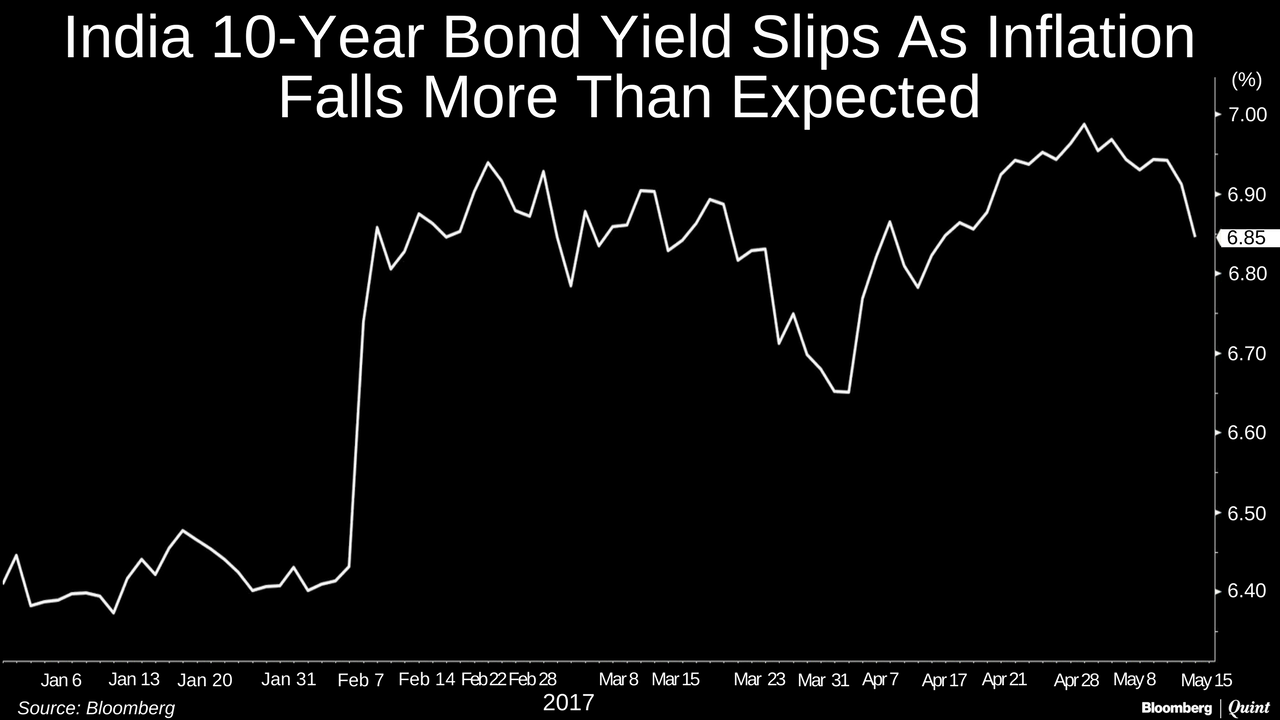
R. Sivakumar, head of fixed income at Axis Asset Management says that while the data has brought yields down, it hasn't yet led to widespread expectations of a rate cut.
The RBI's policy stance will depend on future inflation expectations, said Sivakumar while explaining that there isn't enough reason to believe that sustainable inflation has come down to near 4 percent levels, which is the RBI's medium term target. Core inflation, which eased from 4.8 percent in March to 4.4 percent in April, also still remains elevated. As do inflation expectations which rose in the March edition of the central bank's survey.
Sivakumar, however, adds that the recent data is more in sync with the market's assessment of inflation rather than the central bank's. The move from an accomodative stance to neutral and then the reverse repo hike had confused the market because it was at variance with the trend of inflation as seen in the data, he said.
While the market isn't moving towards an expectation of a rate cut, the lower than expected inflation readings may keep the RBI on hold for the foreseeable future. A rate hike may become necessary only next fiscal, said Nomura Global Market Research in a note on Monday.
We expect the RBI to stay on hold in 2017 as the near-term inflation outlook is benign and as its focus is on resolving the non-performing assets of the banking sector. However, as growth accelerates due to lagged effects of easier financial conditions and as it becomes clear that inflation will continue to stay above its medium-term target of 4 percent owing to still-elevated inflation expectations, we expect the RBI to move towards a tightening policy bias towards end-2017 and hike repo rates by a cumulative 50 basis points in 2018, starting next April.Nomura Global Market Research

-
Talking Points This Week: Leadership Shock At Nvidia, Earnings Strength, And The Fog Over Hormuz

The Anthropic IPO pricing and first trading day, Nvidia's upcoming earnings, and any fresh signals from Iran will set the tone for the following week.
-
Signature Play: The Classic Cocktail Is Dead. Or Is It?
Classic cocktails are disappearing from India's cocktail menus. But they're still being ordered, taught to bartenders and borrowed from. So, who's really having the last drink?
-
A New Samvat Wishlist: Inclusive Prosperity And Human Development
India has strengthened its economic foundations through infrastructure, digital access and enterprise. Its next growth chapter must deepen productivity, create better livelihoods and widen participation in prosperity.
-
Love, Sex Aur Dhokha: The Audacious Plot To Spy On Jensen Huang
A Taipei dinner, a Singapore chip buyer and a suspected Chinese asset: inside the alleged spy operation that got close to NVIDIA's Jensen Huang.
-
Ten Things I Learnt This Samvat
Patience can be a trap. Cheap stocks can stay cheap. Leverage can wipe you out. What did Samvat 2082 teach us? Niraj Shah writes on 10 lessons from the year gone by.
-
Talking Points This Week: Tech Nerves, FII Buying, And A Faraway Banking Shock
The global markets are not shining this Diwali. The exception in the large markets is, India.
-
Midterm Rally Lasted A Day. The Hard Reality Of A Divided US May Last Two Years | Opinion
Between a contested AI boom, a debt ceiling that arrives in 2027 and a president with every incentive to act alone, the next two years may prove more volatile than the first day's rally suggests.
-
Blue Wave Will Derail the AI Trade but Won't Dismantle the AI Era | Unhedged Position
The Democrats' sweep of the US Congress will see politics collide with economic forces both over the long and short term.
-
It's Time To Take The GST Council's Bet On Trust Global
Payment records can prove India's services exports, and clear, proportionate rules can bring foreign digital sellers into the tax net.
-
Opinion | India at 38: From Innovation Overperformer to Innovation Powerhouse
India now has 453 VC-backed deep science startups, 18 of them late-stage, after 117 percent growth since 2020. Laurus Labs, at USD 9.3 billion, is the most valuable deep science company in any middle-income economy outside China.









