Is It The Right Time To Buy A Fallen Angel Like Zomato?
"When we were born, the odds were over 30-to-1 against being born in the United States. Just winning that portion of the lottery, was an enormous plus. We wouldn't be worth a damn in Afghanistan".
These were the words of legendary investor Warren Buffett when he was asked about the role of luck in investing and life. While I couldn't agree more to what he said, Buffett was born in the year 1930 and grew up in the 1950s which coincidently were the best years of the USA.
Well, let's fast-forward to 2021...
Jeff Bezos, the CEO of Amazon, when asked about the prospects of India, remarked, "I predict that the 21st century is going to be the Indian century".
Now that's quite a statement when it comes from one of the richest persons on the planet. Normally, when talking about a country's time, people assign a decade to it. Just like how the decade from the year 2000 to 2010 belonged to China.
However, with statements such as the 21st century belonging to India is quite promising.
It's said that India as a country disappoints both, the optimists, and the pessimists. But if you look at the performance of the benchmark stock market indices - Nifty and Sensex - it's only the pessimists who are going to be disappointed.
While the global markets are near their 52-week lows and reeling under the effects of inflation, the Indian stock markets are 3% away from all-time highs.
It doesn't matter whether foreign investors sell. Retail investors through Systematic Investment Plans (SIP) pump roughly Rs 130 billion every month in Indian equities
Whether you invested in largecaps or bought good quality mid and smallcaps, the majority of investors have created disproportionate wealth over the last 2 years.
However, there is an exception to this. What if you got swayed, followed the fads, and ended up investing in the 'Hot Tech IPOs' in 2021?
Value Destruction In New Age Tech IPOs
(Data source: BSE)
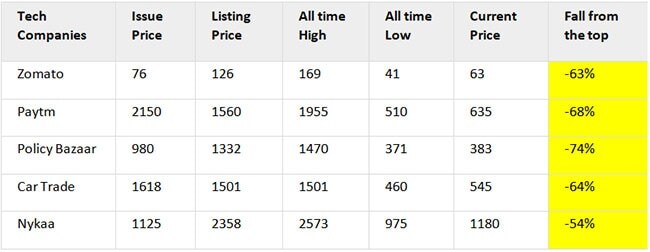
To start with, everything about these new age tech initial public offerings (IPOs) when it came to valuations was wrong.
How can Zomato, a loss-making company that burns cash every year, have a market capitalization of Rs 1.4 trillion at its peak? At the same time, Jubilant foods which sells Dominos Pizzas generating massive profits was trading at half the valuation of Zomato.
How can India's biggest IPO, Paytm, which has one of the most complex business models and tries to do everything at the same time be valued at Rs 1.4 trillion?
If your starting point was wrong, I'm sure the result is not likely to be materially different.
Anyway, in life and investing as they say, the past is past. Post-mortem analysis has no value. What is important is to learn a lesson from your mistakes.
The question to be asked is whether you should buy a stock like Zomato today?
The answer is - Yes and No.
The reason I say this is because it depends on who you are.
Let me explain...
Trader Versus Investor
If you are a long-term investor, then my answer is no.
If your investment style is only fundamental analysis and you derive value of the company by using valuation methods, then my answer is no. It's extremely difficult to estimate future cash flows when the management itself doesn't know when it is going to break even.
However, in stock markets, there are no permanent views about stocks (unless they have a bad corporate governance).
Valuations and earnings are the kings and queens of the market. A stock at price 'X' will be overvalued while the same stock at a 0.5X will become attractive.
As they say, beauty lies in the eyes of the beholder. The same is the case with valuations which are relative.
So, if you are a trader and have the stomach to take risks, then the answer might be yes.
Let us look at it from another perspective. Unfortunately, many of us have fixed ideas towards certain stocks and approach on investing.
Let us look at Zomato from purely a price action perspective.
Marketcap Fall Of 63%
The marketcap of Zomato, at its peak, was Rs 1.4 trillion. Currently, the marketcap of Zomato has fallen 63% to Rs 0.5 trillion.
While a lot of people will try to make projections on when Zomato will be profitable, forecast profitability for the next 10 years, and try to assign an intrinsic value, trust me, it is futile.
Rather let us look at it logically. Zomato a year ago with much worse financials was available at Rs 1.4 trillion marketcap while today that same Zomato with better financials (less cash is being burnt) is available at 60% discount.
Risk Of Insiders And Pre IPO-Funds Selling On Expiry Of Lock-In Past Zomato
The expiry of pre-IPO lock-in saw a massive supply overhang in Zomato. This was responsible for the ferocious fall.
To add to it, initial investors like PE fund Moore and Uber, completely exited Zomato leading to massive supply, taking the stock to an all-time low.
With major PE funds exiting Zomato and their selling being absorbed by domestic mutual funds, the risk of supply overhang doesn't exist for Zomato unlike many of its new listed peers in the platform and tech space.
Improvement In Management Commentary
With the cash burn reducing every quarter due to improvement in financial performance, things are looking way better than estimated.
In fact, the management has guided for adjusted EBITDA break even by end of FY23. The food delivery business in fact, did break even on this metric in the June 2022 quarter itself.
To cut the long story short, while Zomato was an untouchable last year, at 65% discount with better fundamentals today, it's worth exploring for those with an extremely high risk appetite.
After all, in stock markets, Risk hain to Ishq hain.
(Disclaimer: This article is for information purposes only. It is not a stock recommendation and should not be treated as such.)
(This story has not been edited by NDTV staff and is auto-generated from a syndicated feed.)

-
Getting To Work Costs Women More | The Reason Why

It is not just about women paying more than men. It is about women paying much more in cities than in villages.
-
AI Bias In Investing Cannot Be Eliminated, But It Can Be Governed
Framing is a particularly important example as identical financial information presented in terms of gains rather than losses can lead an LLM to reach a different assessment.
-
Joining The Dots | Dark Skies, Steady Diya: Why Hope Holds This Diwali
With war, a weak rupee and foreign outflows weighing on sentiment, policymakers at the NDTV World Summit and market veterans at NDTV Profit Ignite: Diwali Edition offered the same advice: stay invested and filter out the noise.
-
The Curious Case of Equitas Small Finance Bank And A CEO Who Quit For Stock
PN Vasudevan believes persistent investor concerns over a perceived conflict of interest had become a governance overhang on Equitas Small Finance Bank's stock, even as the lender improved profitability and asset quality.
-
Talking Points This Week: AI Cash Burn, A Tiger Comeback And An India That Still Finds Its Own Path
India is not immune to higher oil or tighter global liquidity, yet its earnings base is broader, its domestic policy levers are still available.
-
Foreign Investors Own Half Of HDFC Bank and ICICI Bank. An LTCG Cut Could Matter Most Here
Foreign portfolio investors have US$115 billion parked in HDFC Bank, ICICI Bank. If the government cuts long-term capital gains tax, Jefferies says returning foreign money could land here first.
-
'Never Seen This Level Of Negativity': Sandeep Tandon Says The Next Rally May Be Closer Than You Think
Veteran investor Sandeep Tandon says foreign selling is easing, large-caps are due a comeback and mid-caps are crowded, while he turns positive on gold, power and pharma this Diwali.
-
Indians Stay With Family, Not In Hotels | The Reason Why
India still lacks enough clean, reliable and affordable hotels for budget-conscious travellers.
-
The Economic Imperative: Analysing The Material Driving Force Behind India-Canada Strategic Reset
This economic complementarity is further reinforced by deep institutional investment ties and talent mobility, which form the bedrock of the bilateral framework.
-
Medicine Pricing: Where Must Profit Stop?
India must confront excessive margins, hidden incentives and regulatory gaps that threaten the integrity of medicine.










