Why Indian Millennials Are Pouring Their Money Into Stocks
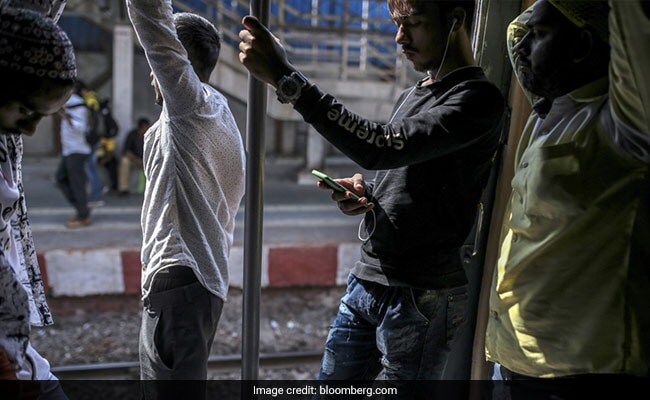
New Delhi: Nithin Kamath, the chief executive officer of India's largest online brokerage, estimates that his platform handles 10 to 12 million orders on the average day. They're increasingly from first-time investors under the age of 30, executing dozens of trades at lightning speed off their mobile phones.
Young investors like those on Kamath's Zerodha Broking Ltd. -- which has come to be known as India's Robinhood Markets Inc. -- helped drive its stock market to records this year, but many are now buying at a time when risks are building up.
India's benchmark S&P BSE Sensex Index rose over 20% in the first 10 months of this year, aided by the central bank's efforts to pump liquidity into the economy. But it's dropped nearly 8% from an all-time high touched in October, partly on expectations that interest rates will rise amid a pick up in economic activity and inflation. Globally, stocks have also been volatile amid concerns about the global spread of the omicron variant.
In recent weeks, brokerages including Goldman Sachs Group Inc. and Nomura Holdings Inc. have lowered their outlook for the Indian stock market, flagging pricey valuations. Meanwhile, a poor debut for the nation's largest ever initial public offering, from digital payments pioneer Paytm, has already left many retail investors with losses.
The more uncertain market outlook means that small investors could face substantial losses in a downturn. But returns on traditional investments like savings deposits remain low, encouraging India's millennials to keep pouring money into stocks.
In the eastern city of Udaipur, Dushyant Rathore, 35, who runs a chain of boutique hotels with his family, says he stepped up his investments in equities during the pandemic after strict lockdowns around the world brought the hospitality industry to a grinding halt.
Rathore's portfolio of stocks is now worth Rs 1.15 crore ($150,000) after doubling in value from March 2020. He isn't pulling back now, and he's even pushing younger cousins and other family members to put some of their savings into equities in small, staggered amounts.
“This is probably one of the best options for someone to create wealth,” Rathore said. “Though business is now slowly picking up as travel resumes, I do plan to maintain my pace of investments.”
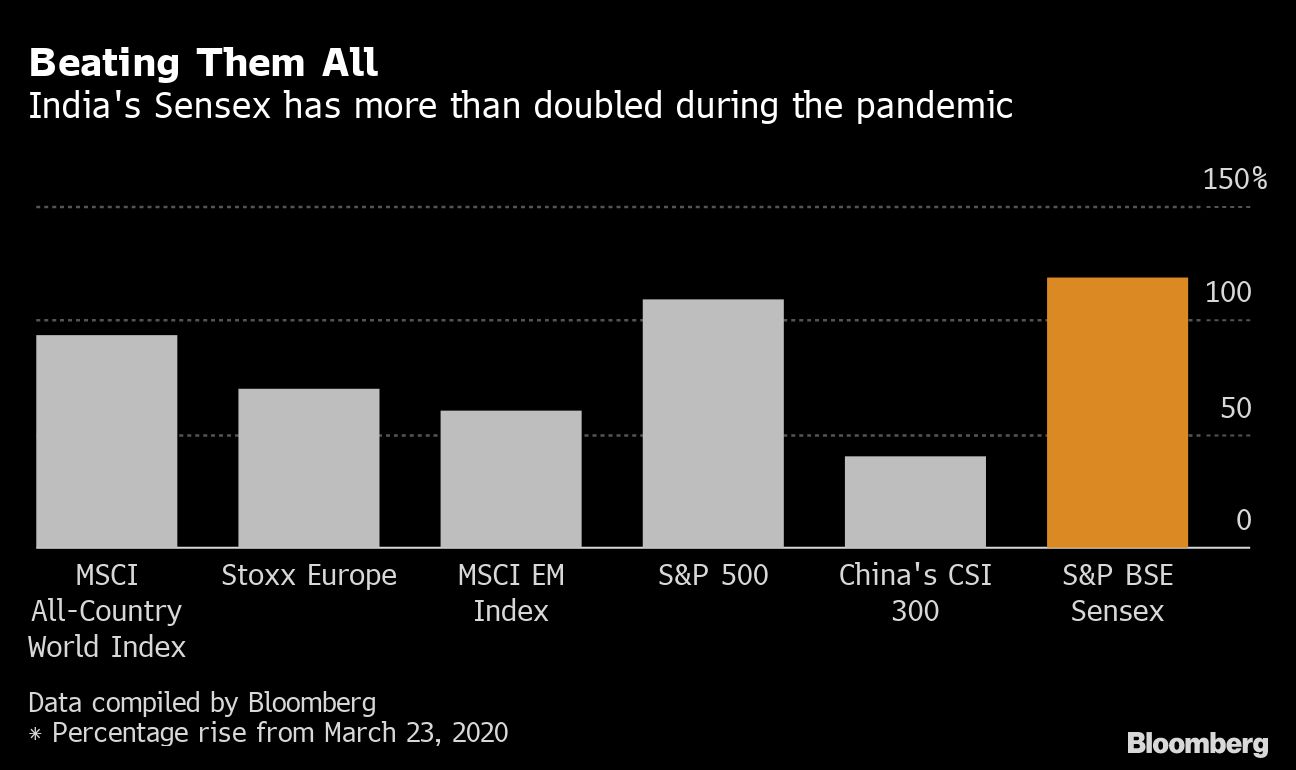
Since a March 2020 low, when stocks plunged worldwide on signs that the coronavirus was spreading globally, India's Sensex has risen about 119%, the highest among countries with stock markets worth $1 trillion or more.
Some analysts see reason for caution. Despite the recent declines, the one-year forward price-to-earnings ratio for the Sensex is near 21, compared to 12.3 for MSCI's Emerging Markets Index, making Indian stocks relatively expensive.
“When people come and tell me that I'm running my monthly household expenses on capital markets, it is a matter of concern,” said Sameer Kaul, managing director of TrustPlutus Wealth India Pvt., which manages nearly Rs 11,000 crore in assets. “The market is not in sync with the real economy and if people think they can make easy money like in a casino, it is a worrying sign.”
Big IPO
Earlier this year, Devashish Pahwa, a 31-year-old entrepreneur in New Delhi's apparel industry, invested about Rs 200,000 from his own and his family's accounts in One 97 Communications Ltd., the operator of Paytm. But the stock has plunged 39% since its listing last month due to doubts over the startup's path to profitability. It reported a wider loss for the latest quarter.
Paytm is a household name in India and Pahwa says he didn't look into its financials as closely as he usually does before investing. “I didn't go through the numbers,” Pahwa said. “That was my mistake. But I'll do more research for future IPOs.”
Pahwa believes there will be a market correction. Although he's become more cautious, he hasn't sold any shares of Paytm or booked profits on his other stock investments, which are worth between Rs 350,000 to Rs 400,000. He also says he will buy into any company that he expects to do well in the coming years, especially when shares are falling since that would make them cheaper.
From Vietnam to South Korea, more families are pumping money into stock markets, but the pace at which India is adding new investors is unprecedented. Retail investors put Rs 86,000 crore into India's National Stock Exchange's cash market this year, compared with Rs 51,200 crore in 2020.
In early 2020, India was adding 400,000 investor accounts every month, according to its market regulator. In 2021, that number has grown to about 2.6 million, about half the population of New Zealand.
Despite the pullback in the Sensex, November was one of the best months for brokerages. Zerodha opened nearly 400,000 new investor accounts last month, while competitors like Angel One and 5paisa.com said they also added similar numbers.
Young investors don't have much to lose, Kamath said. “They have a long path to future earnings. You make mistakes, you learn and you bounce back.”
Despite the recent downturn there may still be room for new investors to jump in. Retail penetration in India's stocks is minuscule compared to other countries.
Indian households invest 7% of financial assets in equities versus an average 30% for other major emerging markets, according to Gaurav Patankar, an analyst at Bloomberg Intelligence. Households in Latin America hold more than 40% in equities, while the U.S. is at 50%.
“At some point, the higher equity returns will stop, but that will not trigger a move back to other assets,” said Ashutosh Tikekar, head of global markets, India at BNP Paribas SA. “The pace at which investors are entering the market may reduce but it will not lead to an exodus.”

-
Joining The Dots | Dark Skies, Steady Diya: Why Hope Holds This Diwali

With war, a weak rupee and foreign outflows weighing on sentiment, policymakers at the NDTV World Summit and market veterans at NDTV Profit Ignite: Diwali Edition offered the same advice: stay invested and filter out the noise.
-
The Curious Case of Equitas Small Finance Bank And A CEO Who Quit For Stock
PN Vasudevan believes persistent investor concerns over a perceived conflict of interest had become a governance overhang on Equitas Small Finance Bank's stock, even as the lender improved profitability and asset quality.
-
Talking Points This Week: AI Cash Burn, A Tiger Comeback And An India That Still Finds Its Own Path
India is not immune to higher oil or tighter global liquidity, yet its earnings base is broader, its domestic policy levers are still available.
-
Foreign Investors Own Half Of HDFC Bank and ICICI Bank. An LTCG Cut Could Matter Most Here
Foreign portfolio investors have US$115 billion parked in HDFC Bank, ICICI Bank. If the government cuts long-term capital gains tax, Jefferies says returning foreign money could land here first.
-
'Never Seen This Level Of Negativity': Sandeep Tandon Says The Next Rally May Be Closer Than You Think
Veteran investor Sandeep Tandon says foreign selling is easing, large-caps are due a comeback and mid-caps are crowded, while he turns positive on gold, power and pharma this Diwali.
-
Indians Stay With Family, Not In Hotels | The Reason Why
India still lacks enough clean, reliable and affordable hotels for budget-conscious travellers.
-
The Economic Imperative: Analysing The Material Driving Force Behind India-Canada Strategic Reset
This economic complementarity is further reinforced by deep institutional investment ties and talent mobility, which form the bedrock of the bilateral framework.
-
Medicine Pricing: Where Must Profit Stop?
India must confront excessive margins, hidden incentives and regulatory gaps that threaten the integrity of medicine.
-
Why Amazon And Flipkart Are Struggling To Beat Meesho In India's Smaller Cities
With 274 million users and lowest-cost logistics, Meesho is defending its value commerce crown against giants like Amazon and Flipkart.
-
High US Salaries, No Green Card Certainty: The Financial Calculation Facing Indian H-1B Families
The suspension of PERM processing at eight technology employers does not cancel existing H-1B visas. What it does is force a question many Indian families have been avoiding: is the US salary worth tying your career and family plans to one employer?










