Investments Key To Ensure Growth In India: Former RBI Governor Subbarao
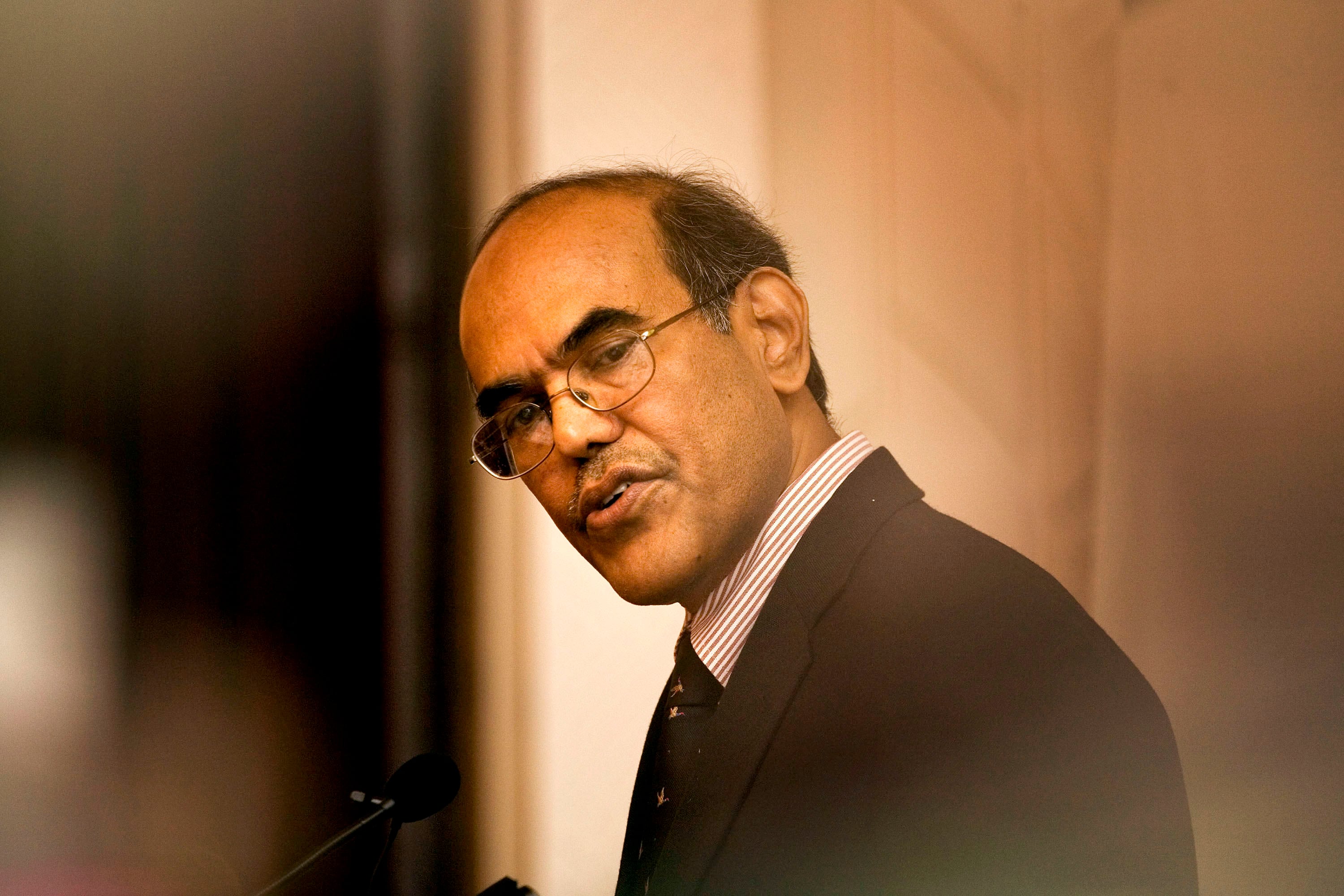
- Investment and growth rate have a strong correlation, former RBI Governor D Subbarao said.
- India's had high growth before the global financial crisis, but that did not continue.
- Job creation on a large scale would happen in manufacturing.
- Creating jobs is something that the government has not done as well as it should have.
Investments, especially in the manufacturing sector, is the key to ensure sustained growth in the country, former RBI Governor D Subbarao said.
"I am sure all of you have read the Economic Survey that was presented to the Parliament last week. What the survey said was that in a situation where you have such low real investment, low export volume, low credit growth, you cannot sustain seven plus percent growth,” he commented.
"So, if you ask me, give a one word answer to what should be done to get India to continue to grow, I would say investment," he said.
Subbarao was speaking at a meeting jointly organised last night by the Rotary Clubs of Hyderabad and the Federation of Telangana and Andhra Pradesh Chamber of Commerce and Industry (FTAPCCI).
Investment and growth rate have a strong correlation, he said.
When we grew at nine plus percent before the global financial crisis, from 2003 to 2008, there was a very high investment. Again after the crisis, growth dropped because investment dropped. Today, there is no investment taking place. So, unless investment is jacked up, it is difficult to accelerate growth.D Subba Rao, Former RBI Governor
On India's Growth
India holds great promise, at a time when advanced economies are struggling with low growth and deflation, but growth in the country is "not inevitable", he said.
"Today, we are growing at seven plus percent. But, that growth has a very narrow base...There is no investment taking place. Exports are quite muted. Inflation is low. But, inflation is low because of low oil prices and low food prices. Low food prices because of the good monsoon. Rupee is steady of course,” he stated.
"But, rupee is steady because of foreign institutional investor inflows. The most important worry for us today is that investment is not taking place," he said.
Some spoke highly about India's growth, before the global financial crisis when the country clocked a growth of nine percent, but the high growth rate did not continue, he said.
Job creation on a large scale would happen in manufacturing and not in agriculture or services sector, added the former RBI Governor.
“…In order to get the elephant (the Indian economy is often compared with an elephant) to dance..., the first thing we should do is invest in manufacturing. Because, manufacturing …is key to creating jobs.”
Where Are The Jobs?
The main thing "everybody pointed out" when the NDA government completed three years in office was its alleged failure to deliver on massive job creation though what was witnessed was "not a jobless growth", he said.
According to him, everybody had pointed out two things, and the two things that the government has failed on or not delivered on are: Jobs and (addressing) agriculture distress.
"So, creating jobs is something that the government has not done as well as it should have. It is not a jobless growth. But, the number of jobs created with seven percent growth, I think has been less than adequate. That's the reason the Prime Minister talks about Make in India, Start Up India, Stand Up India etc," he said.
"There is nothing inevitable about the demographic dividend. ...You cannot get the demographic dividend unless you are able to create jobs, provide jobs for all the people”, he mentioned.
“Today, one million people join the labour force every month and we are not even creating one million jobs per year," he said.
Demonetisation is not the cause for low job creation as it is only a transient event and the causes are "structural", said Rao.
In order to generate a manufacturing revolution, he said, the country needs to do a lot of things, including skill development.
"We produce 400,000 engineers every year. 200,000 engineers are not employable," he quipped.
Investing in infrastructure is another important factor for growth. However, banks are not equipped to finance infrastructure and long term financial institutions like pension funds can do it, he said.
Among others, improving agriculture productivity, investing in irrigation, health and education outcomes, maintaining macro-economic stability, managing urbanisation and environment issues are the things that needs to be done to get the "elephant dance", said Subbarao.
Also Read: Fiscal Outlook For This Year Is Uncertain, Says Government's Economic Survey

-
Getting To Work Costs Women More | The Reason Why

It is not just about women paying more than men. It is about women paying much more in cities than in villages.
-
AI Bias In Investing Cannot Be Eliminated, But It Can Be Governed
Framing is a particularly important example as identical financial information presented in terms of gains rather than losses can lead an LLM to reach a different assessment.
-
Joining The Dots | Dark Skies, Steady Diya: Why Hope Holds This Diwali
With war, a weak rupee and foreign outflows weighing on sentiment, policymakers at the NDTV World Summit and market veterans at NDTV Profit Ignite: Diwali Edition offered the same advice: stay invested and filter out the noise.
-
The Curious Case of Equitas Small Finance Bank And A CEO Who Quit For Stock
PN Vasudevan believes persistent investor concerns over a perceived conflict of interest had become a governance overhang on Equitas Small Finance Bank's stock, even as the lender improved profitability and asset quality.
-
Talking Points This Week: AI Cash Burn, A Tiger Comeback And An India That Still Finds Its Own Path
India is not immune to higher oil or tighter global liquidity, yet its earnings base is broader, its domestic policy levers are still available.
-
Foreign Investors Own Half Of HDFC Bank and ICICI Bank. An LTCG Cut Could Matter Most Here
Foreign portfolio investors have US$115 billion parked in HDFC Bank, ICICI Bank. If the government cuts long-term capital gains tax, Jefferies says returning foreign money could land here first.
-
'Never Seen This Level Of Negativity': Sandeep Tandon Says The Next Rally May Be Closer Than You Think
Veteran investor Sandeep Tandon says foreign selling is easing, large-caps are due a comeback and mid-caps are crowded, while he turns positive on gold, power and pharma this Diwali.
-
Indians Stay With Family, Not In Hotels | The Reason Why
India still lacks enough clean, reliable and affordable hotels for budget-conscious travellers.
-
The Economic Imperative: Analysing The Material Driving Force Behind India-Canada Strategic Reset
This economic complementarity is further reinforced by deep institutional investment ties and talent mobility, which form the bedrock of the bilateral framework.
-
Medicine Pricing: Where Must Profit Stop?
India must confront excessive margins, hidden incentives and regulatory gaps that threaten the integrity of medicine.










