Infosys Is Boring Again, And That's A Good Thing, Says Nandan Nilekani
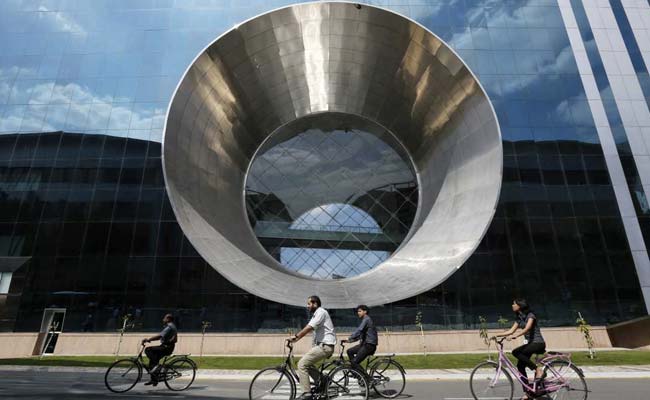
Infosys Ltd. has returned to stability, almost a year after the appointment of a new chief executive ended a tumultuous period at the software and services company. Chairman Nandan Nilekani, speaking on the sidelines of Bloomberg's New Economy Forum in Singapore, said that the turnaround is complete. "This is all very much from the past," he said of the board turmoil that engulfed the company last year. "I've been chairman now over a year. We have an excellent CEO in Salil Parekh. Infosys is really on a very stable and forward-looking path."
Investors seem to agree. The Bangalore-based company's shares are up almost 30 per cent this year, compared with a 3.1 per cent gain in 2017. In the latest quarter, Infosys booked more than $2 billion in deals and net income topped projections. Parekh, who formally took over in January, has focused on stabilizing the company after public wrangles between its board and co-founders culminated in the dramatic exit of the well-regarded Vishal Sikka.
"The future of India's IT services is bright because all over the world, the businesses and even governments are going through a huge digital transformation," Nilekani said. "Be it automobile, retail, financial services, in every industry there is massive reinvention going on."
The same is true for Tata Consultancy Services Ltd., Infosys's bigger rival, which in April became India's first company to top $100 billion in market value in more than a decade. Both are adjusting to the adoption of automation in key areas such as financial services, while immigration curbs hamper its ability to move workers into its largest market of the US. The country's $167 billion-IT services industry is now investing in cloud computing and artificial intelligence to jump-start growth.
Nilekani also pointed to Aadhar, the biometric national ID system, as an opportunity for companies like Infosys as well as a tool of empowerment for individuals. Using iris-scanning technology, the database lets people identify themselves, while private companies have embraced it as a way to authenticate job seekers, blood donors and loan applicants.
"Historically, data has benefited companies and governments," the Infosys chairman said. "India's unique infrastructure, thanks to Aadhar, thanks to its regulations, has the ability for every individual to access his own data and put it to good use. We call that data empowerment, which means a person can use his own data to get a loan, better health care, better education."
The New Economy Forum is being organized by Bloomberg Media Group, a division of Bloomberg LP, the parent company of Bloomberg News.

-
Indians Are Travelling, But Not Every Journey Is A Holiday | The Week In Whys

Pilgrims, patients and working women are the real travellers, and the system hasn't quite caught up with them.
-
Getting To Work Costs Women More | The Reason Why
It is not just about women paying more than men. It is about women paying much more in cities than in villages.
-
AI Bias In Investing Cannot Be Eliminated, But It Can Be Governed
Framing is a particularly important example as identical financial information presented in terms of gains rather than losses can lead an LLM to reach a different assessment.
-
Joining The Dots | Dark Skies, Steady Diya: Why Hope Holds This Diwali
With war, a weak rupee and foreign outflows weighing on sentiment, policymakers at the NDTV World Summit and market veterans at NDTV Profit Ignite: Diwali Edition offered the same advice: stay invested and filter out the noise.
-
The Curious Case of Equitas Small Finance Bank And A CEO Who Quit For Stock
PN Vasudevan believes persistent investor concerns over a perceived conflict of interest had become a governance overhang on Equitas Small Finance Bank's stock, even as the lender improved profitability and asset quality.
-
Talking Points This Week: AI Cash Burn, A Tiger Comeback And An India That Still Finds Its Own Path
India is not immune to higher oil or tighter global liquidity, yet its earnings base is broader, its domestic policy levers are still available.
-
Foreign Investors Own Half Of HDFC Bank and ICICI Bank. An LTCG Cut Could Matter Most Here
Foreign portfolio investors have US$115 billion parked in HDFC Bank, ICICI Bank. If the government cuts long-term capital gains tax, Jefferies says returning foreign money could land here first.
-
'Never Seen This Level Of Negativity': Sandeep Tandon Says The Next Rally May Be Closer Than You Think
Veteran investor Sandeep Tandon says foreign selling is easing, large-caps are due a comeback and mid-caps are crowded, while he turns positive on gold, power and pharma this Diwali.
-
Indians Stay With Family, Not In Hotels | The Reason Why
India still lacks enough clean, reliable and affordable hotels for budget-conscious travellers.
-
The Economic Imperative: Analysing The Material Driving Force Behind India-Canada Strategic Reset
This economic complementarity is further reinforced by deep institutional investment ties and talent mobility, which form the bedrock of the bilateral framework.










