Two Key Things That Keep IndiGo Ahead Of SpiceJet
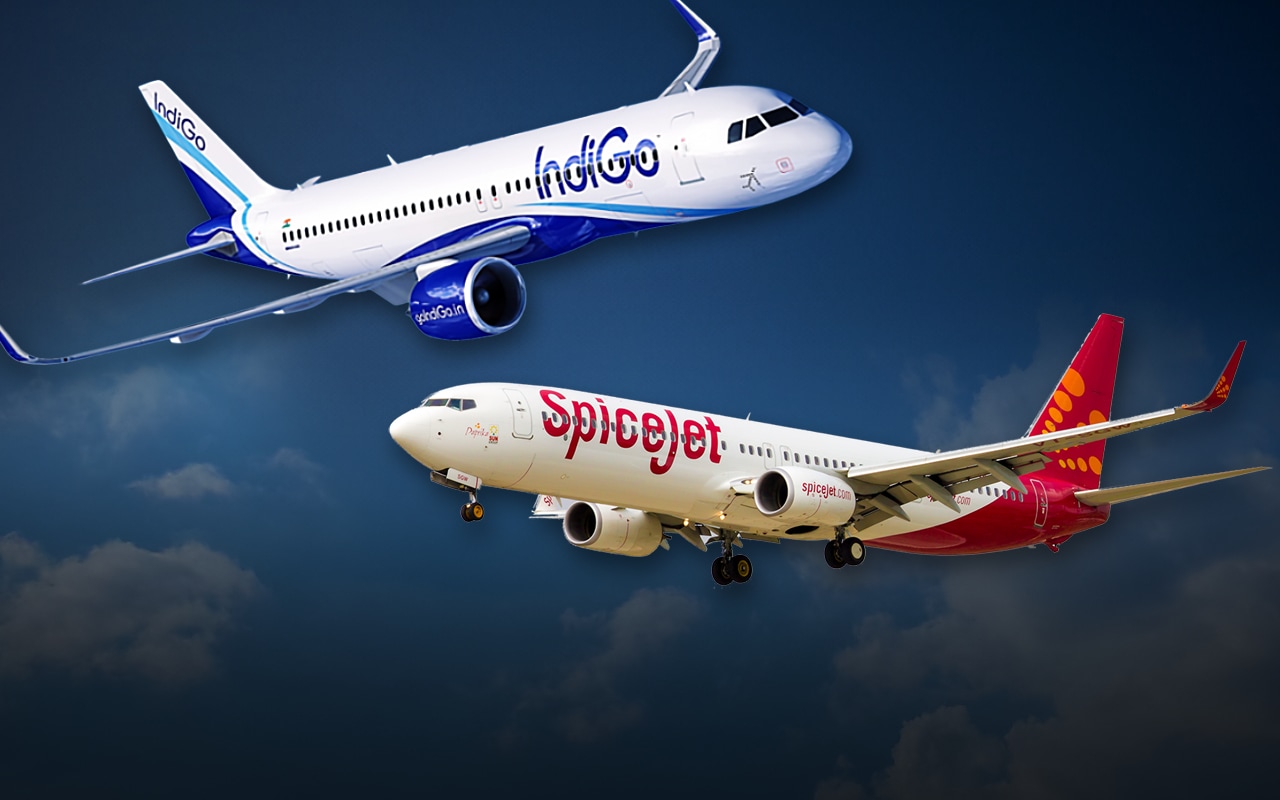
WATCH | Indigo vs SpiceJet
SpiceJet Ltd. has added the most capacity since the grounding of Jet Airways India Ltd. Yet, its larger peer InterGlobe Aviation Ltd. remains better placed operationally in a market grappling with falling yields, volatile costs and engine glitches.
Average fare per passenger per kilometre, or yields, have been falling in India because of higher capacity addition, weak demand and competition in India. Crude prices and the dollar remained fairly volatile. For an airline, cost volatility is high, as 60-70 percent of its expenses are dollar-denominated and fuel accounts for more than a third of its costs.
Both SpiceJet and IndiGo, operated by InterGlobe Aviation, saw costs also rise due to grounding of Boeing 737 Max aircraft and replacement of engines of Airbus A320neos, respectively.
IndiGo, India's largest carrier, scores higher on two key parameters even as SpiceJet is looking to catch up.
Costs
IndiGo's cost per unit is lower than that of SpiceJet. On an average, in the last five quarters, IndiGo's cost per available seat kilometre remained lower by 17 percent, according to data disclosed by the companies. That helped the airline to report profits or pare losses even as yields declined.
These costs could come down as the share of fuel-efficient A320neos and A321 increases in its fleet. To be sure, the aircraft are facing engine issues and IndiGo has said that Airbus has delayed deliveries.
Also Read: Airbus Wins 300-Jet Order From Asian Discount Carrier IndiGo
Cash
IndiGo has a stronger balance sheet with higher free cash on books worth Rs 8,700 crore and a better liquidity ratio—cash-to-sales—of 26 percent. Usually, keeping a fifth of the sales as cash is considered safe for airlines globally.
A stronger balance sheet is even more important for airlines as the operating environment is volatile because of changing costs.
Also Read: Will SpiceJet's Expansion Falter On A Thin Cash Buffer?
IndiGo, with three times the size of SpiceJet, doubled its share in the domestic market in the last five years. Its international share doubled in just a year, and the airline plans to add more capacity on global routes.
International operations act as a hedge against foreign currency movements and help lower costs. That's because fuel used for international flights does not attract any taxes and is cheaper outside India.
IndiGo still aims to grow its overall capacity at more than 20 percent. But it lowered the forecast twice in 45 days and now hopes to increase capacity by 22-23 percent in the ongoing fiscal ending March, down from the original estimate of 30 percent.
What SpiceJet Is Banking On
SpiceJet is expecting the return of Boeing 737 Max aircraft, which were grounded because of global safety issues. The planes are 15 percent more fuel efficient compared to SpiceJet's existing fleet and have 20 percent higher seating capacity.
The airline expects the aircraft to be back in service by the end of January. Boeing, however, has said that additional delays are possible as regulators around the world evaluate the 737 Max, including its proposed software upgrade.
Also Read: Boeing Nears SpiceJet Deal for 737 Max Planes to End Sales Lull
SpiceJet plans to negotiate higher discounts with Boeing, thus boosting sale and leaseback income on aircraft delivery, said Edelweiss Securities in its note. The company also expects compensation from Boeing for the grounded planes in the coming quarters.
SpiceJet has partly offset the 737 Max grounding by adding capacity, aided by the closure of Jet Airways. The Ajay Singh-led airline increased its capacity by more than 50 percent in the second quarter ended September—the most in last four years. That's because, according to SBICAP Securities, it received most of the slots vacated by Jet Airways.
SpiceJet also narrowed the gap with IndiGo on non-fuel costs. The difference fell to 20 percent in the second quarter from 29-30 percent three months earlier. The management targets to bring it down to 10 percent.
And unlike IndiGo, the nation's second-largest carrier has seen a stable management even as founders of IndiGo were engaged in a public quarrel. While that didn't result in any financial impact on IndiGo, it remains an overhang.
Also Read: IndiGo Promoter Dispute Has ‘Zero Impact' On Airline: CEO Ronojoy Dutta
Analysts are more bullish on SpiceJet. The average of 12-month price targets compiled by Bloomberg implies a 32 percent upside of SpiceJet compared with 26 percent for IndiGo.
SpiceJet also has a higher percentage of ‘Buy' ratings because of its lower valuations.

-
The Economic Imperative: Analysing The Material Driving Force Behind India-Canada Strategic Reset

This economic complementarity is further reinforced by deep institutional investment ties and talent mobility, which form the bedrock of the bilateral framework.
-
Medicine Pricing: Where Must Profit Stop?
India must confront excessive margins, hidden incentives and regulatory gaps that threaten the integrity of medicine.
-
Why Amazon And Flipkart Are Struggling To Beat Meesho In India's Smaller Cities
With 274 million users and lowest-cost logistics, Meesho is defending its value commerce crown against giants like Amazon and Flipkart.
-
High US Salaries, No Green Card Certainty: The Financial Calculation Facing Indian H-1B Families
The suspension of PERM processing at eight technology employers does not cancel existing H-1B visas. What it does is force a question many Indian families have been avoiding: is the US salary worth tying your career and family plans to one employer?
-
Swiggy vs Eternal: Food Delivery's Two Rivals Are No Longer In The Same Race
Eternal is building a private AI assistant, dark.ai. Swiggy is still working out how to make Instamart pay, with an operating loss of Rs 895 crore in the July-September quarter while Blinkit stayed profitable.
-
Where You Live Shapes How You Get To Work | The Reason Why
Two-wheelers are the most popular way to get to work in India, accounting for nearly 43% of workplace commutes.
-
Unhedged Position: Can India See An Indonesia-Style Time Correction?
The Nifty is trading below levels it first clocked in 2024. Is there, then, as I have suggested in the headline, potential that the current time correction drags on painfully for the next three-five, even ten years?
-
Navigating Friction And Energy Realities: An Analysis Of Marco Rubio's October Visit To India
Occurring at a critical juncture marked by stalled trade negotiations and escalating geopolitical pressures over global energy supplies, the visit offers a profound window into modern US-India relations.
-
India Exports Capital. Why Not Export Trusteeship?
The big question, then, is whether India can build an institution that global borrowers, investors, banks, and lawyers can trust, even without an Indian connection.
-
France's Economy & Politics Are In Crisis | The Reason Why
Let's look at how the French economy and politics evolved under Nicolas Sarkozy, Franois Hollande and Emmanuel Macron.










