India's Services Exports Industry Has Begun Its Second Innings

The butterfly effect, in popular culture, is when small changes in initial conditions can lead to large-scale and unpredictable variations in the future state of the system. The story of India's IT industry seems to be a consequence of many such effects over the years. Today, it's resilience in the pandemic, and continuing growth has led to a rise in India's share in services globally—a trend that is expected to persist.
India has gained by close to 80 basis points in market share in services exports globally since the onset of the pandemic, according to estimates by Upasana Chachra, chief India economist at Morgan Stanley. Factors such as remote working contributed to the rise. While there will be some slowdown in annual terms owing to slower global growth, market share gains tend to be sticky and will provide a cushion, Chachra said.
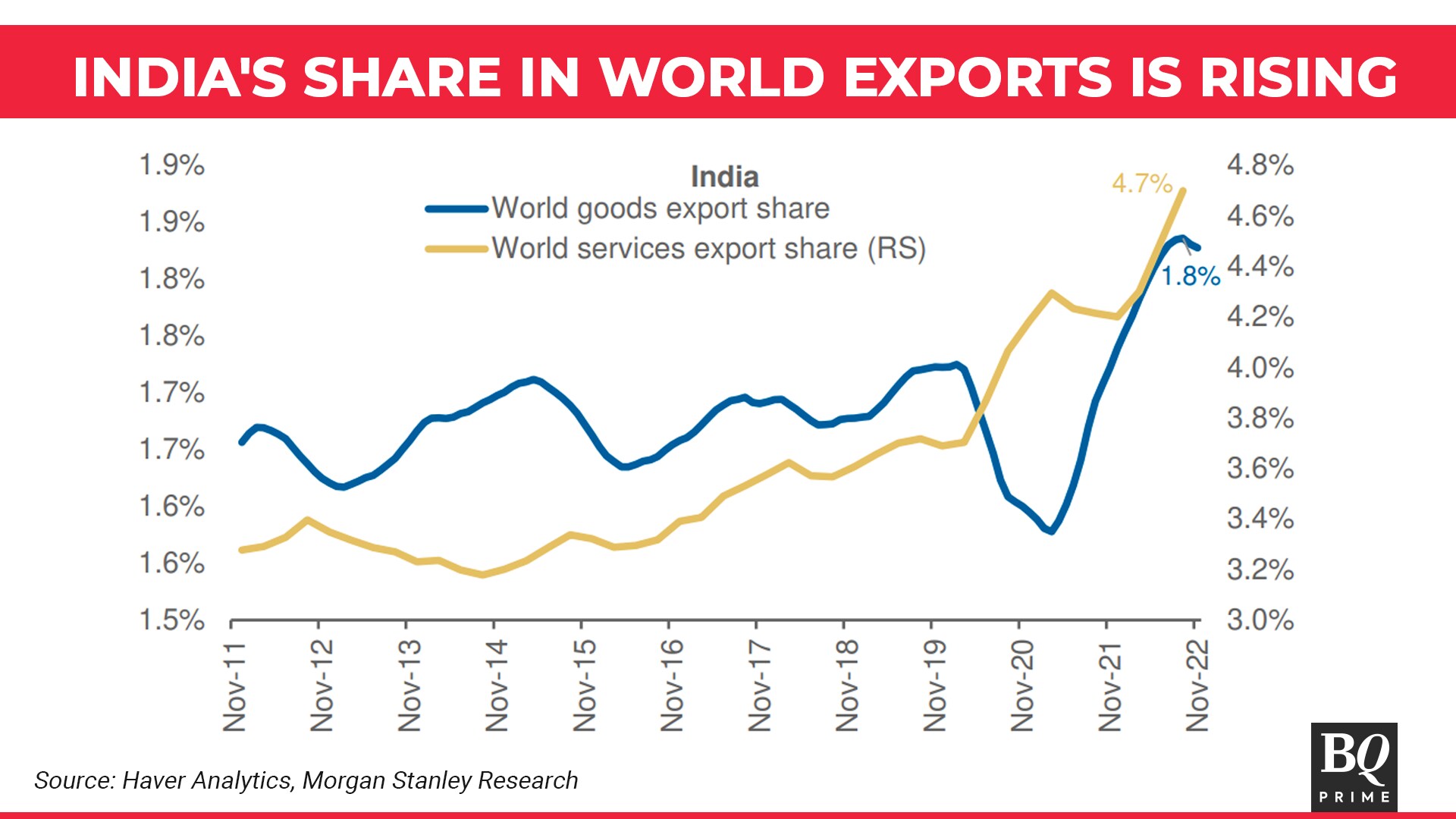
India's services exports have remained resilient during the Covid-19 pandemic and amid current geopolitical uncertainties, driven by higher demand for digital support, cloud services, and infrastructure modernisation catering to new challenges, according to the Economic Survey. A further increase in the share is likely, with the services exports registering a growth of 27.7% in April-December 2022 compared with 20.4% in the corresponding period a year earlier.
Beyond the next two years, the outlook looks exciting as tech penetration spreads, according to a note authored by Pranjul Bhandari, chief economist at HSBC. The National Association of Software and Service Companies has a target of $500 billion in IT services revenues by FY30. If that comes to bear, the net services exports could rise by $100 billion between FY23 and FY30, Bhandari said.
On a net basis, they now rake in $60 billion a year more in revenues than in the pre pandemic period, said Bhandari. That has provided some much-needed relief on the balance of payments front, she added.
"We've always known about India's promising IT sector. But what's driving the recent exuberance? The rise in the revenues of the top IT companies has definitely played a role," said Bhandari. But other IT services exports are rising even more rapidly.
Mid-sized IT firms have been gaining market share, professional and management consulting services exports have grown the fastest at 29% CAGR, followed by computer services at 16%, and research and development at 13%, according to Bhandari.
The one sector that generates revenues under each of these headings has contributed to the fast growth in IT services is the rise in global capability or delivery centres set up by large MNCs, according to her.
The Rise Of Global Capability Centers
What began as a cost arbitrage has now become a key source of high-quality talent and leading-edge innovation. Recognising the value of the Indian demographic dividend, global corporations have set up over 1,500 GCCs in India as of September 2022, according to a research note by EY.
India accounts for over 45% of such centres in the world outside of home country, according to Nasscom. Mirroring the growing maturity of the India software services industry, GCCs today have moved past the “cost centre” stage, it said. They are now increasingly focusing on high-value activities such as IP-creation, building competencies around emerging technologies, setting up centres of excelling and taking full ownership of vendor management.
Speed Breakers Ahead?
After a terrific run, however, it is possible that the pace of increase in India's IT services exports moderates over the next year or two, in line with slowing global growth, Bhandari cautioned.
The Economic Survey, too, cautioned that insofar as India is concerned, some headwinds may be observed in the coming months because of the slowing growth in some of India's major trading partners. Yet, on the contrary, services exports may improve as runaway inflation in advanced economies drives up wages and makes local sourcing expensive, opening up avenues for outsourcing to low-wage countries, including India, it said.
EY sees a long-term opportunity the reliance on technology increases. In the next two decades, it said, as India further gains strength as the world's technology and innovation hub, the share of transformational and more complex, expertise-based services will enable Indian IT sector to grow faster.

-
'Never Seen This Level Of Negativity': Sandeep Tandon Says The Next Rally May Be Closer Than You Think

Veteran investor Sandeep Tandon says foreign selling is easing, large-caps are due a comeback and mid-caps are crowded, while he turns positive on gold, power and pharma this Diwali.
-
Indians Stay With Family, Not In Hotels | The Reason Why
India still lacks enough clean, reliable and affordable hotels for budget-conscious travellers.
-
The Economic Imperative: Analysing The Material Driving Force Behind India-Canada Strategic Reset
This economic complementarity is further reinforced by deep institutional investment ties and talent mobility, which form the bedrock of the bilateral framework.
-
Medicine Pricing: Where Must Profit Stop?
India must confront excessive margins, hidden incentives and regulatory gaps that threaten the integrity of medicine.
-
Why Amazon And Flipkart Are Struggling To Beat Meesho In India's Smaller Cities
With 274 million users and lowest-cost logistics, Meesho is defending its value commerce crown against giants like Amazon and Flipkart.
-
High US Salaries, No Green Card Certainty: The Financial Calculation Facing Indian H-1B Families
The suspension of PERM processing at eight technology employers does not cancel existing H-1B visas. What it does is force a question many Indian families have been avoiding: is the US salary worth tying your career and family plans to one employer?
-
Swiggy vs Eternal: Food Delivery's Two Rivals Are No Longer In The Same Race
Eternal is building a private AI assistant, dark.ai. Swiggy is still working out how to make Instamart pay, with an operating loss of Rs 895 crore in the July-September quarter while Blinkit stayed profitable.
-
Where You Live Shapes How You Get To Work | The Reason Why
Two-wheelers are the most popular way to get to work in India, accounting for nearly 43% of workplace commutes.
-
Unhedged Position: Can India See An Indonesia-Style Time Correction?
The Nifty is trading below levels it first clocked in 2024. Is there, then, as I have suggested in the headline, potential that the current time correction drags on painfully for the next three-five, even ten years?
-
Navigating Friction And Energy Realities: An Analysis Of Marco Rubio's October Visit To India
Occurring at a critical juncture marked by stalled trade negotiations and escalating geopolitical pressures over global energy supplies, the visit offers a profound window into modern US-India relations.










