India's Drone Strategy Could Be A Money Spinner. Here's How To Play It
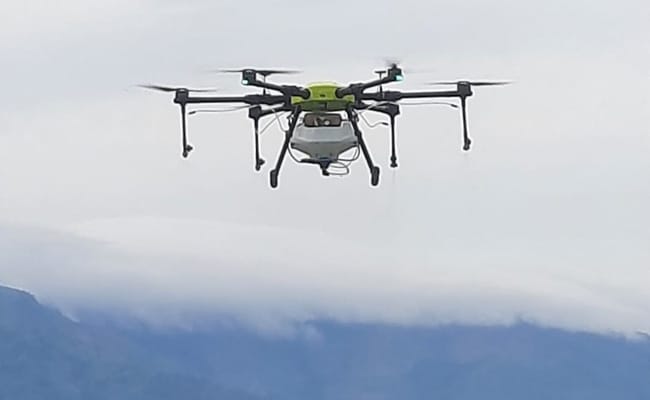
For quite some time now, we've been writing to you about the massive opportunity in drone manufacturing.
You can read our previous pieces on drones, here, here, and here.
In fact, Co-head of Research at Equitymaster Tanushree Banerjee spotted this opportunity over a year ago. She discussed why it's a 4x growth opportunity in drone manufacturing by conservative estimates.
Well, it's official now.
The government has banned import of foreign drones with immediate effect.
The import of any drones, either in completely built up (CBU), or completely knocked down (CKD) / semi knocked down (SKD) forms is now banned. This is massive for drone manufacturers in India as well as startups who are involved in this field.
A few exceptions, however, were made. Drones can still be imported for the purposes of defence, security, and research and development (R&D).
The government, educational institutions, and government recognised R&D entities will still be allowed to import drones in all forms. But they will need to get an import authorisation from the Directorate General of Foreign Trade. This would be provided after consultation with the relevant ministry.
Also, the ban does not apply to the import of drone components.
Why did the Indian government ban import of drones?
The move is aimed to promote domestic manufacturing of drones in India. India currently imports most of its drones and components from China and other countries. Indian drone manufacturers will no doubt have a grin on their faces now.
This move has also opened a door of opportunities for new drone companies in India. Their potential customers will now have to buy drones from them rather than global firms.
The government is doing everything it can to encourage local manufacturing of drones to become self-reliant as a part of its Make in India program.
How did the Industry React?
The drone industry was pleased.
Here's the official response of Garuda Aerospace...
It is a great move by the government. We are now getting calls from various companies on exploring opportunities. Now drone users/operators would have to deal with those having drone manufacturing facilities.
The city-based Drones-As-A-Service (DaaS) startup is putting up drone assembly units at Manesar in Haryana's Gurugram and Tamil Nadu's Hosur at an outlay of $3 million.
This is what Aarav Unmanned Systems said...
Very encouraging news for the India drone ecosystem. With so many socially impactful use cases across the country, how long can we rely on borrowed technology and expertise?
We see this import ban as a powerful step in making India self-reliant. And there is a huge potential for India to become a big exporter of drone technology in the near future.
Here's co-founder of Skye Air Mobility, a drone delivery tech company…
If you see the fine details of the notification, it is a good thing for us. They have actually given clarity on the import of components. Earlier, there was none.
The Immense Potential of Drones
Today, drones are not just used for security and defence purpose. There are many non-defence uses.
Various companies are changing their stance and adopting drone technology.
Take the mining sector, for instance. These companies are spending heavily to equip themselves with drones for regular business operations.
Then there's oil exploration companies like Indian Oil Corporation (IOC), which plan to use drones to monitor pipelines for safe operations.
There's agriculture companies like Dhanuka Agritech making large investments to promote the use of drone technology in the agriculture sector to boost crop production.
Zomato and Swiggy have already tested deliveries via drones.
Logistics companies can't rule out drones as they help deliver essentials including vaccines from one place to another in a short span.
Drones also help telecom companies maintain telecom towers and survey potential new tower locations.
These were just a few examples. Other companies have also deployed drones.
As you can see, drones are now used even by civilians as it offers multiple use cases. This just goes on to show the massive opportunity drones provide.
You better start believing that drones are here to disrupt the market.
Drone Manufacturers get Wings to Fly
This is not the first time the government has given drone manufacturers wings to fly.
The import ban on drones follows the New Drone Rules 2021. This eased many norms on registration and operation of drones in India. It also rules reduced compliances and fees required to operate drones.
Then came the production linked incentive (PLI) scheme worth Rs 1.2 bn to boost the manufacturing of drones in India.
On a conservative estimate, the PLI scheme for drones would generate investment of over Rs 50 bn and 10,000 direct jobs in India's drone manufacturing sector till fiscal 2024.
It will also boost the total turnover of the domestic industry to Rs 9 bn in the next three years.
Most recently, in her Budget 2022 speech, Finance Minister Nirmala Sitharaman also mentioned a big mission for Drones - Drone Shakti, aimed at making India a drone hub by 2030. This initiative will help make India's drone sector a US$5 bn market.
A new integrated office is to be opened in the ministry of civil aviation to facilitate faster growth, coordination and approvals for drones.
Slowly and steadily, the government is giving wings to the defence sector by imposing ban on certain items. Like last year, the Ministry of Defence (MoD) had announced a "Positive Indigenisation List" of 108 items of defence equipment that must be sourced locally.
Since December 2021, out of the 108 items, 49 items were banned for import and 21 would not be imported any more after the end of 2022. The remaining items will be banned entirely by 2025.
All this bodes well for defence manufacturers that are setting up capacities to meet demand.
Top Drone Companies in India
We first wrote to you about the 4 Indian companies in the exploding drone market last year.
In that piece, we mentioned these 4 companies to watch out for...
#1 Info Edge (India)
#2 DCM Shriram Industries
#3 Zen Technologies
#4 RattanIndia Enterprises
A few months later, we provided a detailed update on the plans of these companies.
Since then, there are a lot of companies who have ventured into or planning to enter the drone market.
For instance, Infosys is invested in a drone-startup ideaForge since 2016. L&T also entered into a pact with ideaForge two years back to offer drones and allied systems for defence use.
The newly listed Paras Defence, via its subsidiary Paras Aerospace, has tied up with a few drone manufacturers in Israel, Latvia, & Italy.
Even big corporates Adani and Reliance have big plans.
Reliance Industries has put together an aggressive plan to build its drone business which includes expanding manufacturing capacity five-fold, participating in the new drone PLI scheme, and experimenting with limited logistics payloads to deliver goods.
Reliance will be carrying out its drone business through a Bangalore-based startup, Asteria Aerospace, in which Reliance has taken a majority stake. Asteria is a subsidiary of Jio Platforms.
In the unlisted space too, startups are getting good funding. The recent budget gave a boost to startups and covered multiple aspects for the drone industry. It focused on promoting agricultural drones and the NABARD fund to support startups.
Although at a nascent stage, the industry has a wide scope and looks quite promising. So we're not far away from when India becomes a global drone hub.
Co-head of Research at Equitymaster Tanushree Banerjee summed it up pretty well in here recent editorial on defence stocks.
Here's an excerpt:
Recently, Turkey has developed an impressive local drone industry from the ground up. Armed Turkish-built drones have proven themselves in combat operations in Syria, Iraq, and as far afield as Libya. Turkish companies are developing a variety of lethal armed drones.
They range from large, high-flying, bomb-laden ones to very small, low-flying ones that can form deadly swarms.
To put it simply, Turkey has now gained the attention of global defence experts. They believe Turkey could become the Middle East's drone superpower.
The US was the first country to use drones as missiles after 9/11. But Turkey now rivals the US, UK, and China as the world's most advanced drone market.
And all of this happened in the last six years.
Like India, Turkey too relied on defence imports for decades. But in 2016, Turkey stopped relying on allies who thought it was in an arms race with the US and other NATO countries. Developing its own military drones became a top priority.
And the results are there for all to see. Companies like Boeing and Lockheed Martin acknowledge that the technology in Turkish drones is at par with theirs.
So, the boom in Indian defence manufacturing sector is not far away.
You can read the entire piece here: War or Not, Defence Stocks are Set to Boom.
Happy Investing!
Disclaimer: This article is for information purposes only. It is not a stock recommendation and should not be treated as such.
(This article is syndicated from Equitymaster.com)
(This story has not been edited by NDTV staff and is auto-generated from a syndicated feed.)

-
Getting To Work Costs Women More | The Reason Why

It is not just about women paying more than men. It is about women paying much more in cities than in villages.
-
AI Bias In Investing Cannot Be Eliminated, But It Can Be Governed
Framing is a particularly important example as identical financial information presented in terms of gains rather than losses can lead an LLM to reach a different assessment.
-
Joining The Dots | Dark Skies, Steady Diya: Why Hope Holds This Diwali
With war, a weak rupee and foreign outflows weighing on sentiment, policymakers at the NDTV World Summit and market veterans at NDTV Profit Ignite: Diwali Edition offered the same advice: stay invested and filter out the noise.
-
The Curious Case of Equitas Small Finance Bank And A CEO Who Quit For Stock
PN Vasudevan believes persistent investor concerns over a perceived conflict of interest had become a governance overhang on Equitas Small Finance Bank's stock, even as the lender improved profitability and asset quality.
-
Talking Points This Week: AI Cash Burn, A Tiger Comeback And An India That Still Finds Its Own Path
India is not immune to higher oil or tighter global liquidity, yet its earnings base is broader, its domestic policy levers are still available.
-
Foreign Investors Own Half Of HDFC Bank and ICICI Bank. An LTCG Cut Could Matter Most Here
Foreign portfolio investors have US$115 billion parked in HDFC Bank, ICICI Bank. If the government cuts long-term capital gains tax, Jefferies says returning foreign money could land here first.
-
'Never Seen This Level Of Negativity': Sandeep Tandon Says The Next Rally May Be Closer Than You Think
Veteran investor Sandeep Tandon says foreign selling is easing, large-caps are due a comeback and mid-caps are crowded, while he turns positive on gold, power and pharma this Diwali.
-
Indians Stay With Family, Not In Hotels | The Reason Why
India still lacks enough clean, reliable and affordable hotels for budget-conscious travellers.
-
The Economic Imperative: Analysing The Material Driving Force Behind India-Canada Strategic Reset
This economic complementarity is further reinforced by deep institutional investment ties and talent mobility, which form the bedrock of the bilateral framework.
-
Medicine Pricing: Where Must Profit Stop?
India must confront excessive margins, hidden incentives and regulatory gaps that threaten the integrity of medicine.










