India's Big Problems In Dealing With World's Worst Bad-Loan Mess
A prolonged shadow-banking crisis and hurdles in bankruptcy rules are set to keep India atop the world's worst bad-debt pile, even as Italy, which held the title previously, quickens the clean-up of its lenders.
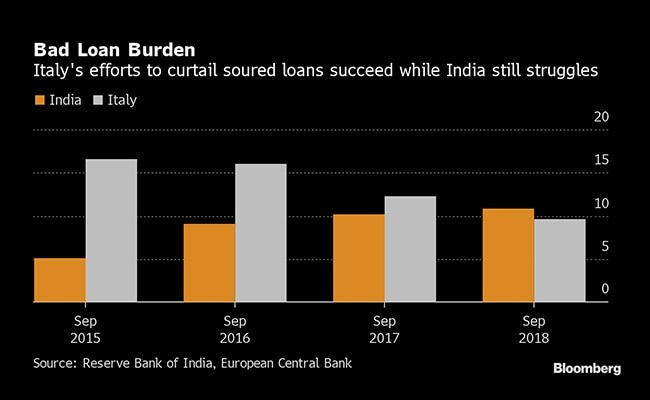
Moody's Investors Service to Credit Suisse Group AG. warned that more loans may sour in the Asian nation's banking system. More than 2.4 per cent of total loans in India's banking system may be under stress on top of the 9.6 per cent bad debt ratio as of June, the highest among major economies, Credit Suisse estimates shows. Italy, on the other hand, has nearly halved its ratio to 8.5 per cent in the last three years.
The failure to slash stressed assets is undermining India's efforts to revive economic growth that has cooled to a six-year low. A cash crunch in the shadow-banking sector that started with the collapse of IL&FS Group last year and the delays in the bankruptcy process are adding to the challenges faced by banks as they seek to tidy up their balance sheets.
"When the economy decelerates like this we will see non-performing loans go up," said Saurabh Mukherjea, founder of investment advisory firm Marcellus Investment Managers Ltd. "You'll see more bad loans come through as we approach the first anniversary of IL&FS meltdown."
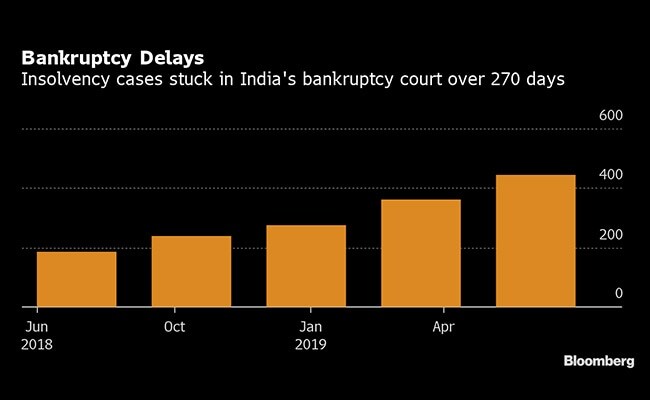
Of the nation's 12 largest delinquent borrowers which Reserve Bank of India asked lenders to push to bankruptcy in 2017, only six have been resolved so far, data compiled by Bloomberg shows. The delays highlight impediments to the process including conflicting regulations and lack of resolution infrastructure, which is derailing a 270-day resolution deadline set by the insolvency law.
Bolstering the pace of resolutions is crucial for Prime Minister Narendra Modi's efforts to spur fresh credit and jump-start the $2.7 trillion economy after growth slumped to 5 per cent in the quarter through June. India has announced a slew of measures including merging weak state-run banks with stronger ones in recent weeks to reverse the economic slowdown and avoid a surge in bad loans.
Meanwhile, Italian banks including Banco BPM SpA., Unicredit SpA and Intesa Sanpaolo have cut the amount of toxic debt on their balance sheets by almost half from a peak of 341 billion euros in 2015, data compiled by PricewaterhouseCoopers shows.
"Delays in the bankruptcy process, changes in stressed asset rules and a slowing economy are hindering India's cleanup efforts," said Mathew Antony, managing partner of Aditya Consulting, an advisory firm that's working with bankrupt companies. "Unlike in Italy, banks in India have been reluctant to sell down bad loans at discounts to tidy up the pile."

-
The Curious Case of Equitas Small Finance Bank And A CEO Who Quit For Stock

PN Vasudevan believes persistent investor concerns over a perceived conflict of interest had become a governance overhang on Equitas Small Finance Bank's stock, even as the lender improved profitability and asset quality.
-
Talking Points This Week: AI Cash Burn, A Tiger Comeback And An India That Still Finds Its Own Path
India is not immune to higher oil or tighter global liquidity, yet its earnings base is broader, its domestic policy levers are still available.
-
Foreign Investors Own Half Of HDFC Bank and ICICI Bank. An LTCG Cut Could Matter Most Here
Foreign portfolio investors have US$115 billion parked in HDFC Bank, ICICI Bank. If the government cuts long-term capital gains tax, Jefferies says returning foreign money could land here first.
-
'Never Seen This Level Of Negativity': Sandeep Tandon Says The Next Rally May Be Closer Than You Think
Veteran investor Sandeep Tandon says foreign selling is easing, large-caps are due a comeback and mid-caps are crowded, while he turns positive on gold, power and pharma this Diwali.
-
Indians Stay With Family, Not In Hotels | The Reason Why
India still lacks enough clean, reliable and affordable hotels for budget-conscious travellers.
-
The Economic Imperative: Analysing The Material Driving Force Behind India-Canada Strategic Reset
This economic complementarity is further reinforced by deep institutional investment ties and talent mobility, which form the bedrock of the bilateral framework.
-
Medicine Pricing: Where Must Profit Stop?
India must confront excessive margins, hidden incentives and regulatory gaps that threaten the integrity of medicine.
-
Why Amazon And Flipkart Are Struggling To Beat Meesho In India's Smaller Cities
With 274 million users and lowest-cost logistics, Meesho is defending its value commerce crown against giants like Amazon and Flipkart.
-
High US Salaries, No Green Card Certainty: The Financial Calculation Facing Indian H-1B Families
The suspension of PERM processing at eight technology employers does not cancel existing H-1B visas. What it does is force a question many Indian families have been avoiding: is the US salary worth tying your career and family plans to one employer?
-
Swiggy vs Eternal: Food Delivery's Two Rivals Are No Longer In The Same Race
Eternal is building a private AI assistant, dark.ai. Swiggy is still working out how to make Instamart pay, with an operating loss of Rs 895 crore in the July-September quarter while Blinkit stayed profitable.










