Indian Companies’ Ability To Pay Interest On Loans Hits New Low
.jpg?downsize=1010:568 "Indian Companies’ Ability To Pay Interest On Loans Hits New Low")
India's corporate debt remained high in the three months ended March as the ability to cover pending interest payments fell to a new low, according to Credit Suisse's Corporate Health Tracker.
Indian companies' total debt stood at Rs 14.5 lakh crore in the fourth quarter, slightly lower than the Rs 14.8 lakh crore in the previous three months, according to the report. While the overall corporate stress level remained largely unchanged, the share of debt with interest coverage ratio of less than one was at 40 percent of the total debt, down 1 percentage point from the previous quarter, the report said.
Interest coverage, the ratio of operating profit to interest expenses, is used to determine how easily a company can service interest payments on outstanding debt. A ratio of one or more means that the company will cover its cost of debt for the year.
Across key sectors, the share of companies with interest cover less than 1 remains high, shows the report.
- Power debt with interest cover < 1 is now at 70 percent of the sample
- Telecom debt with interest cover < 1 stood at 57 percent
- Steel debt with interest cover < 1 was at 55 percent
Weak corporate credit quality has been a key reason for the build up of bad loans across banks. The Indian banking system has been saddled with bad loans, which have risen to about 17 percent of the total loans, the highest among major economies. On Tuesday, the Reserve Bank of India identified 12 stressed accounts for resolution under the Insolvency and Bankruptcy Code, after the government stepped in to give the financial regulator powers to order banks to clean up soured loans on their books.
The report finds that profitability of Indian corporates has remained subdued with their operating incomes falling 4 percent sequentially. Not just that, the weaker companies with interest coverage of less than one have seen their operating incomes fall 35 percent year-on-year.
Credit Suisse sampled 3,700 Indian companies which had an aggregate debt of $540 billion. Aggregate interest coverage of these companies fell to a new low, the report said.
.png)
Power, Telecom, Steel Sectors Overleveraged
The contribution of the infrastructure and metal sectors to the total debt declined in the fourth quarter. However, they still continued to lead the pack with 21 percent and 15 percent of the total debt, respectively. Steel companies continued to report losses even when prices grew steadily over the year. Over half of the steel sector's debt is with companies whose borrowings are over 12 times their operating incomes, the report showed, and have an interest coverage of less than one.
The telecom sector, which has been under the radar for a while, now contributes almost 12 percent to the total debt. The share of the utility sector debt, which is largely dominated by power companies, has also increased to 17 percent in the fourth quarter.
.jpg)
The ‘House Of Debt' Grows Bigger
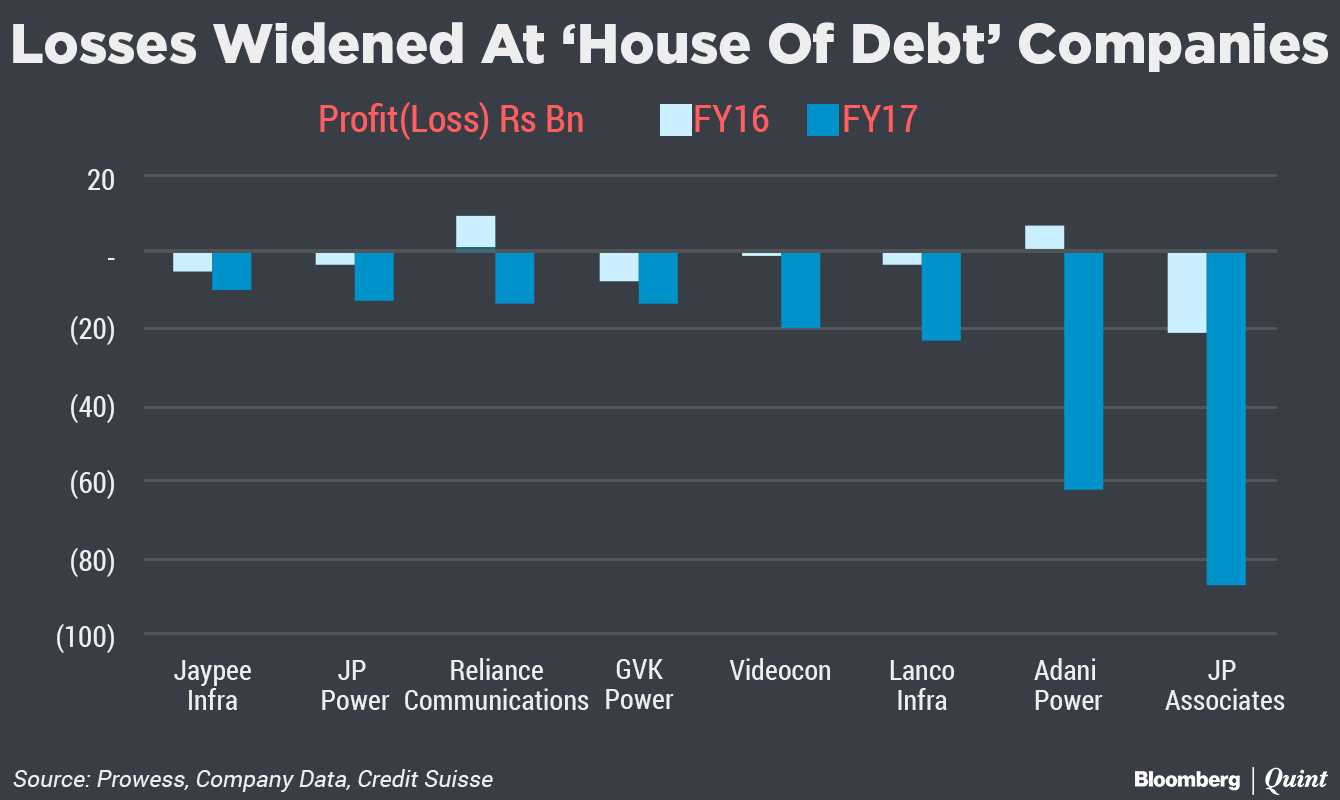
Losses at the biggest debtors among Indian corporates widened, with most of Credit Suisse's ‘House of Debt' companies reporting larger losses. Excluding commodity companies, the net debt of this group increased to over 15 times their operating income in the fourth quarter, compared to nine times in the third quarter. Their interest coverage ratio fell to 0.2 from 0.9 in the previous quarter.
Adani Power Ltd. has seen a sharp decline in profitability with its debt-to-EBITDA ratio increasing to 13 times. Reliance Communications Ltd. and Reliance Defence and Engineering Ltd. continued to see their losses widen. Jaiprakash Associates Ltd. and Jaiprakash Power Ventures Ltd. too reported losses but with the invocation of strategic debt restructuring by its lenders, their aggregate debt has fallen.
GMR Infrastructure Ltd. saw its debt decline as it sold its energy business and its lenders invoked SDR at its subsidiaries GMR Chhattisgarh and GMR Rajahmundry.
Other prominent indebted companies on the list are Lanco Infratech Ltd., Vedanta Ltd., Videocon Industries Ltd, JSW Steel Ltd. and JSW Energy Ltd.
Lenders Are In Control Here
The share of “chronically stressed debt” which has had interest coverage of less than one for over four quarters has declined marginally. This was on account of “non-consolidation of subsidiary debt” in a few stressed companies like Jaiprakash Associates and GMR.
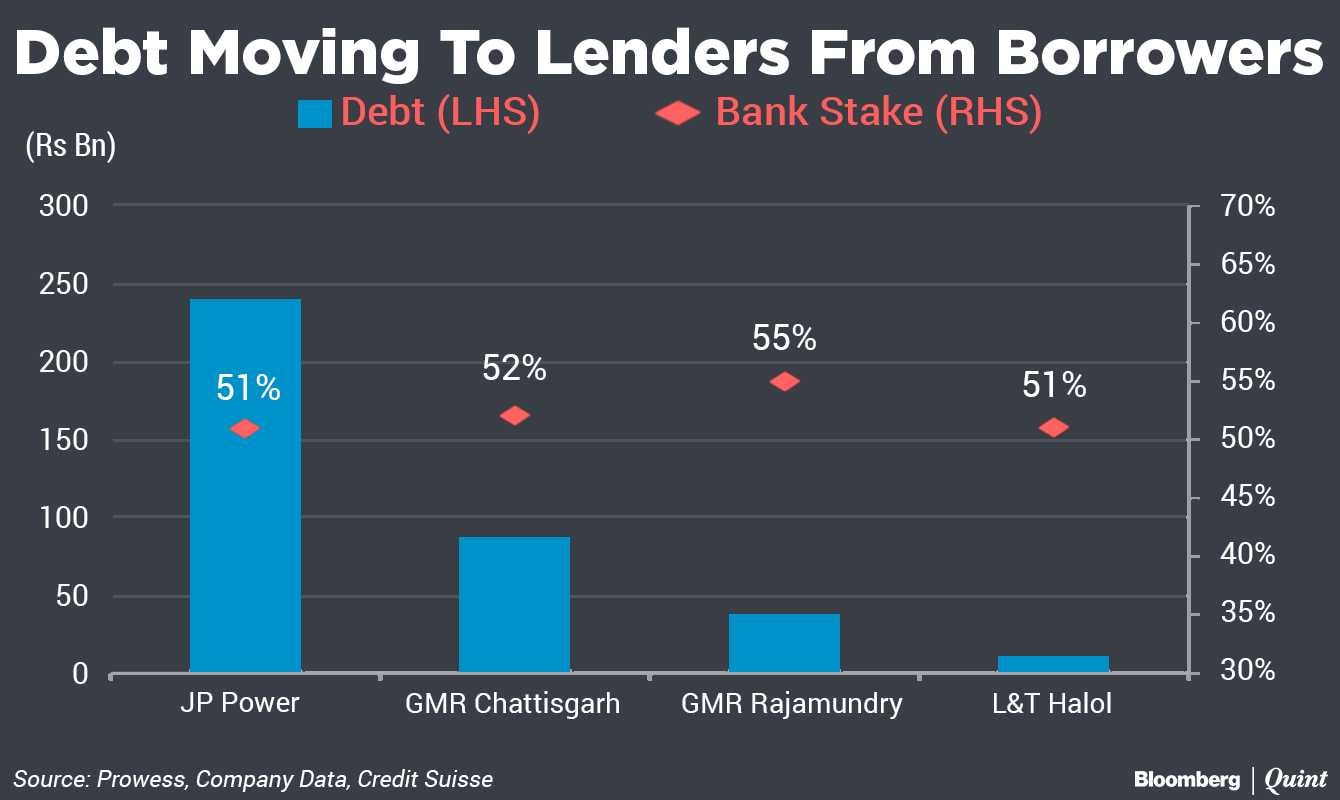
As banks invoked SDR in stressed subsidiaries like Jaiprakash Power and GMR Chattishgarh and Rajahmundry, the debt was converted to equity, giving majority stake to the lenders.
This meant that the debt of the groups as a whole did not go up. The following chart shows the debt of such subsidiaries and the jointly held stake of banks in the companies.
Larger Haircuts Needed
Resolution of non-performing assets will need higher provisioning by banks which have seen bad loans on their books rise to around Rs 7.7 lakh crore, the report said.
Stress levels have turned out to be higher than our original estimates.Credit Suisse India's Corporate Health Tracker
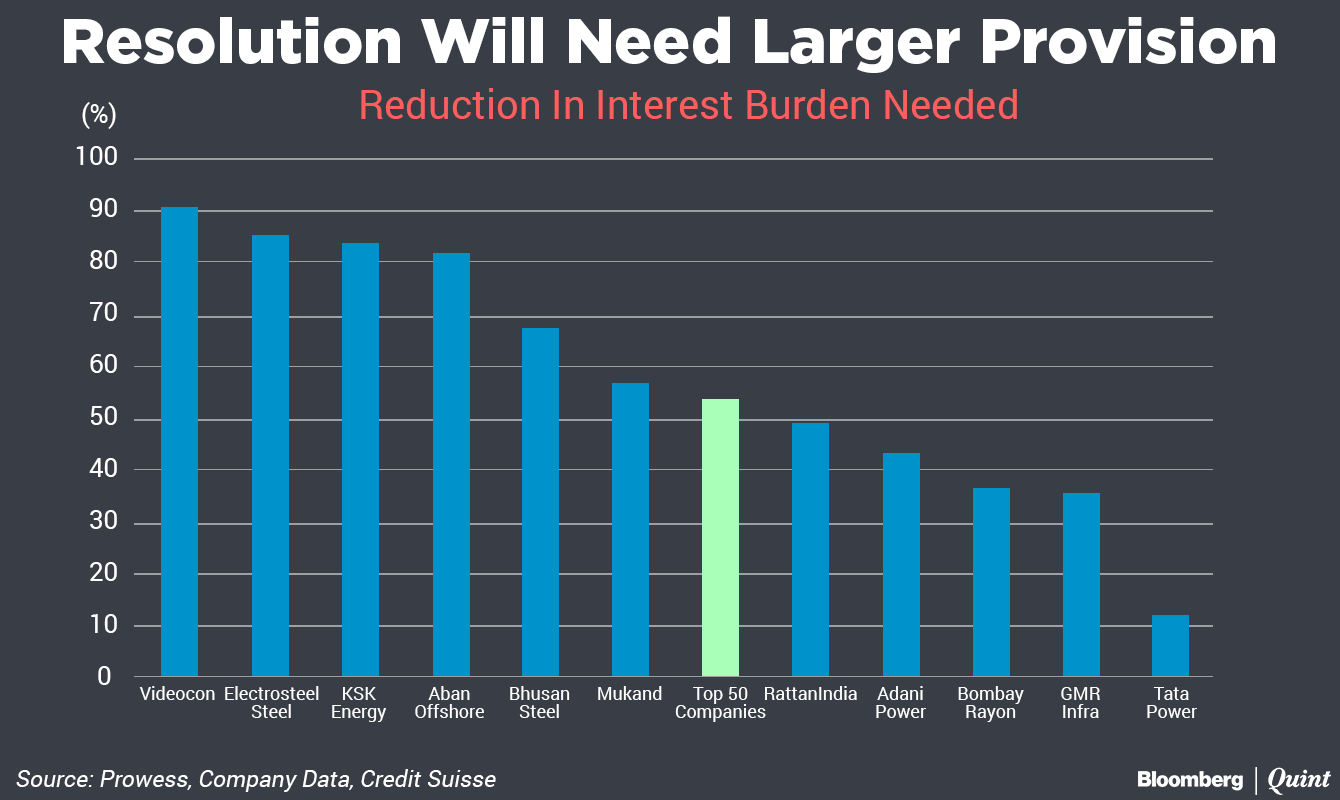
The report suggests that around Rs 1 lakh crore of bad loans in the power sector are still unrecognised. At their current level of profitability, companies would need a 30-80 percent reduction in their interest costs to get their interest coverage ratios to one, and become able to service their obligations for the year.
Videocon Industries, for an instance, would need a 90 percent reduction in interest burden to be able to service its interest payments at current levels.

-
India's Troika Of Good Luck | Joining The Dots

A weaker Trump, a cooling AI trade and resilient earnings have put Indian markets back in favour. Rising inflation could spoil the party.
-
Talking Points This Week: Leadership Shock At Nvidia, Earnings Strength, And The Fog Over Hormuz
The Anthropic IPO pricing and first trading day, Nvidia's upcoming earnings, and any fresh signals from Iran will set the tone for the following week.
-
Signature Play: The Classic Cocktail Is Dead. Or Is It?
Classic cocktails are disappearing from India's cocktail menus. But they're still being ordered, taught to bartenders and borrowed from. So, who's really having the last drink?
-
A New Samvat Wishlist: Inclusive Prosperity And Human Development
India has strengthened its economic foundations through infrastructure, digital access and enterprise. Its next growth chapter must deepen productivity, create better livelihoods and widen participation in prosperity.
-
Love, Sex Aur Dhokha: The Audacious Plot To Spy On Jensen Huang
A Taipei dinner, a Singapore chip buyer and a suspected Chinese asset: inside the alleged spy operation that got close to NVIDIA's Jensen Huang.
-
Ten Things I Learnt This Samvat
Patience can be a trap. Cheap stocks can stay cheap. Leverage can wipe you out. What did Samvat 2082 teach us? Niraj Shah writes on 10 lessons from the year gone by.
-
Talking Points This Week: Tech Nerves, FII Buying, And A Faraway Banking Shock
The global markets are not shining this Diwali. The exception in the large markets is, India.
-
Midterm Rally Lasted A Day. The Hard Reality Of A Divided US May Last Two Years | Opinion
Between a contested AI boom, a debt ceiling that arrives in 2027 and a president with every incentive to act alone, the next two years may prove more volatile than the first day's rally suggests.
-
Blue Wave Will Derail the AI Trade but Won't Dismantle the AI Era | Unhedged Position
The Democrats' sweep of the US Congress will see politics collide with economic forces both over the long and short term.
-
It's Time To Take The GST Council's Bet On Trust Global
Payment records can prove India's services exports, and clear, proportionate rules can bring foreign digital sellers into the tax net.









