India, UK Seek to Wrap Up Trade Talks Before Busy Election Year

(Bloomberg) --
India and the UK have begun crunch-time talks to secure a landmark free-trade deal, as leaders on both sides seek to resolve outstanding issues before they face election battles next year.
A UK team — including Amanda Brooks, director general for trade negotiations, and Douglas McNeill, chief economic adviser to the prime minister — is in New Delhi this week for further talks, according to people familiar with the matter, who asked not to be identified because the discussions are private. It's the 13th round of negotiations on a deal intended to expand a trading relationship that was worth more than $24 billion last year.
The UK Department for Business and Trade declined to comment on Monday. A spokesperson for India's trade ministry didn't respond to an email seeking further information.
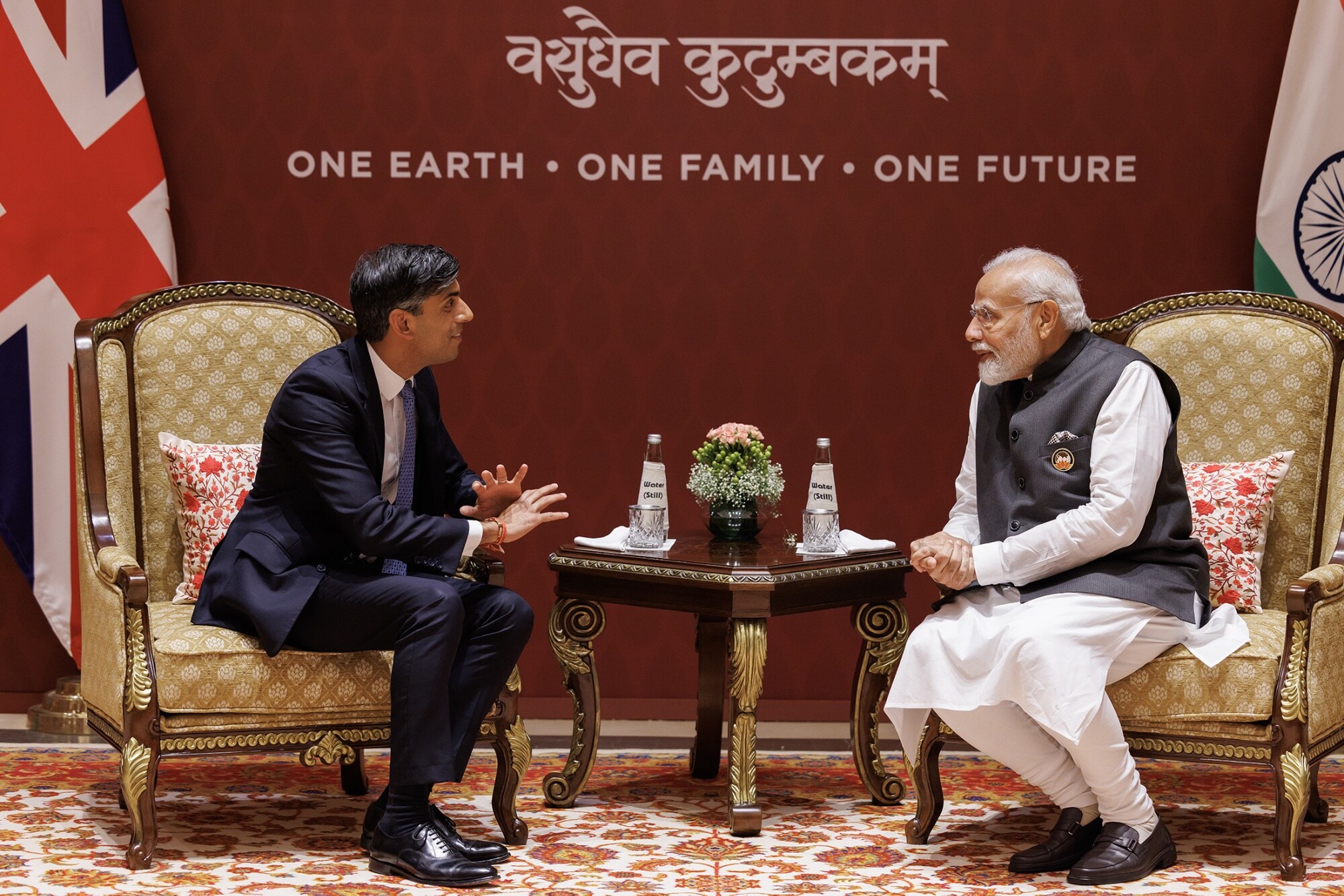
Indian Prime Minister Narendra Modi has a small window to clinch the deal between his big victory in state elections confirmed on Sunday and a nationwide vote next year. The trade deal, which has been under discussion for more than two years, would be India's most ambitious, underscoring the country's growing clout as the world's most populous nation and fastest-growing major economy.
The British premier, Rishi Sunak, is also looking for deeper ties to India to make good on the UK's 2016 decision to leave the European Union. The ruling Conservatives are currently trailing the opposition Labour Party by some 20 percentage points in public opinion polls and Sunak has so far struggled to get the UK's stagnant economy growing.
Officials on both sides have for weeks pointed to December as the best time to wrap up negotiations. While the parties have softened their stance on issues such as scotch whisky and visas for professionals, a handful of topics — ranging from tariffs on electric vehicles to post-study visas for students — continue to hold up a deal.
Here are some of the outstanding issues:
Financial and Legal Services
Indian officials see three sticking points in financial and legal services:
- The UK wants India to allow its portfolio managers and non-life insurance consultants to be able to operate in the South Asian country without having a permanent office there, people familiar with the discussions said. India wants them to have a commercial presence in the country to operate there.
- The UK wants the Modi government to remove a cap on the number of branches its banks can open in India. India restricts market access for foreign banks to 12 branches a year, in line with its commitments under the World Trade Organization.
- The UK also wants greater access for its law firms and legal professionals. Under current laws, foreign law firms in India can advise on international laws and work on corporate transactions such as mergers, but aren't allowed to appear before Indian courts and tribunals.
Rules of Origin
There are some disagreements over rules of origin, which relate to the criteria that determine where a product is made. The UK is seeking lenient rules of origin for its medical devices and a few other items, according to people familiar with the discussions. India wants tighter rules to ensure that the benefits of the FTA are not exploited by other trading partners.
Investment Treaty
India and the UK are discussing a bilateral investment protection and promotion agreement to ensure investors get equitable and predictable treatment and have a mechanism for dispute resolution. The UK wants to include the issue of tax disputes in a proposed pact, although the details weren't immediate clear. Britain's request is shaped by bitter tax disputes faced by some of its firms that invested in India.
Farm Goods
The UK has sought easier market access for its farm goods such as apples and cheese — both of which are politically sensitive subjects in India, where farmers are a crucial voting bloc. For British rice millers, worries are also growing about India's push to have tariffs on white rice reduced. The UK also wants protection for geographical indication tag products, according to reports in local media. GI products are distinctly identified based on their specific geographical origin. After receiving GI status, others can't sell a similar item under the same name. Britain wants GI tags for its cheese, a proposal that India has resisted. The UK is also seeking a GI tag for its whisky, something that India doesn't currently have.
Electric Vehicles
The UK wants a reduction in duties on electric vehicles exported to India. India has proposed a concessional tariff of 30% on 2,500 electric vehicles imported annually from the UK priced above $80,000. Britain has yet to agree to the proposal.
Mobility and Social Security Pact
India wants liberalized rules for post-study visas for young people studying in the UK, a politically difficult request for Sunak as he faces criticism for failing to curb surging migration. Post-study work visas allow students to look for work for up to three years after graduation. New Delhi also wants to reclaim around £8 million ($10 million) in payments made annually by Indian workers toward the UK's social-security system.
--With assistance from Ellen Milligan and Lucy White.
More stories like this are available on bloomberg.com
©2023 Bloomberg L.P.

-
'Never Seen This Level Of Negativity': Sandeep Tandon Says The Next Rally May Be Closer Than You Think

Veteran investor Sandeep Tandon says foreign selling is easing, large-caps are due a comeback and mid-caps are crowded, while he turns positive on gold, power and pharma this Diwali.
-
Indians Stay With Family, Not In Hotels | The Reason Why
India still lacks enough clean, reliable and affordable hotels for budget-conscious travellers.
-
The Economic Imperative: Analysing The Material Driving Force Behind India-Canada Strategic Reset
This economic complementarity is further reinforced by deep institutional investment ties and talent mobility, which form the bedrock of the bilateral framework.
-
Medicine Pricing: Where Must Profit Stop?
India must confront excessive margins, hidden incentives and regulatory gaps that threaten the integrity of medicine.
-
Why Amazon And Flipkart Are Struggling To Beat Meesho In India's Smaller Cities
With 274 million users and lowest-cost logistics, Meesho is defending its value commerce crown against giants like Amazon and Flipkart.
-
High US Salaries, No Green Card Certainty: The Financial Calculation Facing Indian H-1B Families
The suspension of PERM processing at eight technology employers does not cancel existing H-1B visas. What it does is force a question many Indian families have been avoiding: is the US salary worth tying your career and family plans to one employer?
-
Swiggy vs Eternal: Food Delivery's Two Rivals Are No Longer In The Same Race
Eternal is building a private AI assistant, dark.ai. Swiggy is still working out how to make Instamart pay, with an operating loss of Rs 895 crore in the July-September quarter while Blinkit stayed profitable.
-
Where You Live Shapes How You Get To Work | The Reason Why
Two-wheelers are the most popular way to get to work in India, accounting for nearly 43% of workplace commutes.
-
Unhedged Position: Can India See An Indonesia-Style Time Correction?
The Nifty is trading below levels it first clocked in 2024. Is there, then, as I have suggested in the headline, potential that the current time correction drags on painfully for the next three-five, even ten years?
-
Navigating Friction And Energy Realities: An Analysis Of Marco Rubio's October Visit To India
Occurring at a critical juncture marked by stalled trade negotiations and escalating geopolitical pressures over global energy supplies, the visit offers a profound window into modern US-India relations.










