India Can’t Afford to Lose the World’s Trust on Trade
(Bloomberg Opinion) -- Indian Prime Minister Narendra Modi often speaks of “trusted” supply chains. At the G-20 last year, he said that global supply chains depend upon “trust, transparency, and timeframes”; he's made a similar pitch for Japan, the United States and Australia to “trust” India as a trade partner.
And he's right: The only chance that countries such as India have to entice value chains away from China is by focusing on resilience and reliability.
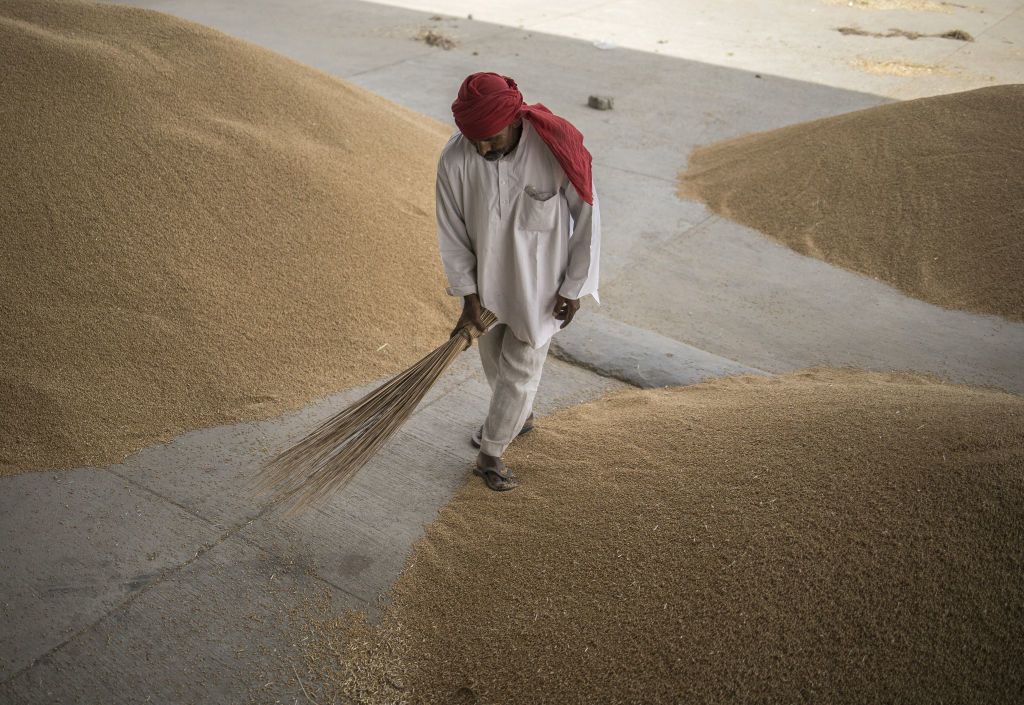
Yet the actions of Modi's government are severely undermining his argument. India has responded to rising global commodity prices by unexpectedly blocking exports of sugar and wheat; some expect rice to be next. These are products in which India plays a major role in global markets; the country is the world's second-largest exporter of sugar and the second-largest producer of wheat. World prices for wheat rose 6% on news of India's export ban.
True, for India, food prices are of particular importance. It's one of the few countries in the world in which food products comprise more than half the consumer price index. If you don't control food prices, you risk inflation expectations spiraling out of control and years of macroeconomic instability.
But export bans aren't the only way to manage food inflation. Besides, what's the excuse for all of New Delhi's other anti-trade moves? India's steel industry is still reeling from the unexpected and arbitrary increase in export taxes for finished steel products imposed last month. Share prices for Tata Steel Ltd. fell by 15% and those of Steel Authority of India Ltd. by even more.
The arbitrariness of India's trade policy is even more evident in the way the government has treated the country's paper industry. After two years of global price increases, officials recently declared that all imports of paper products would henceforth require “pre-registration” — dangerously close to a 1970s-style license. This, the government claimed, would “go a long way in promoting ‘Make In India' and ‘Atmanirbhar' [self-reliance].”
Thus, rather than arguments detailing how consistent trade policy helps productivity and investment, we're left with empty slogans. Every bad, anti-trade decision is presented as either supporting Modi's “Make in India” and “self-reliance” drives, or as necessary to control inflation. And the slogans can cheerfully point in opposite directions: Two years ago, India levied tariffs on steel imports to protect domestic producers; now it has an export tax to protect domestic consumers.
India's trade policy is not just incoherent across time but contradictory at any particular moment in time. For example, steel producers justifiably complain that the new export taxes mean that they will fail to meet government-set targets for exports under an incentive subsidy regime begun as recently as last year. To sum up: First, the government raised steel tariffs, then it subsidized exports and set stiff targets for the steel industry, and then it slapped an export tax on steel products to control domestic prices — all in just a few years.
These aren't, to say the least, the sort of decisions that build trust. Who will sign a long-term contract for Indian steel under such circumstances? India can't hope to steal investment away from China as long as its trade policy is so unpredictable.
Moreover, Indian protectionism doesn't just hurt Indian producers; it hurts the world. As my Bloomberg Opinion colleague David Fickling has pointed out, the global safety net against hunger depends on the world's large food producers — including India — avoiding disruptions such as export bans. If India, which will assume the G-20 presidency later this year, expects to be treated as a global leader, we need to start taking the global effect of our policies into account.
Modi himself is intensely attuned to international perceptions of India. Yet he keeps on being forced into embarrassing climbdowns by his own government. Last year, he promised India would vaccinate the world — only to end vaccine exports after the Delta variant hit. In April, he promised to “feed the world” and to “send relief from tomorrow itself”; within weeks, his government shut down the wheat trade.
Judging by his words, Modi certainly understands how critical trust is. Now he just needs to build some.
More From Other Writers at Bloomberg Opinion:
- Heat Waves, Wheat and India's Chapati Crisis: Andy Mukherjee
- Is the Great Sri Lanka Fire Sale About to Begin?: Ruth Pollard
- Joe Biden's Big Asian Trade Deal Is Only a Baby Step: Editorial
This column does not necessarily reflect the opinion of the editorial board or Bloomberg LP and its owners.
Mihir Sharma is a Bloomberg Opinion columnist. A senior fellow at the Observer Research Foundation in New Delhi, he is author of “Restart: The Last Chance for the Indian Economy.”
More stories like this are available on bloomberg.com/opinion
©2022 Bloomberg L.P.

-
Talking Points This Week: Leadership Shock At Nvidia, Earnings Strength, And The Fog Over Hormuz

The Anthropic IPO pricing and first trading day, Nvidia's upcoming earnings, and any fresh signals from Iran will set the tone for the following week.
-
Signature Play: The Classic Cocktail Is Dead. Or Is It?
Classic cocktails are disappearing from India's cocktail menus. But they're still being ordered, taught to bartenders and borrowed from. So, who's really having the last drink?
-
A New Samvat Wishlist: Inclusive Prosperity And Human Development
India has strengthened its economic foundations through infrastructure, digital access and enterprise. Its next growth chapter must deepen productivity, create better livelihoods and widen participation in prosperity.
-
Love, Sex Aur Dhokha: The Audacious Plot To Spy On Jensen Huang
A Taipei dinner, a Singapore chip buyer and a suspected Chinese asset: inside the alleged spy operation that got close to NVIDIA's Jensen Huang.
-
Ten Things I Learnt This Samvat
Patience can be a trap. Cheap stocks can stay cheap. Leverage can wipe you out. What did Samvat 2082 teach us? Niraj Shah writes on 10 lessons from the year gone by.
-
Talking Points This Week: Tech Nerves, FII Buying, And A Faraway Banking Shock
The global markets are not shining this Diwali. The exception in the large markets is, India.
-
Midterm Rally Lasted A Day. The Hard Reality Of A Divided US May Last Two Years | Opinion
Between a contested AI boom, a debt ceiling that arrives in 2027 and a president with every incentive to act alone, the next two years may prove more volatile than the first day's rally suggests.
-
Blue Wave Will Derail the AI Trade but Won't Dismantle the AI Era | Unhedged Position
The Democrats' sweep of the US Congress will see politics collide with economic forces both over the long and short term.
-
It's Time To Take The GST Council's Bet On Trust Global
Payment records can prove India's services exports, and clear, proportionate rules can bring foreign digital sellers into the tax net.
-
Opinion | India at 38: From Innovation Overperformer to Innovation Powerhouse
India now has 453 VC-backed deep science startups, 18 of them late-stage, after 117 percent growth since 2020. Laurus Labs, at USD 9.3 billion, is the most valuable deep science company in any middle-income economy outside China.









