India To Head BRICS' $100 Billion New Development Bank
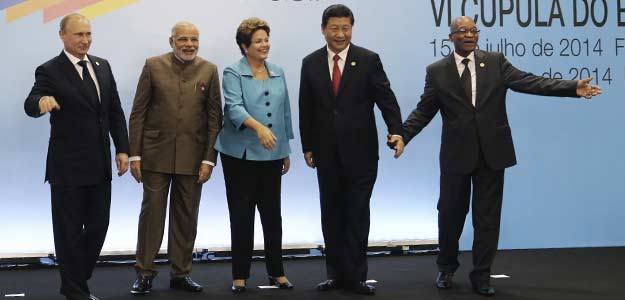
Leaders of the BRICS emerging market nations launched a $100 billion development bank and a currency reserve pool on Tuesday in their first concrete step toward reshaping the Western-dominated international financial system.
The bank, aimed at funding infrastructure projects in developing nations, will be based in Shanghai, China, and India will preside over its operations for the first six years, followed by five-year terms for Brazil and then Russia, leaders of the five-country group announced at the 6th BRICS - Brazil, Russia, India, China and South Africa - summit.
The member countries will also set up a $100 billion currency reserves pool to help countries forestall short-term liquidity pressures.
For India, it was a moment of success after hard bargaining to settle where the bank would be located and the share-holding in it. The bank will be called the New Development Bank, a name suggested by Prime Minster Narendra Modi.
Also, the bank will begin with a subscribed capital of $50 billion divided equally between its five founders; China, the world's number 2 economy, had argued that the economic strength of a member nation should be the criteria for contribution to the bank - a higher contribution would automatically mean greater control. But in intense negotiations that delayed the bank for two years, India and Brazil fought China's attempts to get a bigger share in the lender than the others.
"The agreement towards setting up the BRICS New Development Bank is a significant step. I am happy the initiative announced in 2012 in Delhi has become a reality," PM Modi said. The summit is Mr. Modi's first multilateral engagement since he took over as Prime Minister in May this year.
The long-awaited bank is the first major achievement of the BRICS countries since they got together in 2009 to press for a bigger say in the global financial order created by Western powers after World War Two and centered on the International Monetary Fund and the World Bank.
The BRICS were prompted to seek coordinated action following an exodus of capital from emerging markets last year, triggered by the scaling back of US monetary stimulus. The new bank reflects the growing influence of the BRICS, which account for almost half the world's population and about one-fifth of global economic output.

-
Joining The Dots | Dark Skies, Steady Diya: Why Hope Holds This Diwali

With war, a weak rupee and foreign outflows weighing on sentiment, policymakers at the NDTV World Summit and market veterans at NDTV Profit Ignite: Diwali Edition offered the same advice: stay invested and filter out the noise.
-
The Curious Case of Equitas Small Finance Bank And A CEO Who Quit For Stock
PN Vasudevan believes persistent investor concerns over a perceived conflict of interest had become a governance overhang on Equitas Small Finance Bank's stock, even as the lender improved profitability and asset quality.
-
Talking Points This Week: AI Cash Burn, A Tiger Comeback And An India That Still Finds Its Own Path
India is not immune to higher oil or tighter global liquidity, yet its earnings base is broader, its domestic policy levers are still available.
-
Foreign Investors Own Half Of HDFC Bank and ICICI Bank. An LTCG Cut Could Matter Most Here
Foreign portfolio investors have US$115 billion parked in HDFC Bank, ICICI Bank. If the government cuts long-term capital gains tax, Jefferies says returning foreign money could land here first.
-
'Never Seen This Level Of Negativity': Sandeep Tandon Says The Next Rally May Be Closer Than You Think
Veteran investor Sandeep Tandon says foreign selling is easing, large-caps are due a comeback and mid-caps are crowded, while he turns positive on gold, power and pharma this Diwali.
-
Indians Stay With Family, Not In Hotels | The Reason Why
India still lacks enough clean, reliable and affordable hotels for budget-conscious travellers.
-
The Economic Imperative: Analysing The Material Driving Force Behind India-Canada Strategic Reset
This economic complementarity is further reinforced by deep institutional investment ties and talent mobility, which form the bedrock of the bilateral framework.
-
Medicine Pricing: Where Must Profit Stop?
India must confront excessive margins, hidden incentives and regulatory gaps that threaten the integrity of medicine.
-
Why Amazon And Flipkart Are Struggling To Beat Meesho In India's Smaller Cities
With 274 million users and lowest-cost logistics, Meesho is defending its value commerce crown against giants like Amazon and Flipkart.
-
High US Salaries, No Green Card Certainty: The Financial Calculation Facing Indian H-1B Families
The suspension of PERM processing at eight technology employers does not cancel existing H-1B visas. What it does is force a question many Indian families have been avoiding: is the US salary worth tying your career and family plans to one employer?










