The World’s Most-Loved Emerging Market Is Feeling Jittery

(Bloomberg Opinion) -- India is the world's most-loved emerging market this year. Foreigners have poured in billions of dollars so far in 2023 even as they have pulled money from most other developing economies tracked by Bloomberg data. The surfeit of enthusiasm has also stored up apprehension: How much longer before this bastion of stability wobbles may depend on $4 flip-flops.
Where India has stood apart from most other emerging markets is in delivering high economic growth — 6%-plus expected in 2023 and 2024, according to the International Monetary Fund. It did so amid the turmoil caused by a strong dollar and a 525 basis-point increase in US interest rates. The spending power of the urban rich was visible in the $2,400–a-night hotel-room tariffs during the recently concluded Cricket World Cup final in Ahmedabad, in Prime Minister Narendra Modi's home state of Gujarat.
According to Marcellus Investment Managers, a Mumbai-based advisory firm, much of this spending may be coming from just 200,000 families that constitute an elite “Octopus class,” whose wealth has grown 16 times over the past 20 years. As the super-affluent open their wallets wide, some of their demand may be spilling over, as evident in India's record $31 billion trade deficit last month.
This resource gap isn't posing serious concerns yet. For one thing, the central bank's tight lid on domestic liquidity has helped keep the rupee stable. Also, from June next year India will be included in JPMorgan Chase & Co.'s global bond indexes, a move that's expected to draw in about $24 billion over a short period.
What's worrying from the stock market's perspective, though, is that the Reserve Bank of India is also taking more direct steps to rein in debt-fueled consumption. The octopi have assets; the non-octopi have liabilities. Consumer loans is how the masses are keeping their heads above water amid high food and energy costs. Banks and finance companies have been so active in pushing retail credit out the door that the central bank had to step in this month and raise capital requirements against unsecured personal loans.
That is the prudent thing to do. Lending to subprime borrowers has become incredibly efficient in India because of the new digital technologies employed to attract and screen borrowers, pool their loans and find a deposit-taking institution to take the credit risk. However, retail loans, growing at twice the pace of total advances, could spiral out of control. And that could become a recipe for future trouble amid high unemployment and stagnant real wages.
However, to equity markets, the central bank's prudential measure against personal loans is problematic. The class that has real purchasing power may be buying $60 Birkenstock sandals, but how to profit from their spending? The stock that's available locally is Relaxo Footwears Ltd., which makes $4 flip-flops and shoes for the masses. So investors have gone and bid up its price to 145 times annual per-share earnings.
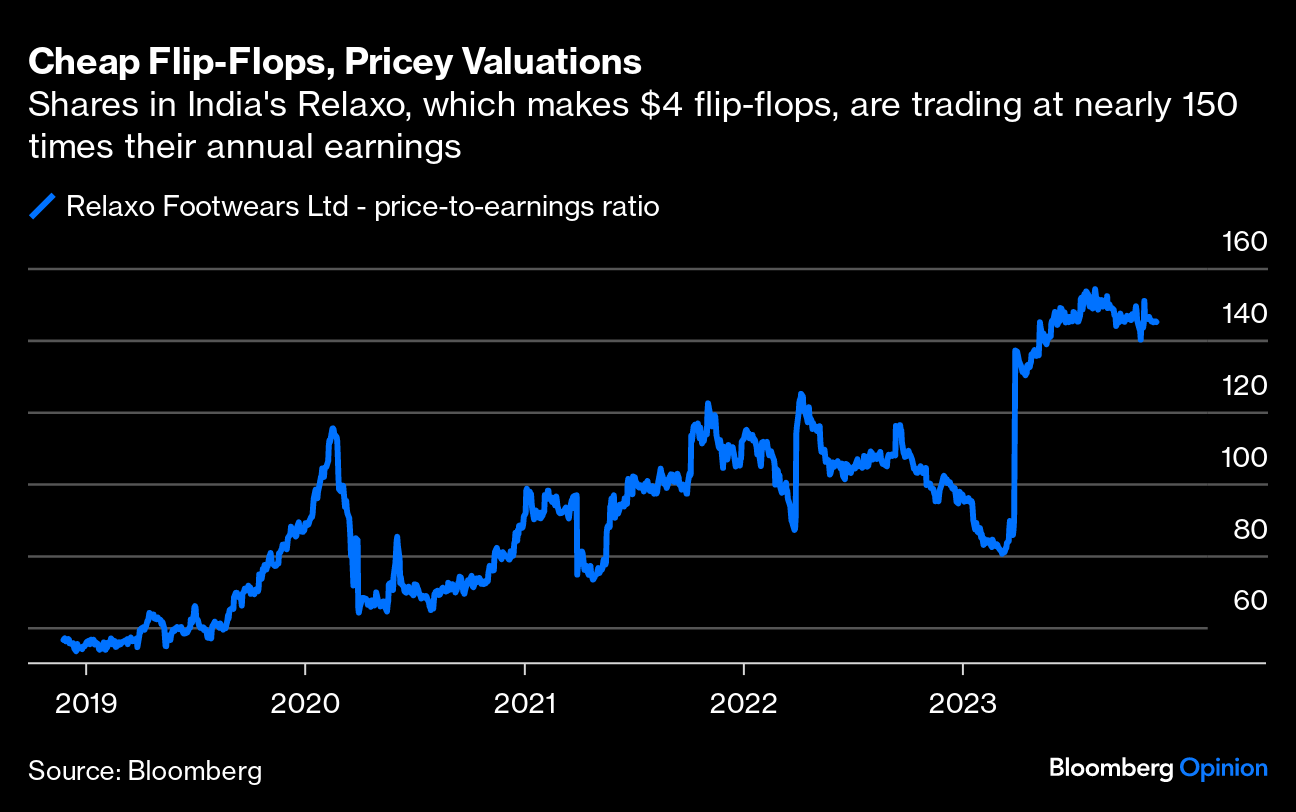
Indeed, most Indian stocks that depend on the wider public — and not just the elite — to spend more are trading at very expensive levels. This is when, as Kotak Securities notes, “data and management commentary do not point to an imminent revival in consumption.” Even the September quarter “saw muted demand for consumer staples and durables,” the brokerage notes.
Analysts are penciling in more broad-based spending for 2024. The consensus bet is that rural demand will recover from its multiyear funk. Ahead of India's general elections due by May 2024, the Modi government will try to channel as much money in handouts as it can to deflect political criticism about jobless growth and the high cost of living. An RBI-induced increase in borrowing costs could suck out air from the consumption-recovery thesis.
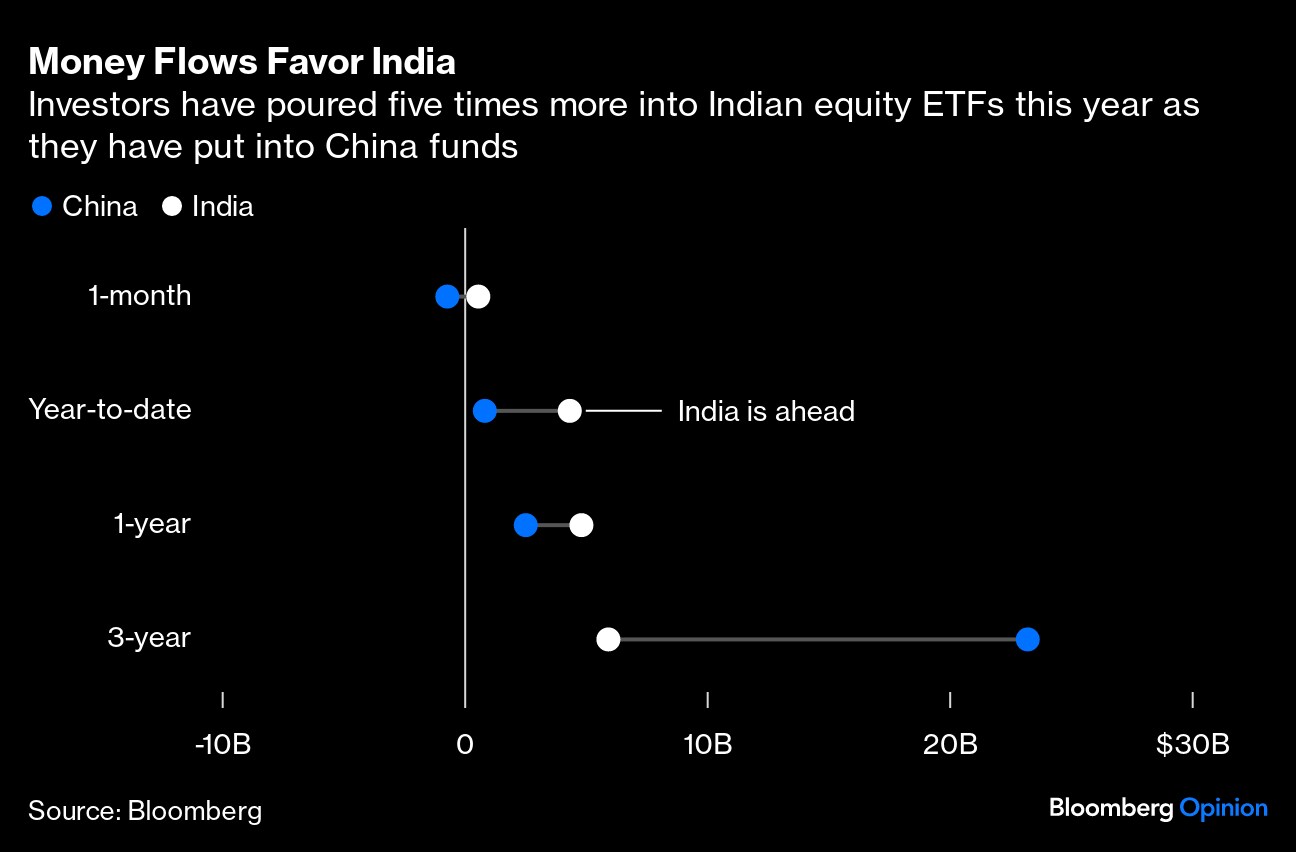
India has been the star beneficiary of China's tepid post-pandemic growth and cracks in its overleveraged property sector. The smaller economy, which many analysts had expected to surrender some of the pandemic-era global interest in its stock market, now accounts for more than 15% of the MSCI Emerging Market Index, up from 10% 2 ½ years ago. During the past month, $700 million has left from exchange-traded funds that invest in Chinese equities. The ETFs that target Indian stocks collected $600 million over the same period, bringing their total haul this year to nearly $4.5 billion.
But there are signs of nervousness around smaller companies. The iShares MSCI India Small-Cap ETF, which holds stocks with a median market value of $2.4 billion, hasn't had inflows in nearly two months, whereas the iShares MSCI India ETF, whose median holding has a capitalization of $30 billion, is witnessing steady interest. The reason is not hard to see. Smaller Indian companies are more expensive now than larger firms.
In fact, it's the big conglomerates, which haven't done much for shareholders the last one or two years, that may be more reasonably priced. Tycoon Gautam Adani's infrastructure empire is still to recover from the valuation loss suffered after Hindenburg Research's short-seller report in January invited intense worldwide scrutiny of the group's corporate governance. His rival Mukesh Ambani's Reliance Industries Ltd. has been promising a new round of value creation in everything from retail and telecom to finance and green hydrogen under the next-generation leadership of his three children. So far, investors don't seem impressed. Large Indian banks are looking spent.
Even if the Fed is done raising interest rates, policymakers in New Delhi and Mumbai won't reach for growth at the cost of stability. The RBI's warning on Wednesday against credit “exuberance” is evidence of that. What is far from certain, however, is the political environment after May. A third term for Modi may aid groups like Adani that are staunchly aligned with his policies. But any shakeup may come to hurt pricey small caps. If the Birkenstock-sporting octopi lose their proximity to power, the market might shed its faith in the stratospheric valuation of Relaxo.
More From Bloomberg Opinion:
- To Be the Next China, India Needs Faster Trains: Andy Mukherjee
- Diwali Smoke Billows From India's Failed Policy: David Fickling
- Tata, Vedanta Offer India Lessons in Industry Policy: Tim Culpan
This column does not necessarily reflect the opinion of the editorial board or Bloomberg LP and its owners.
Andy Mukherjee is a Bloomberg Opinion columnist covering industrial companies and financial services in Asia. Previously, he worked for Reuters, the Straits Times and Bloomberg News.
More stories like this are available on bloomberg.com/opinion
©2023 Bloomberg L.P.

-
Signature Play: The Classic Cocktail Is Dead. Or Is It?

Classic cocktails are disappearing from India's cocktail menus. But they're still being ordered, taught to bartenders and borrowed from. So, who's really having the last drink?
-
A New Samvat Wishlist: Inclusive Prosperity And Human Development
India has strengthened its economic foundations through infrastructure, digital access and enterprise. Its next growth chapter must deepen productivity, create better livelihoods and widen participation in prosperity.
-
Love, Sex Aur Dhokha: The Audacious Plot To Spy On Jensen Huang
A Taipei dinner, a Singapore chip buyer and a suspected Chinese asset: inside the alleged spy operation that got close to NVIDIA's Jensen Huang.
-
Ten Things I Learnt This Samvat
Patience can be a trap. Cheap stocks can stay cheap. Leverage can wipe you out. What did Samvat 2082 teach us? Niraj Shah writes on 10 lessons from the year gone by.
-
Talking Points This Week: Tech Nerves, FII Buying, And A Faraway Banking Shock
The global markets are not shining this Diwali. The exception in the large markets is, India.
-
Midterm Rally Lasted A Day. The Hard Reality Of A Divided US May Last Two Years | Opinion
Between a contested AI boom, a debt ceiling that arrives in 2027 and a president with every incentive to act alone, the next two years may prove more volatile than the first day's rally suggests.
-
Blue Wave Will Derail the AI Trade but Won't Dismantle the AI Era | Unhedged Position
The Democrats' sweep of the US Congress will see politics collide with economic forces both over the long and short term.
-
It's Time To Take The GST Council's Bet On Trust Global
Payment records can prove India's services exports, and clear, proportionate rules can bring foreign digital sellers into the tax net.
-
Opinion | India at 38: From Innovation Overperformer to Innovation Powerhouse
India now has 453 VC-backed deep science startups, 18 of them late-stage, after 117 percent growth since 2020. Laurus Labs, at USD 9.3 billion, is the most valuable deep science company in any middle-income economy outside China.









