India Bans Wheat Exports as Food Security Comes Under Threat
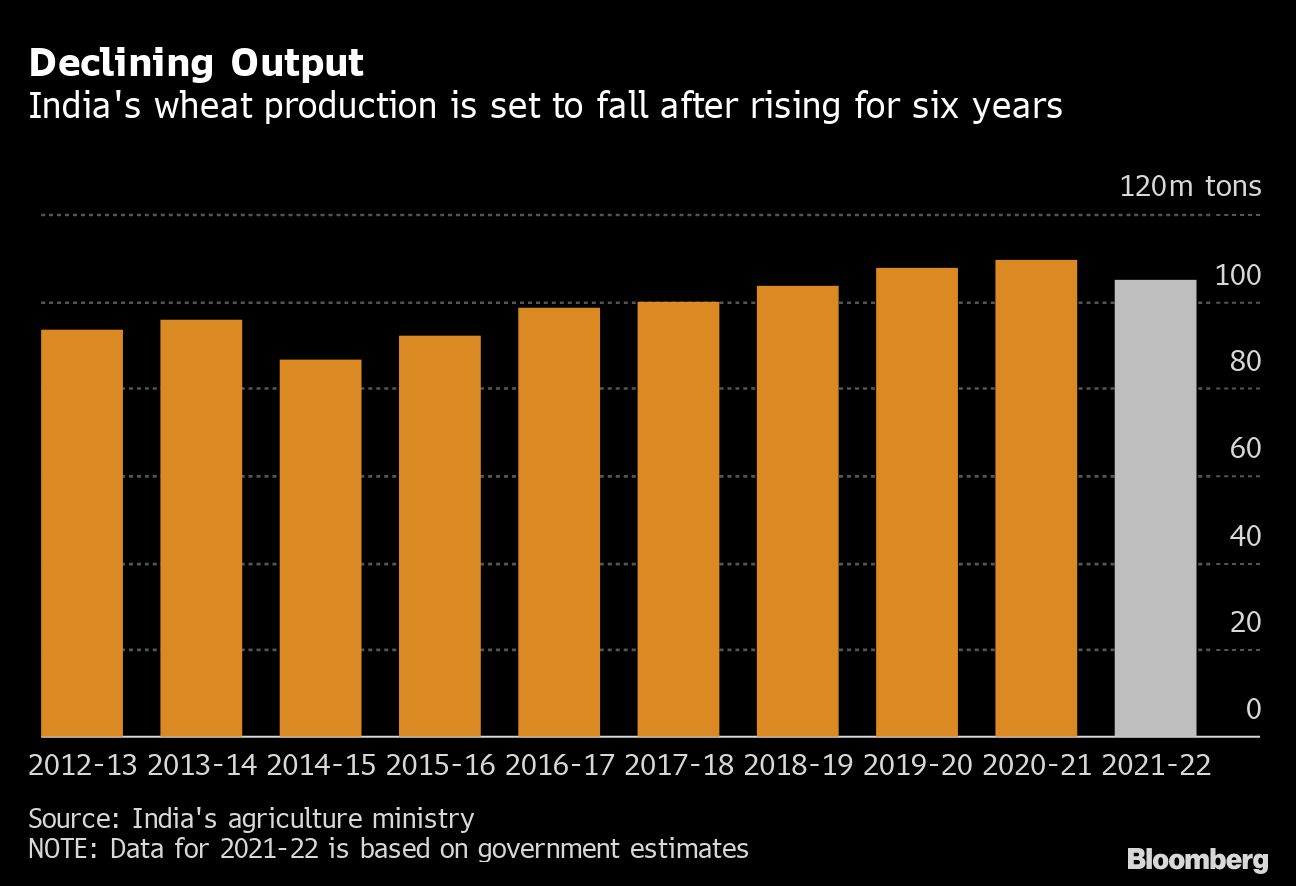
(Bloomberg) -- India prohibited wheat exports that the world was counting on to alleviate supply constraints sparked by the war in Ukraine, saying that the food security of the nation is under threat.
Exports will still be allowed to countries that require wheat for food security needs and based on the requests of their governments, India's Directorate General of Foreign Trade said in a notification dated May 13. All other new shipments will be banned with immediate effect.

Food Secretary Sudhanshu Pandey said at a media briefing on Saturday that higher local wheat prices prompted the ban, and that costs are likely to fall after the move. The policy will allow some supplies to be diverted to the needy and vulnerable people across the world, Commerce Secretary B.V.R. Subrahmanyam said at the same event.
The decision to halt wheat exports highlights India's concerns about high inflation, adding to a spate of food protectionism since the war started. Governments around the world are seeking to ensure local food supplies with agriculture prices surging. Indonesia has halted palm oil exports, while Serbia and Kazakhstan imposed quotas on grain shipments.
Curbing exports would be a hit to India's ambition to cash in on the global wheat rally after the war upended trade flows out of the Black Sea breadbasket region. Importing nations have looked to India for supplies, with top buyer Egypt recently approving the South Asian nation as an origin for wheat imports.
German Agriculture Minister Cem Oezdemir said he and his Group of Seven counterparts had discussed “with concern” on Saturday both Indonesia's decision to limit exports of palm oil and India's move to halt wheat exports.
“If we all started imposing these export limits, or even closed down markets, that just makes the crisis worse,” Oezdemir said at a news conference in Stuttgart. “It also hurts India itself and the farmers there because of course it means a roller-coaster ride for prices.”

“We now have an environment with another supplier removed from contention in global trade flows,” said Andrew Whitelaw, a grains analyst at Melbourne-based Thomas Elder Markets, adding that he's been skeptical about the high volumes expected from India.
“The world is starting to get very short of wheat,” Whitelaw said. At present, the US winter wheat is in poor condition, France's supplies are drying out and Ukraine's exports are stymied.
Bloomberg News reported earlier this month that a record-shattering heat wave has damaged wheat yields across the South Asian nation, prompting the government to consider export restrictions. The food ministry had said it didn't see a need to control exports, even as the government cut estimates for India's wheat production.

Shipments with irrevocable letters of credit that have already been issued will still be allowed, according to the latest notification. Traders have contracted to export 4.5 million tons so far in 2022-23, the food ministry said. After Egypt, Turkey has also given approval to import wheat from India, it said.
After the war hampered logistics in the Black Sea region, which accounts for about a quarter of all wheat trade, India has tried to fill the vacuum. The country targeted to export a record 10 million tons in 2022-23.

But its domestic challenges have come into sharper focus in recent weeks. Hundreds of acres of wheat crops were damaged during India's hottest March on record, causing yields to potentially slump by as much as 50% in some pockets of the country, according to a Bloomberg survey.
That's raised concerns for the domestic market, with millions depending on farming as their main livelihood and food source. The government said wheat purchases for its food aid program, the world's largest, will be less than half of last year's level. The ban on exports will likely hurt farmers and traders who have stockpiled the grain in anticipation of higher prices.

Controlling wheat exports by India -- given uncertainties related to the crop size, the grain procurement program, the war, high fertilizer costs and extreme weather in other growing nations -- is a logical move to ensure domestic availability and manage inflation, said Siraj Chaudhry, managing director and chief executive officer of National Commodities Management Services Ltd., a warehousing and trading company.
However, an approach with measures such as a minimum export price and quantitative restrictions would have been better as a sudden ban throws challenges to trade, affects Indian exporters' reliability and hits the earning potential of farmers, Chaudhry said.
(Updates to add comments in third and sixth paragraphs.)
More stories like this are available on bloomberg.com
©2022 Bloomberg L.P.

-
One El Nino, India Can Handle. Two Could Break The Granary

India's grain stocks can absorb one bad year, but a second El Nino could drain the buffer in two to three years, economists say.
-
India's Troika Of Good Luck | Joining The Dots
As Jensen Huang's exit drags Nvidia down, a cooling AI trade and resilient earnings have revived investor interest in India. A likely RBI rate hike looms.
-
Talking Points This Week: Leadership Shock At Nvidia, Earnings Strength, And The Fog Over Hormuz
The Anthropic IPO pricing and first trading day, Nvidia's upcoming earnings, and any fresh signals from Iran will set the tone for the following week.
-
Signature Play: The Classic Cocktail Is Dead. Or Is It?
Classic cocktails are disappearing from India's cocktail menus. But they're still being ordered, taught to bartenders and borrowed from. So, who's really having the last drink?
-
A New Samvat Wishlist: Inclusive Prosperity And Human Development
India has strengthened its economic foundations through infrastructure, digital access and enterprise. Its next growth chapter must deepen productivity, create better livelihoods and widen participation in prosperity.
-
Love, Sex Aur Dhokha: The Audacious Plot To Spy On Jensen Huang
A Taipei dinner, a Singapore chip buyer and a suspected Chinese asset: inside the alleged spy operation that got close to NVIDIA's Jensen Huang.
-
Ten Things I Learnt This Samvat
Patience can be a trap. Cheap stocks can stay cheap. Leverage can wipe you out. What did Samvat 2082 teach us? Niraj Shah writes on 10 lessons from the year gone by.
-
Talking Points This Week: Tech Nerves, FII Buying, And A Faraway Banking Shock
The global markets are not shining this Diwali. The exception in the large markets is, India.
-
Midterm Rally Lasted A Day. The Hard Reality Of A Divided US May Last Two Years | Opinion
Between a contested AI boom, a debt ceiling that arrives in 2027 and a president with every incentive to act alone, the next two years may prove more volatile than the first day's rally suggests.
-
Blue Wave Will Derail the AI Trade but Won't Dismantle the AI Era | Unhedged Position
The Democrats' sweep of the US Congress will see politics collide with economic forces both over the long and short term.









