India’s Sell-Side Researchers Should Say What They Mean
(Bloomberg Opinion) -- The sell-side research community in Mumbai has to be the world's most polite. Rare is the analyst who will use an unkind word if a more painless and pointless alternative can be found — or invented. But tactfulness extracted a price six years ago, and it may come to bite again. Last time, trouble erupted in banking. This time, it is brewing in outsourcing.
As George Orwell said in Politics and the English Language, the decline of language ultimately has political and economic causes. Stockbrokers in India use empty phrases as a tribute to corporate power. So, sales and profit don't decline for large Indian outsourcing companies, they “degrow.” A workforce doesn't shrink; the addition of employees turns negative.
The motto is simple: Present the good news, boldly, clearly and upfront in plain English; then, and only then, slip in the bad news, but after obscuring it with jargon. Like in the Monty Python sketch, the parrot may be nailed to the cage, but it's never dead. It's always resting, pining for the fjords.
Want to put a sell rating on a storied Indian outsourcing firm without upsetting the chief executive? Start by talking about record orders. Since despite that gurgling pipeline of business, sales still came in below target, you have two options: Either spin the rise in the so-called book-to-bill ratio as a future windfall, or allude to a “revenue leak:” If you choose the latter approach, you're pronouncing the global economy to be in tip-top shape; the bucket has a hole somewhere.
At times, though, playing nice becomes a serious handicap. Around 2016 and 2017, most banking analysts in India kept missing the deterioration in lenders' asset quality. As the independent analyst Hemindra Hazari described it back then, they would dismiss every souring of large corporate credit as “the last cockroach,” after which there would be no more to be found. Well, the creepy crawlies just kept coming until India was saddled with the worst bad-loan problem in the world.
The banking industry's troubles may be in the rearview mirror. Now it's the turn of the outsourcing firms' elevated price-to-truth ratio. Leverage isn't an issue for these cash cows. Their problem is the quality of orders.
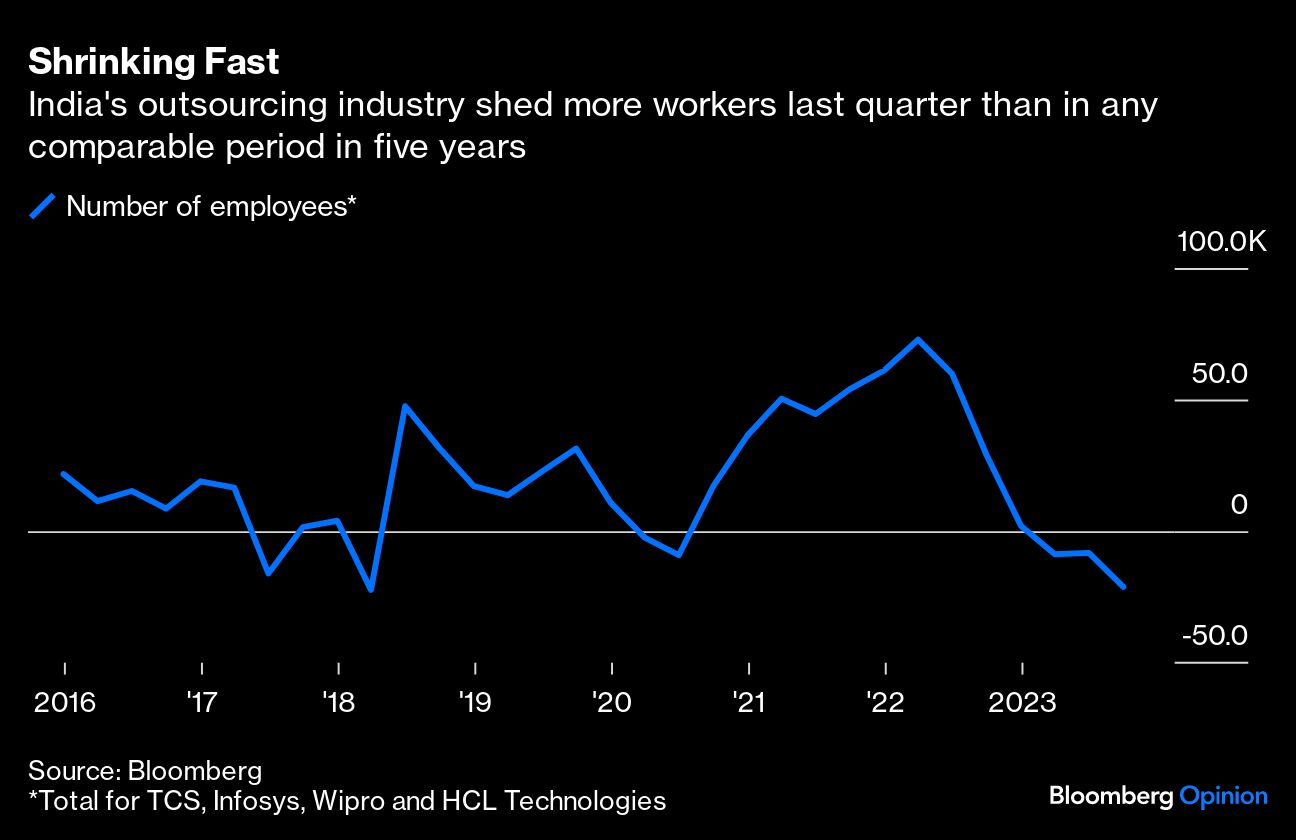
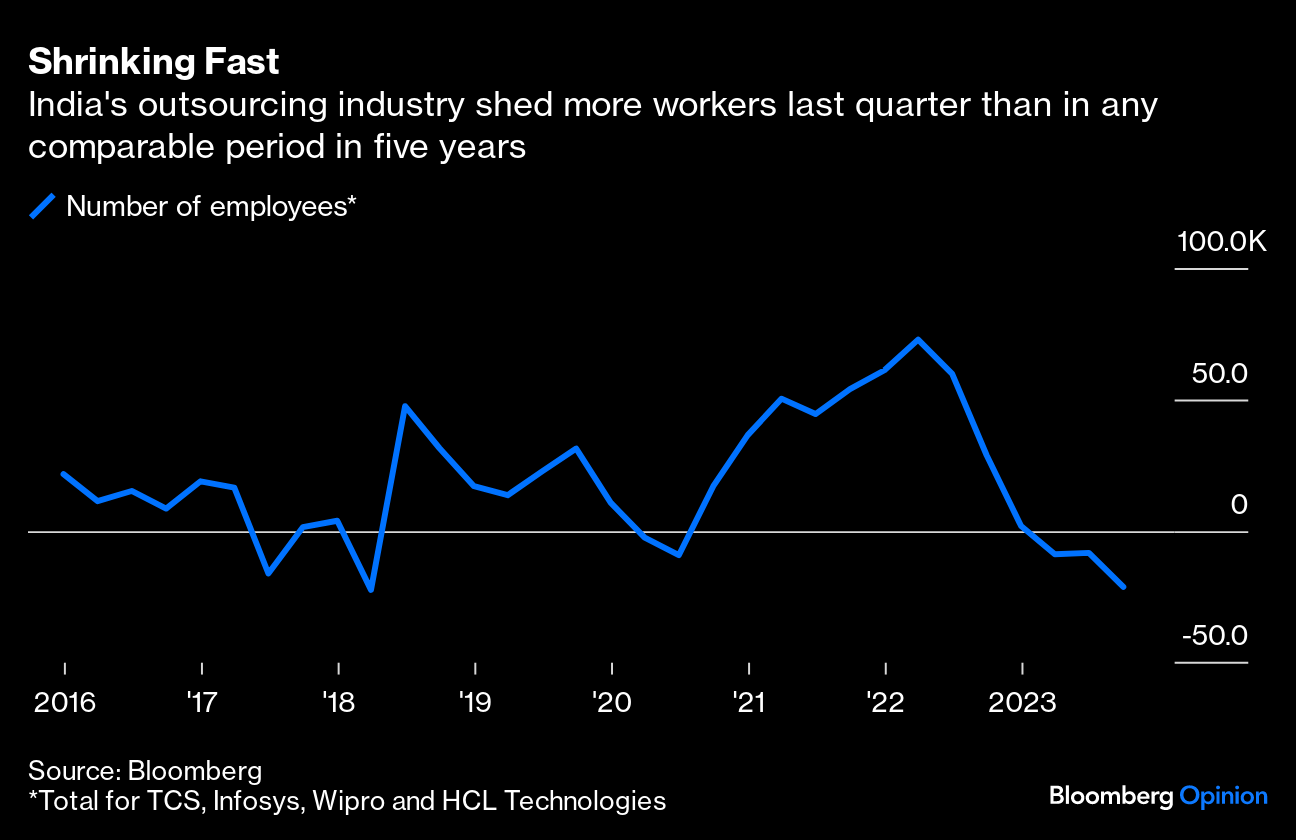
But at least the growing chasm between contract values and lackluster sales is getting discussed on earnings calls. Workers aren't getting the same attention. The top players in the industry contracted their payrolls by more than 21,000 in three months to September. Not only is this the worst in more than five years, a third straight quarter of decline isn't something that the industry is accustomed to. Maybe one part of this is just a correction after a post-pandemic hiring boom, and another part is caution among US and European multinationals about slowing economies.
But could there be more here at play?
By taking recourse to anodyne language, such as negative net addition, analysts aren't doing their core audience any favors. Code-writing work is a barometer of white-collar employment in the world's fifth-largest economy. It influences everything from middle-class homebuying to consumer spending at shopping malls. A prolonged funk could even have a bearing on Gen Z's voting choices — at least in urban constituencies — in next year's general elections. Even if they have no exposure to the software firms, investors need to assess how much of their current downturn is because of temporary uncertainty around order flows and what part may have become durable.
From the outside, it's hard to tell. The Big Four of Indian offshoring giants — Tata Consultancy Services Ltd., Infosys Ltd., Wipro Ltd. and HCL Technologies Ltd. — have hired half a million engineering graduates in the past three years. Two of the companies have indicated they won't be going to campuses this year, according to an article in the Mint. This is a big blow. It seems, the industry is mimicking its clients by employing generative artificial intelligence tools like ChatGPT to boost productivity. If AI is going to permanently reduce the number of entry-level programming jobs in an average year, then youngsters need to pick up other skills to improve their chances. It's better to let them know when they're yet to hit the job market.
For the society at large, euphemisms are more damaging than the unvarnished truth.
More from Bloomberg Opinion:
- India's Growth Story May Not Have a Happy Ending: Mihir Sharma
- Slow and Steady Is Never Enough for China: John Authers
- The West's India Problem Isn't Getting Any Easier: Pankaj Mishra
This column does not necessarily reflect the opinion of the editorial board or Bloomberg LP and its owners.
Andy Mukherjee is a Bloomberg Opinion columnist covering industrial companies and financial services in Asia. Previously, he worked for Reuters, the Straits Times and Bloomberg News.
More stories like this are available on bloomberg.com/opinion
©2023 Bloomberg L.P.

-
One Battle After Another: India's Corporate Dynasties Battle For Control

2026 could go down as Corporate India's year of succession wars, governance battles and family fault lines.
-
Rs 50-Lakh Gold In Bank Locker, Rs 3 Lakh Of Protection: The Gap Most Families Don't Know About
The RBI ties a bank's liability to the annual locker rent and families who want to insure their jewellery face a separate question about how to prove what was inside.
-
The More Food Turns Into Fuel, The Harder It Is To Read Agricultural Markets | The Reason Why
A policy designed to reduce dependence on imported fuel can create new pressures elsewhere in the food economy.
-
Your iPhone Costs 12 Grams Of Gold, A Car About 100. What Does Your Life Weigh?
Measured in rupees, almost everything looks more expensive than it did a generation ago. Measured in grams of gold, a lot of it has become cheaper.
-
Gold Is Rs 22,000 Cheaper Than A Month Ago. Should You Buy Amid The Wedding Season?
Gold's potential slide to $3,500 could save around Rs 4,700 per 10 grams, but a soft inflation print could just as easily push prices back up. One way to split the risk is to buy in parts, some now and the rest after the Fed's Dec. 9 decision.
-
AI Agents Are Gaining Power. Who Governs Them?
Artificial intelligence agents promise to transform productivity by moving machines from assisting decisions to executing them. But as organisations delegate greater authority to these AI-agents, they must first establish who controls that authority and who remains accountable when things go wrong.
-
Why Swapping Your Old Gold Can Trigger A Rs 5 Lakh Tax Bill, And How You Can Avoid It Legally
Swapping old gold for new is taxed as a sale and a fresh purchase. Getting your own gold remade can cut most of that bill, though it has its own costs.
-
The AI Trade is Done. The Real Opportunity for Investors Starts in 2027 | Unhedged Position
As pureplay AI stocks plunge and circular, capex-led financing unwinds, 2027 is set to be a year of reckoning for AI companies. Yet the bust clears the way for a better opportunity for investors in 2027 -- shifting the spotlight from AI builders to the companies using AI.
-
Leadership As Mission: Why The Age Of AI Demands More Human Leadership
Debjani Ghosh examines how AI is changing leadership, arguing that its success must be measured by its impact on people and the accountability of those guiding its use.
-
We May Need Another Tukaram Mundhe To Fight Air Pollution | The Reason Why
Developers may install basic measures such as sprinklers and green nets, resume work, and continue violating rules when this equipment stops working.









