Electric Scooters Are Choking Oil’s Boom Market
(Bloomberg Opinion) -- Life moves pretty fast. That's especially true in India's booming cities.
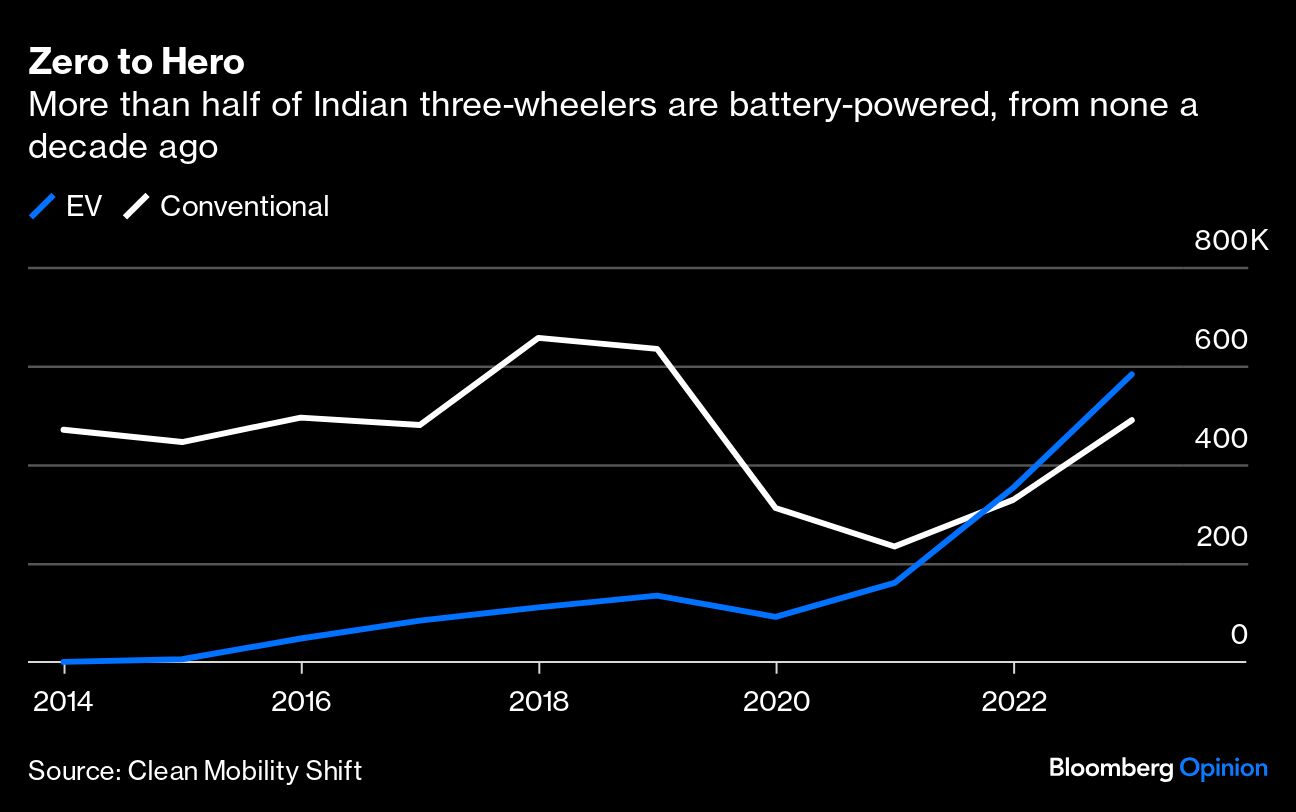
A decade ago, the country's iconic auto-rickshaws had three wheels and a diesel engine. Battery-powered versions existed, but only enough to be seen as a novelty and unregulated threat. Officially, just 12 e-rickshaws were sold nationwide in 2014.(1)
How far we've come. The place where road transport is shifting most rapidly to battery power isn't Oslo or Shenzhen, but Delhi. E-rickshaws took a 54% share of India's three-wheeler market last year, driven by zippy, longer-range models and running costs that are a fraction of petroleum-powered alternatives. Visiting the country last week, one of the first stops for Uber Technologies Inc. Chief Executive Officer Dara Khosrowshahi was to get behind the wheel of a Mahindra & Mahindra Ltd. electric three-wheeler and promise an expansion into two- and three-wheeled ride-hailing.
Those betting India will come to the rescue of flailing global oil demand (it's reckoned to be the biggest source of consumption growth between now and 2030, outstripping even China) need to reckon with how things are changing on the streets.

There's no mystery why e-rickshaws have been taking over. Buy a Bajaj Maxima with an engine and you'll pay about three rupees per kilometer (5.8 cents per mile) for diesel — a significant slice of earnings that average out around 10 rupees per kilometer. A Piaggio Ape E City with a lithium-ion battery charged at home, on the other hand, might cost just 0.27 rupees per kilometer. As a result, e-rickshaws aren't just cleaner and quieter — they're more profitable, too. That's a decisive consideration for drivers who are usually rural migrants trying to get a foothold in the big city.
If this revolution was confined only to three-wheelers, it wouldn't be much to get excited about. Auto-rickshaws are a highly distinctive part of India's road fleet, but not a very significant one. Trucks and cars are sold in far greater numbers, while more than 70% of vehicle sales are two-wheeled scooters and motorbikes.

However, the hard financial logic that's caused e-rickshaws to take over is starting to play out on two wheels, too. Manufacturers are currently launching a slew of new models with price tags and performance to compete with conventional bikes and scooters that retail for less than 100,000 rupees ($1,200). With gasoline prices up about a third thanks to the rise in crude since the start of the Covid-19 pandemic, that could spark a stampede like the one that transformed the e-rickshaw market. Only about 5% of two-wheelers sold last year were battery-powered. McKinsey & Co. forecasts that figure will hit 60% to 70% by 2030.
“The industry is going through a price war,” Swadesh Srivastava, the head of bike-maker Hero MotoCorp Ltd.'s emerging mobility unit, told an investor call Feb. 10. Hero's main domestic two-wheeler rival TVS Motor Co. plans to offer models this year in every segment of the market, from premium to basic, and will expand its dealership network from 400 cities to 800 over the three months through March.
That could start to cause real pain for oil producers who've mostly shrugged off the e-rickshaw revolution. Only about 1.4% of India's gasoline and diesel is consumed by three-wheelers, but two-wheelers gulp down about 17% of the total. The International Energy Agency's latest estimates for the country's oil demand are already being trimmed. Its latest report reckons 6.6 million barrels a day will be consumed in 2030 — above 5.5 million barrels last year, but well down from a central forecast of 6.8 million daily barrels in its global outlook last October.

The real prize lies beyond two wheels, however. The biggest polluters by far on India's roads aren't two- or three-wheelers but trucks, which consume nearly half of all gasoline and diesel. Trucks are normally seen as the hardest segment for EVs to crack. The biggest rigs are simply too energy-hungry to be powered by a battery. Even smaller ones are worked hard day and night for thin margins, making it difficult to spare the time to charge up their power packs.
Even here, though, the sands are shifting. Tata Motors Ltd. launched its first small electric truck in 2022 while Mahindra, the leading e-rickshaw producer, is planning to release a range in 2025. Truck owners, like rickshaw drivers, are intensely sensitive to the combined costs of purchase, refueling and maintenance — and manufacturers seem on the cusp of hitting their sweet spot.

Current e-trucks work out cheaper than diesel models once you've been operating them for five to seven years, Ashok Leyland Ltd. managing director Shenu Agarwal told investors Feb. 6. “If we can bring it down below five years, then it will start making much more sense,” he said.
In the US and Europe, the shift to electric vehicles was a top-down affair, best exemplified by Elon Musk's 2006 promise to start by building an electric sports car and then use the profits to make progressively more affordable mass-market vehicles. Well-heeled drivers can't get enough of luxury EVs like Porsche AG's Taycan and Rolls-Royce's Spectre, while the rest of us are waiting in vain for the sub-$30,000 city cars we were promised.
India seems to be moving in the opposite direction. Electrification of conventional cars and SUVs is still moving at a snail's pace, with battery cars winning just a 2% share of four-wheelers last year. That doesn't matter much in a market that's dominated by smaller vehicles and cost-conscious drivers. When the EV revolution arrives in India, it will come from the bottom up.
More From Bloomberg Opinion:
- EVs Take a Gap Year Awaiting Sub-$30,000 Tesla: Liam Denning
- To Sell an EV, Put a $420,000 Price Tag on It: Tim Culpan
- The EU Gives Carbon Traders What They Want — More Rules: Lara Williams
(1) The true number would be higher, but the unregulated nature of the industry meant that most sales weren't captured in official statistics.
This column does not necessarily reflect the opinion of the editorial board or Bloomberg LP and its owners.
David Fickling is a Bloomberg Opinion columnist covering energy and commodities. Previously, he worked for Bloomberg News, the Wall Street Journal and the Financial Times.
More stories like this are available on bloomberg.com/opinion
©2024 Bloomberg L.P.

-
AI Bias In Investing Cannot Be Eliminated, But It Can Be Governed

Framing is a particularly important example as identical financial information presented in terms of gains rather than losses can lead an LLM to reach a different assessment.
-
Joining The Dots | Dark Skies, Steady Diya: Why Hope Holds This Diwali
With war, a weak rupee and foreign outflows weighing on sentiment, policymakers at the NDTV World Summit and market veterans at NDTV Profit Ignite: Diwali Edition offered the same advice: stay invested and filter out the noise.
-
The Curious Case of Equitas Small Finance Bank And A CEO Who Quit For Stock
PN Vasudevan believes persistent investor concerns over a perceived conflict of interest had become a governance overhang on Equitas Small Finance Bank's stock, even as the lender improved profitability and asset quality.
-
Talking Points This Week: AI Cash Burn, A Tiger Comeback And An India That Still Finds Its Own Path
India is not immune to higher oil or tighter global liquidity, yet its earnings base is broader, its domestic policy levers are still available.
-
Foreign Investors Own Half Of HDFC Bank and ICICI Bank. An LTCG Cut Could Matter Most Here
Foreign portfolio investors have US$115 billion parked in HDFC Bank, ICICI Bank. If the government cuts long-term capital gains tax, Jefferies says returning foreign money could land here first.
-
'Never Seen This Level Of Negativity': Sandeep Tandon Says The Next Rally May Be Closer Than You Think
Veteran investor Sandeep Tandon says foreign selling is easing, large-caps are due a comeback and mid-caps are crowded, while he turns positive on gold, power and pharma this Diwali.
-
Indians Stay With Family, Not In Hotels | The Reason Why
India still lacks enough clean, reliable and affordable hotels for budget-conscious travellers.
-
The Economic Imperative: Analysing The Material Driving Force Behind India-Canada Strategic Reset
This economic complementarity is further reinforced by deep institutional investment ties and talent mobility, which form the bedrock of the bilateral framework.
-
Medicine Pricing: Where Must Profit Stop?
India must confront excessive margins, hidden incentives and regulatory gaps that threaten the integrity of medicine.
-
Why Amazon And Flipkart Are Struggling To Beat Meesho In India's Smaller Cities
With 274 million users and lowest-cost logistics, Meesho is defending its value commerce crown against giants like Amazon and Flipkart.










