India’s Banks Are Making $64 Billion From A Freebie
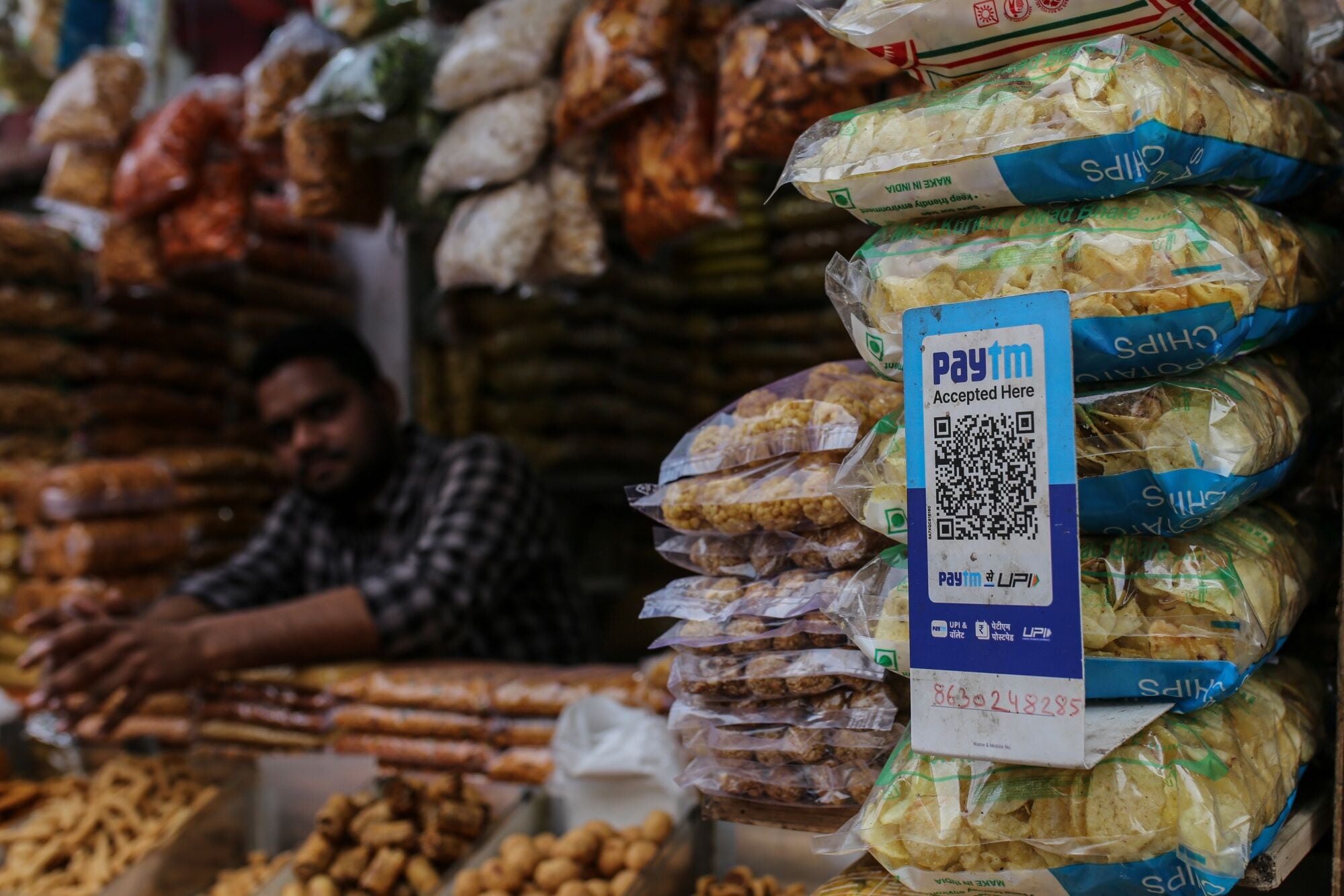
(Bloomberg Opinion) -- On more than 6 billion separate occasions in just one month, the ringing of cash registers in India was replaced by audio confirmations on a digital sound box. Add instances of people paying one another rather than merchants, and the world's most-populous nation drummed up more than 10 billion cashless transactions in August. All were online, instantaneous… and cost nothing.
At least most of them didn't. Since April, customers dipping into their mobile-phone wallets to settle bills of more than 2,000 rupees ($24) may have to bear a part of a 1.1% fee, but only if they are scanning a different platform's quick-response code. This charge goes from the merchant to his QR code provider — Walmart Inc.-owned PhonePe or homegrown Paytm — for hooking up with Alphabet Inc.'s Google Pay. But the Unified Payments Interface, a common protocol for people to send and receive money into accounts at different banks, remains free for regular use.
Banks do try to impose some costs on high-volume users, and the government gives them money to promote low-value online transactions and make formal credit available to disadvantaged groups like street vendors. Yet, a lot of the lenders complain about being made to watch the swelling wave of online payments from the sidelines, rather than being allowed to ride it. Without a profit motive, how will India sustain an industry that — starting from nowhere seven years ago — has come to transact nearly $2 trillion of value annually?
It appears that those concerns are overblown. Even with a free public utility, India's payment revenue swelled last year to $64 billion, behind only China, the U.S. and Brazil, and rivalling Japan, according to McKinsey & Co.'s latest global survey. The rising tide of online transactions has led to a surge in digital commerce. That has, in turn, lifted other boats: Credit card usage has also expanded.
Nor has the lack of a profit motive stifled innovation. New initiatives like pre-approved credit lines will supplement the original protocol that only allowed customers to debit bank accounts or wallet balances to pay someone. Since last year, credit cards have also been allowed to be linked — but only if they are on India's RuPay network. Visa Inc. and Mastercard Inc., which have grumbled about the country's absence of a level playing field, would love to be included.
It's a different story from other successful payment systems. While McKinsey expects instant payments, led by the Pix platform, to account for half of the growth in Brazil's payment revenue from transactions through 2027, the comparable figure for India may not even be 10%.
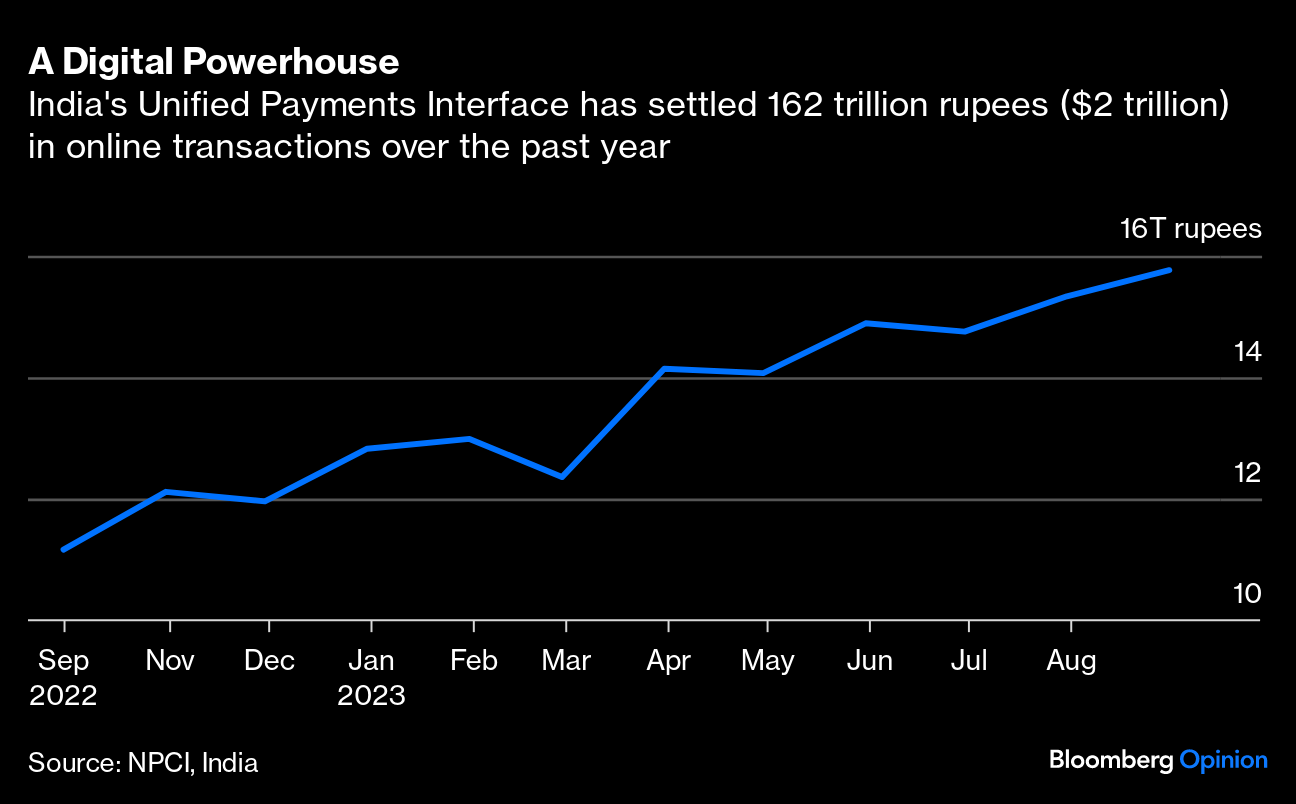
India's profit from payments will expand because of sheer volumes. A fifth of the country's 620 billion transactions last year were settled digitally. By 2027, the figure would rise to 765 billion, and nearly two out of three of these exchanges would be online. Nimble fintech firms would aggressively scout for every new avenue opened by technology or regulatory change. However, “there is ample room for banks to pursue various use cases depending on their specific core competencies and strategic priorities,” the consulting firm notes.
Initially, banks were reluctant to promote the shared network, fearing it would cannibalize their proprietary apps. Those fears weren't unfounded, though in the process of losing their moat, the lenders have won access to the world's fourth-largest pool of payment revenue. And this is just the start. From fees on cards to interest income on credit lines, new opportunities may arise in adjacent activities. In the first two months of last quarter, Paytm distributed $1.3 billion in loans on its platform on behalf of lenders, a 137% jump from a year earlier.
The instant-payment protocol may have become wildly popular, but it has only scratched the surface of its potential. The National Payments Corporation of India, the network's operator, is taking it global. From Paris to Singapore and Dubai, there will be plenty of fees and currency-exchange commissions to be earned when Indian tourists use their rupee wallets — funded by credit lines from local lenders — at shops overseas.
For India's banks that have turned a giveaway into a catalyst for last year's 38% revenue growth, it makes sense to not upset the status quo. There's much to be gained from an online payment system that is familiar, fast, and free.
More from Bloomberg Opinion:
- $1 Trillion in Credit Card Debt Signals Strength: Karl Smith
- Visa, Mastercard Will Dodge Geopolitics in India: Andy Mukherjee
- Sweden Ditching Cash Tells a Cautionary Tale: Lionel Laurent
(Corrects owner of PhonePe in 2nd paragraph.)
This column does not necessarily reflect the opinion of the editorial board or Bloomberg LP and its owners.
Andy Mukherjee is a Bloomberg Opinion columnist covering industrial companies and financial services in Asia. Previously, he worked for Reuters, the Straits Times and Bloomberg News.
More stories like this are available on bloomberg.com/opinion
©2023 Bloomberg L.P.

-
Your iPhone Costs 12 Grams Of Gold, A Car About 100. What Does Your Life Weigh?

Measured in rupees, almost everything looks more expensive than it did a generation ago. Measured in grams of gold, a lot of it has become cheaper.
-
Gold Is Rs 22,000 Cheaper Than A Month Ago. Should You Buy Amid The Wedding Season?
Gold's potential slide to $3,500 could save around Rs 4,700 per 10 grams, but a soft inflation print could just as easily push prices back up. One way to split the risk is to buy in parts, some now and the rest after the Fed's Dec. 9 decision.
-
AI Agents Are Gaining Power. Who Governs Them?
Artificial intelligence agents promise to transform productivity by moving machines from assisting decisions to executing them. But as organisations delegate greater authority to these AI-agents, they must first establish who controls that authority and who remains accountable when things go wrong.
-
Why Swapping Your Old Gold Can Trigger A Rs 5 Lakh Tax Bill, And How You Can Avoid It Legally
Swapping old gold for new is taxed as a sale and a fresh purchase. Getting your own gold remade can cut most of that bill, though it has its own costs.
-
The AI Trade is Done. The Real Opportunity for Investors Starts in 2027 | Unhedged Position
As pureplay AI stocks plunge and circular, capex-led financing unwinds, 2027 is set to be a year of reckoning for AI companies. Yet the bust clears the way for a better opportunity for investors in 2027 -- shifting the spotlight from AI builders to the companies using AI.
-
Leadership As Mission: Why The Age Of AI Demands More Human Leadership
Debjani Ghosh examines how AI is changing leadership, arguing that its success must be measured by its impact on people and the accountability of those guiding its use.
-
We May Need Another Tukaram Mundhe To Fight Air Pollution | The Reason Why
Developers may install basic measures such as sprinklers and green nets, resume work, and continue violating rules when this equipment stops working.
-
Extracting Value From Battery Scrap Could Be Challenging For India | The Reason Why
A discarded lithium-ion battery still contains valuable materials such as lithium, nickel and cobalt. These can be recovered and reused. When such batteries are crushed and shredded, they produce a dark powder called black mass.
-
One El Nino, India Can Handle. Two Could Break The Granary
India's grain stocks can absorb one bad year, but a second El Nino could drain the buffer in two to three years, economists say.
-
India's Troika Of Good Luck | Joining The Dots
As Jensen Huang's exit drags Nvidia down, a cooling AI trade and resilient earnings have revived investor interest in India. A likely RBI rate hike looms.









