India, New Zealand Restart FTA Talks After 10 Year-Gap
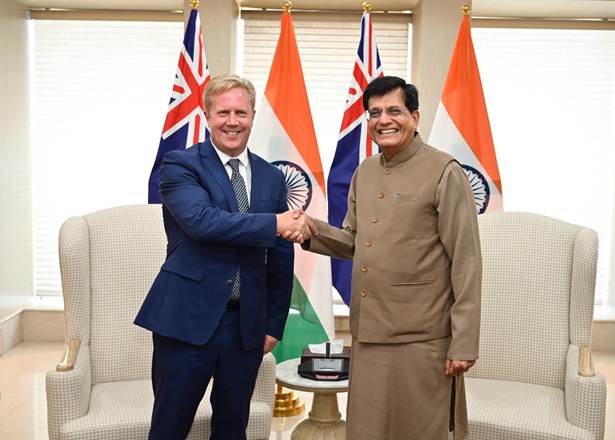
India and New Zealand on Sunday have officially relaunched negotiations for a comprehensive Free Trade Agreement, as the former aims to rapidly set global trade partnerships that could help it achieve an ambitious transition to a developed nation by 2047.
The announcement coincides with the visit of New Zealand's Prime Minister, The Right Honourable Christopher Luxon, to India from March 16-20, 2025.
The FTA discussions were inaugurated during a high-level meeting between India's Minister for Commerce and Industry Piyush Goyal, and New Zealand's Minister for Trade and Investment Todd McClay.
The India-New Zealand FTA is expected to enhance supply chain integration, improve market access, and create new economic opportunities for businesses in both countries.
In April 2010, the two countries had first started negotiating the Comprehensive Economic Cooperation Agreement to boost trade in goods, services, and investment. However, after ten rounds of discussions, the talks stalled in February 2015.
In 2010, one major challenge was New Zealand's demand for greater access to India's dairy market, which India resisted to protect its domestic dairy industry that supports millions of farmers, according to Ajay Srivastava, founder of think tank Global Trade Research Initiative.
India was also reluctant to lower tariffs on New Zealand's dairy, meat, and wine exports, while New Zealand pushed for more favorable trade terms.
"Pressure from the U.S. to open India's dairy and agriculture sectors may also influence negotiations," he added. India-New Zealand trade in FY24 stood at just $1.54 billion.
Another key issue was India's demand for easier movement of its skilled professionals and better access for its IT and services sector. India wanted New Zealand to grant work opportunities similar to those given to Australia and China, but New Zealand did not agree.
Another challenge will be the disparity in tariff structures. New Zealand's average import tariff is only 2.3%, with over half of its tariff lines already duty-free, meaning Indian goods already have substantial access to its market. In contrast, India's average tariff stands at 17.8%, meaning it would have to make significant reductions, making a traditional FTA less attractive for India.
India is already negotiating major trade pacts with the US, the UK, the EU and Oman, among others, in a bid to boost exports via inviting countries and companies to set up domestic manufacturing stations. The country has set an ambitious target to become a fully developed economy by 2047, at about $35 trillion in GDP from the current roughly $4 trillion.

-
Getting To Work Costs Women More | The Reason Why

It is not just about women paying more than men. It is about women paying much more in cities than in villages.
-
AI Bias In Investing Cannot Be Eliminated, But It Can Be Governed
Framing is a particularly important example as identical financial information presented in terms of gains rather than losses can lead an LLM to reach a different assessment.
-
Joining The Dots | Dark Skies, Steady Diya: Why Hope Holds This Diwali
With war, a weak rupee and foreign outflows weighing on sentiment, policymakers at the NDTV World Summit and market veterans at NDTV Profit Ignite: Diwali Edition offered the same advice: stay invested and filter out the noise.
-
The Curious Case of Equitas Small Finance Bank And A CEO Who Quit For Stock
PN Vasudevan believes persistent investor concerns over a perceived conflict of interest had become a governance overhang on Equitas Small Finance Bank's stock, even as the lender improved profitability and asset quality.
-
Talking Points This Week: AI Cash Burn, A Tiger Comeback And An India That Still Finds Its Own Path
India is not immune to higher oil or tighter global liquidity, yet its earnings base is broader, its domestic policy levers are still available.
-
Foreign Investors Own Half Of HDFC Bank and ICICI Bank. An LTCG Cut Could Matter Most Here
Foreign portfolio investors have US$115 billion parked in HDFC Bank, ICICI Bank. If the government cuts long-term capital gains tax, Jefferies says returning foreign money could land here first.
-
'Never Seen This Level Of Negativity': Sandeep Tandon Says The Next Rally May Be Closer Than You Think
Veteran investor Sandeep Tandon says foreign selling is easing, large-caps are due a comeback and mid-caps are crowded, while he turns positive on gold, power and pharma this Diwali.
-
Indians Stay With Family, Not In Hotels | The Reason Why
India still lacks enough clean, reliable and affordable hotels for budget-conscious travellers.
-
The Economic Imperative: Analysing The Material Driving Force Behind India-Canada Strategic Reset
This economic complementarity is further reinforced by deep institutional investment ties and talent mobility, which form the bedrock of the bilateral framework.
-
Medicine Pricing: Where Must Profit Stop?
India must confront excessive margins, hidden incentives and regulatory gaps that threaten the integrity of medicine.










