India Finalises Terms To Hire Adviser For Mega Insurance Merger

The finance ministry is finalising terms of reference to hire a consultant to advise on the merger of three state-run general insurers, two officials aware of the development told BloombergQuint.
A draft was prepared by the end of February and the ministry and General Insurance Public Sector Association—the group of four non-life insurers—are looking into it, the officials quoted above told BloombergQuint. The ministry's approval is expected soon and a tender would be floated most likely by May to select the consultant, one of them said.
The planned merger of National Insurance Company, United India Insurance Company and Oriental Insurance Company will create a financially stronger giant with about 32 percent of the market share based on overall gross premiums for the last six years. This is more than twice of that of New India Assurance's market share — currently the largest general insurer in India. The government will then part-sell its stake in the combined entity in an initial public offering.
The consultant will advise insurers on the reorganisation of personnel and employees, integration of IT systems and consolidation of investments, the two officials said.
“This will be apart from the financial structuring, legal compliance, data privacy issues, competition laws and regulatory approvals that will also have to be looked at,” said Alina Arora, partner at the law firm Luthra & Luthra. The lowest bidder will win the contract, but a merger of such scale requires the best of resources, she said.
The timeline of the merger will be finalised only after an adviser is selected, the first official quoted above said. A high-level committee of 20-30 top officers from the three insurers will supervise the process.
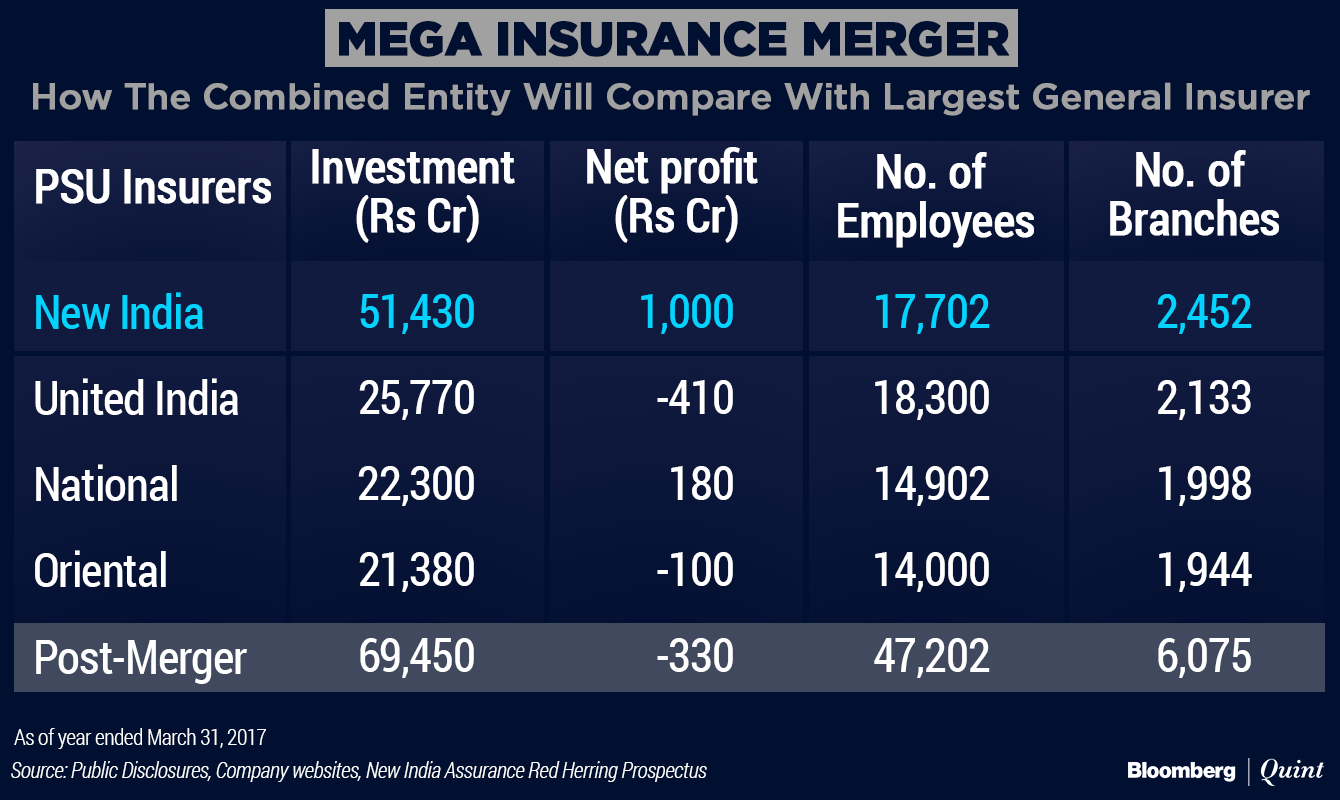
The three non-life insurers together, according to information on their websites, employ about 47,202 people. “Human resources compliance, right from employees' provident funds, gratuities and termination clauses, will pose a major challenge given the size of the manpower,” said Arora.
The three companies have 6,075 branch offices in all, compared to New India's 2,452 branches.
“The merger will also entail rationalisation of offices to ensure that multiple branches of the merged entity are not concentrated in the same area,” said Naresh Makhijani, partner and head of financial services at KPMG. “The integration of IT systems and cultures of these organisations will also be mammoth tasks, where effective implementation would be key to decide the success of the process.”
The three companies together had short- and long-term investments of Rs 69,450 crore in the year ended March 31, 2017, as per disclosures on their website. These will have to be consolidated into the new entity, said one of the official quoted.
“There are various challenges to that,” said Arora. One issue would be meeting the regulatory requirement of limiting an insurer's stake in a company to 15 percent. “Even with the large investment portfolios of these companies, it will have to be ensured that the regulatory requirement is met for each investment without any loss to policyholders.”
United India Insurance's chairman and managing director, MN Sarma had told PTI on Feb. 13. that the merger is likely to be completed by March 31, 2019.
Both Arora and Makhijani agreed that this isn't realistic. The process, Arora said, could take a minimum of two years considering that it's still on the drawing board.

-
The Economic Imperative: Analysing The Material Driving Force Behind India-Canada Strategic Reset

This economic complementarity is further reinforced by deep institutional investment ties and talent mobility, which form the bedrock of the bilateral framework.
-
Medicine Pricing: Where Must Profit Stop?
India must confront excessive margins, hidden incentives and regulatory gaps that threaten the integrity of medicine.
-
Why Amazon And Flipkart Are Struggling To Beat Meesho In India's Smaller Cities
With 274 million users and lowest-cost logistics, Meesho is defending its value commerce crown against giants like Amazon and Flipkart.
-
High US Salaries, No Green Card Certainty: The Financial Calculation Facing Indian H-1B Families
The suspension of PERM processing at eight technology employers does not cancel existing H-1B visas. What it does is force a question many Indian families have been avoiding: is the US salary worth tying your career and family plans to one employer?
-
Swiggy vs Eternal: Food Delivery's Two Rivals Are No Longer In The Same Race
Eternal is building a private AI assistant, dark.ai. Swiggy is still working out how to make Instamart pay, with an operating loss of Rs 895 crore in the July-September quarter while Blinkit stayed profitable.
-
Where You Live Shapes How You Get To Work | The Reason Why
Two-wheelers are the most popular way to get to work in India, accounting for nearly 43% of workplace commutes.
-
Unhedged Position: Can India See An Indonesia-Style Time Correction?
The Nifty is trading below levels it first clocked in 2024. Is there, then, as I have suggested in the headline, potential that the current time correction drags on painfully for the next three-five, even ten years?
-
Navigating Friction And Energy Realities: An Analysis Of Marco Rubio's October Visit To India
Occurring at a critical juncture marked by stalled trade negotiations and escalating geopolitical pressures over global energy supplies, the visit offers a profound window into modern US-India relations.
-
India Exports Capital. Why Not Export Trusteeship?
The big question, then, is whether India can build an institution that global borrowers, investors, banks, and lawyers can trust, even without an Indian connection.
-
France's Economy & Politics Are In Crisis | The Reason Why
Let's look at how the French economy and politics evolved under Nicolas Sarkozy, Franois Hollande and Emmanuel Macron.










