Economic Rebound Faces Rising Risk From COVID-19 Variants: Report

The country's economic rebound, already weakened in recent months, could lose further momentum as coronavirus variants pose the greatest threat and inflation rises, a Reuters poll of economists found.
The latest survey results suggest difficult policy decisions lie ahead for the Reserve Bank of India, which has already seen two consecutive months of inflation above the six per cent upper limit of the range it tolerates.
The RBI said last week that prospects for the economy had brightened and the inflation rise would be transitory, echoing the views of most major central banks.
But the fast spread of the Delta variant in some states - and it is becoming dominant around the world - has raised doubts as the country contends with a devastating wave of COVID-19.
The July 15-22 poll of 52 economists showed a third consecutive downgrade to the growth outlook for the current fiscal year 2021-22, but also the third such upgrade to the following year.
About two-thirds of economists, or 23 of 36, who responded to an extra question said virus variants were the biggest risk, while only a handful cited high inflation.
"Resurgence in cases and (any) emergence of fresh variants are notable risks for the economy for the rest of the year, particularly at a time when vaccination coverage is short of achieving a critical mass," said DBS economist Radhika Rao.
"Reinstatement of movement curbs risks deepening the damage inflicted on the informal sector, which contributes to nearly half of the national output and employs a majority."
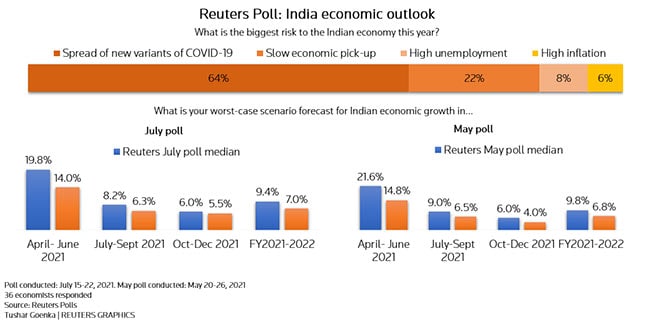
Reuters poll graphic on India economic outlook
Photo Credit: Reuters
A separate Reuters survey of global health experts last month concluded another wave of infections and COVID-19 in India was likely by October.
After contracting in the previous fiscal year at its fastest annual pace since records began over four decades ago - one of the worst-hit in Asia, the economy was predicted to expand 9.4% in the current fiscal year. The last time the economy grew that quickly was in 2010.
The latest consensus forecast was a downgrade from 9.8 per cent in the previous poll in May, itself down from 11.0 per cent in April, and slightly below the RBI's latest projection of 9.5 per cent.
Asked for their worst-case scenario this fiscal year, economists provided a median seven per cent, in a five per cent- nine per cent range. Growth in any case was expected to slow to 6.9 per cent in fiscal 2022-23.
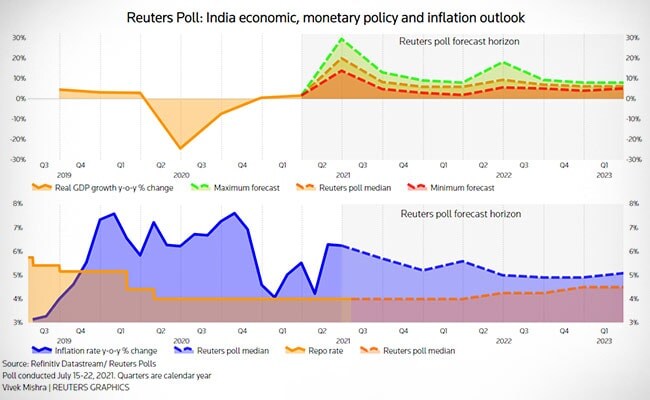
Reuters poll graphic on India economic growth, monetary policy and inflation outlook -
Photo Credit: Reuters
Inflation Lingers
Although inflation was forecast to ease from 6.3 per cent at the last measure, the consensus was for it to average above the mid-point of the RBI's medium-term target of two per cent-six per cent at least until early 2023.
Inflation was predicted to average 5.5 per cent and 4.7 per cent in the current fiscal year and next, up from five per cent and steady with 4.7 per cent predicted in May. For now, the RBI is expected to keep its policy rates unchanged as inflation appears to be coming off a peak.
But the consensus pointed to two 25 basis point hikes each next fiscal year, taking the repo rate to 4.50 per cent by end-March 2023, with 32 economists now predicting at least one hike by early that year compared with 24 in the previous poll.
"Despite the growth concerns, we think the RBI will eventually need to act to bottle the inflation genie so as not to lose control. We therefore expect monetary policy normalisation to start relatively soon," noted Kunal Kundu, India economist at Societe Generale.
"However, with a third wave of the pandemic appearing to be a certainty, with experts pointing to the less than desirable pace of vaccination, the precise timing of normalisation remains uncertain."

-
Foreign Investors Own Half Of HDFC Bank and ICICI Bank. An LTCG Cut Could Matter Most Here

Foreign portfolio investors have US$115 billion parked in HDFC Bank, ICICI Bank. If the government cuts long-term capital gains tax, Jefferies says returning foreign money could land here first.
-
'Never Seen This Level Of Negativity': Sandeep Tandon Says The Next Rally May Be Closer Than You Think
Veteran investor Sandeep Tandon says foreign selling is easing, large-caps are due a comeback and mid-caps are crowded, while he turns positive on gold, power and pharma this Diwali.
-
Indians Stay With Family, Not In Hotels | The Reason Why
India still lacks enough clean, reliable and affordable hotels for budget-conscious travellers.
-
The Economic Imperative: Analysing The Material Driving Force Behind India-Canada Strategic Reset
This economic complementarity is further reinforced by deep institutional investment ties and talent mobility, which form the bedrock of the bilateral framework.
-
Medicine Pricing: Where Must Profit Stop?
India must confront excessive margins, hidden incentives and regulatory gaps that threaten the integrity of medicine.
-
Why Amazon And Flipkart Are Struggling To Beat Meesho In India's Smaller Cities
With 274 million users and lowest-cost logistics, Meesho is defending its value commerce crown against giants like Amazon and Flipkart.
-
High US Salaries, No Green Card Certainty: The Financial Calculation Facing Indian H-1B Families
The suspension of PERM processing at eight technology employers does not cancel existing H-1B visas. What it does is force a question many Indian families have been avoiding: is the US salary worth tying your career and family plans to one employer?
-
Swiggy vs Eternal: Food Delivery's Two Rivals Are No Longer In The Same Race
Eternal is building a private AI assistant, dark.ai. Swiggy is still working out how to make Instamart pay, with an operating loss of Rs 895 crore in the July-September quarter while Blinkit stayed profitable.
-
Where You Live Shapes How You Get To Work | The Reason Why
Two-wheelers are the most popular way to get to work in India, accounting for nearly 43% of workplace commutes.
-
Unhedged Position: Can India See An Indonesia-Style Time Correction?
The Nifty is trading below levels it first clocked in 2024. Is there, then, as I have suggested in the headline, potential that the current time correction drags on painfully for the next three-five, even ten years?










