India 5G Launch: PM Modi Launches 5G Services In India
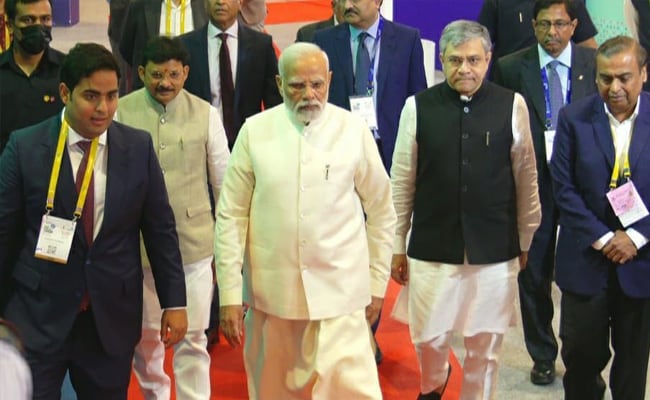
Prime Minister Narendra Modi on Saturday launched the 5G telephony services that promise to provide ultra high-speed internet on mobile phones, saying it marks the beginning of a new era and presents a sea of opportunities.
The Prime Minister launched 5G services in select cities at the India Mobile Congress (IMC) 2022 conference. The services will progressively cover the entire country over the next couple of years.
"5G marks the dawn of a new era and presents a sea of opportunities," he said.
While the nation was dependent on foreign countries for technology for 2G, 3G and 4G telecom services, India has created history with 5G, he said.
The Prime Minister said his government's vision for 'Digital India' was founded on four pillars -- the cost of devices, digital connectivity, data cost and digital-first approach.
This approach has led to mobile manufacturing units in India increasing from just two in 2014 to over 200 now, bringing down the cost of handsets.
Stating that India now has the world's lowest data charges, he said from Rs 300 per 1 GB of data in 2014, tariffs have come down to Rs 10 per GB.
Going by the average consumption of 14 GB of data per month, the data cost has come down from Rs 4,200 to Rs 125-150, he said.
From zero exports, the country is now shipping phones worth crores of rupees. Also, digital payments have increased, he pointed out.
Technology has truly now become democratised, he said.
Taking a dig at the previous Congress-led UPA government, he said this was possible because of the right intentions of his government.
"2G ki niyat and 5G ki niyat mein yehi farak hai (this is the difference between the intentions during 2G era and 5G era now)," he said in reference to the alleged 2G spectrum allocation scam.
Capable of supporting ultra-high-speed internet, the fifth generation or 5G service is expected to unleash new economic opportunities and societal benefits, serving as a transformational force for Indian society.
After the launch, all three major telecom operators demonstrated one use case to show the potential of 5G technology in India.
Billionaire Mukesh Ambani's Reliance Jio connected a teacher from a school in Mumbai with students in three different locations in Maharashtra, Gujarat and Odisha.
This demonstrated how 5G will facilitate education by bringing teachers closer to students, obliviating the physical distance between them. It also demonstrated the power of Augmented Reality (AR) on screen and how that is being used to teach children across the country, remotely, without the need of an AR device.
PM Modi interacted with school children in the demo case, asking them about their favourite subject and how the use of technology has helped in learning.
The Vodafone Idea test case demonstrated the safety of workers in an under-construction tunnel of Delhi Metro through the creation of a 'digital twin' of the tunnel on the dias. The digital twin will help give safety alerts to workers in real-time from a remote location.
PM Modi interacted with Lt Governor of Delhi V K Saxena as well as the workers in the tunnel.
In the Airtel demo, a girl from Uttar Pradesh witnessed a lively and immersive education experience to learn about the solar system with the help of virtual reality and augmented reality.
The girl shared her experience of learning with the Prime Minister by appearing on the dias through a hologram.
(This story has not been edited by NDTV staff and is auto-generated from a syndicated feed.)

-
We May Need Another Tukaram Mundhe To Fight Air Pollution | The Reason Why

Developers may install basic measures such as sprinklers and green nets, resume work, and continue violating rules when this equipment stops working.
-
Extracting Value From Battery Scrap Could Be Challenging For India | The Reason Why
A discarded lithium-ion battery still contains valuable materials such as lithium, nickel and cobalt. These can be recovered and reused. When such batteries are crushed and shredded, they produce a dark powder called black mass.
-
One El Nino, India Can Handle. Two Could Break The Granary
India's grain stocks can absorb one bad year, but a second El Nino could drain the buffer in two to three years, economists say.
-
India's Troika Of Good Luck | Joining The Dots
As Jensen Huang's exit drags Nvidia down, a cooling AI trade and resilient earnings have revived investor interest in India. A likely RBI rate hike looms.
-
Talking Points This Week: Leadership Shock At Nvidia, Earnings Strength, And The Fog Over Hormuz
The Anthropic IPO pricing and first trading day, Nvidia's upcoming earnings, and any fresh signals from Iran will set the tone for the following week.
-
Signature Play: The Classic Cocktail Is Dead. Or Is It?
Classic cocktails are disappearing from India's cocktail menus. But they're still being ordered, taught to bartenders and borrowed from. So, who's really having the last drink?
-
A New Samvat Wishlist: Inclusive Prosperity And Human Development
India has strengthened its economic foundations through infrastructure, digital access and enterprise. Its next growth chapter must deepen productivity, create better livelihoods and widen participation in prosperity.
-
Love, Sex Aur Dhokha: The Audacious Plot To Spy On Jensen Huang
A Taipei dinner, a Singapore chip buyer and a suspected Chinese asset: inside the alleged spy operation that got close to NVIDIA's Jensen Huang.
-
Ten Things I Learnt This Samvat
Patience can be a trap. Cheap stocks can stay cheap. Leverage can wipe you out. What did Samvat 2082 teach us? Niraj Shah writes on 10 lessons from the year gone by.
-
Talking Points This Week: Tech Nerves, FII Buying, And A Faraway Banking Shock
The global markets are not shining this Diwali. The exception in the large markets is, India.









