How To Make Most Of Atal Pension Scheme: Age Limit, Contribution, Tax Treatment And More

APY or Atal Pension Yojana is a pension scheme focused on the unorganised sector in the country. Introduced in 2015, the Atal pension scheme allows individuals aged from 18 to 40 years of age to make pre-defined monthly investments in the scheme, and offers a pension benefit in multiples of Rs 1,000 up to Rs 5,000 per month, according to pension fund regulator PFRDA's website - pfrda.org.in. The amount of monthly contribution depends on two factors: (i) the age of investor at the time of joining the pension scheme and (ii) the fixed pension slab chosen (Rs 1,000 per month, Rs 2,000 per month, Rs 3,000 per month, Rs 4,000 per month or Rs 5,000 per month). The Atal pension scheme, therefore, requires a minimum contribution period of 20 years by the investor. (Also read: How to make most of Atal Pension Yojana)
The government is considering a proposal to increase the pension limit under Atal Pension Yojana (APY) to up to Rs 10,000 per month, news agency Press Trust of India had reported last month citing a top government official.
Here are five key details you need to know in order to make most of the Atal pension scheme (Atal Pension Yojana):
1. What is the age requirement to be eligible to invest in the Atal pension scheme?
The minimum age to invest in Atal Pension Yojana is 18 years and the maximum age is 40 years, according to PFRDA. The pension starts once the investor attains the age of 60 years.
2. What is the minimum amount of investment required for the Atal pension scheme?
One can invest in the Atal pension scheme through three modes of payment: monthly, quarterly and half-yearly. That means the pension scheme requires the investor to make a minimum of two contributions every year. Subscribing to the Atal pension scheme at an early age minimises the contribution required to reach the desired minimum monthly pension, maximising the pension benefit, say experts. For instance, an investor subscribing for the Atal scheme at the age of 18 years is required to pay Rs 42 per month to reach a pension goal of Rs. 1,000 per month.
3. How to subscribe to or exit from the Atal pension scheme?
Opening an Atal Pension Yojana account requires the applicant to hold a savings account either with a bank or a post office. Atal pension scheme subscribers are allowed premature exit before the age of 60 years "only in exceptional circumstances, i.e., in the event of the death/ terminal disease", according to the PFRDA website. (Read more)
4. How much maximum pension can be earned through the Atal pension scheme?
Currently, the Atal pension scheme offers five fixed, pre-defined pension slabs: Rs 1,000, Rs 2,000, Rs 3,000, Rs 4,000 and Rs 5,000. The earlier one starts, the lower is the monthly contribution required to reach the desired pension goal, say experts. For instance, a subscriber at the age of 18 will contribute Rs 210 per month for 42 years to earn a pension of Rs 5,000 per month after maturity of the scheme. That means a total investment of Rs. 1,05,840. That is lower than investment worth Rs 3,48,960 required by an individual who enters the scheme at 40 years of age for the same pension slab. The 40-year-old investor is required to contribute Rs. 1,454 per month for a period of 20 years for the pension goal of Rs 5,000 per month.
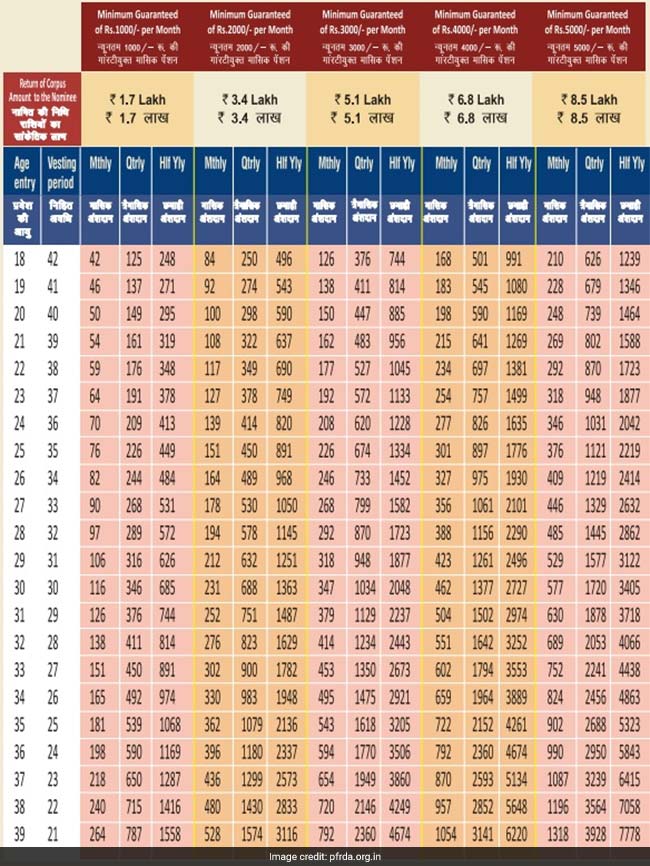
(Using a chart, pension regulator PFRDA explains the contribution levels vis-a-vis minimum fixed monthly pension in the Atal pension scheme)
5. What are the income tax benefits one can claim by investing in the Atal pension scheme?
Contributions paid in Atal Pension Yojana can be claimed for income tax deduction up to Rs. 50,000 under Section 80CCD (1B) of the Income Tax Act, over and above the Rs. 1.5 lakh per financial year allowed under Section 80C.

-
Getting To Work Costs Women More | The Reason Why

It is not just about women paying more than men. It is about women paying much more in cities than in villages.
-
AI Bias In Investing Cannot Be Eliminated, But It Can Be Governed
Framing is a particularly important example as identical financial information presented in terms of gains rather than losses can lead an LLM to reach a different assessment.
-
Joining The Dots | Dark Skies, Steady Diya: Why Hope Holds This Diwali
With war, a weak rupee and foreign outflows weighing on sentiment, policymakers at the NDTV World Summit and market veterans at NDTV Profit Ignite: Diwali Edition offered the same advice: stay invested and filter out the noise.
-
The Curious Case of Equitas Small Finance Bank And A CEO Who Quit For Stock
PN Vasudevan believes persistent investor concerns over a perceived conflict of interest had become a governance overhang on Equitas Small Finance Bank's stock, even as the lender improved profitability and asset quality.
-
Talking Points This Week: AI Cash Burn, A Tiger Comeback And An India That Still Finds Its Own Path
India is not immune to higher oil or tighter global liquidity, yet its earnings base is broader, its domestic policy levers are still available.
-
Foreign Investors Own Half Of HDFC Bank and ICICI Bank. An LTCG Cut Could Matter Most Here
Foreign portfolio investors have US$115 billion parked in HDFC Bank, ICICI Bank. If the government cuts long-term capital gains tax, Jefferies says returning foreign money could land here first.
-
'Never Seen This Level Of Negativity': Sandeep Tandon Says The Next Rally May Be Closer Than You Think
Veteran investor Sandeep Tandon says foreign selling is easing, large-caps are due a comeback and mid-caps are crowded, while he turns positive on gold, power and pharma this Diwali.
-
Indians Stay With Family, Not In Hotels | The Reason Why
India still lacks enough clean, reliable and affordable hotels for budget-conscious travellers.
-
The Economic Imperative: Analysing The Material Driving Force Behind India-Canada Strategic Reset
This economic complementarity is further reinforced by deep institutional investment ties and talent mobility, which form the bedrock of the bilateral framework.
-
Medicine Pricing: Where Must Profit Stop?
India must confront excessive margins, hidden incentives and regulatory gaps that threaten the integrity of medicine.










