IMF Chief Economist Gita Gopinath To Leave Job, Return To Harvard University
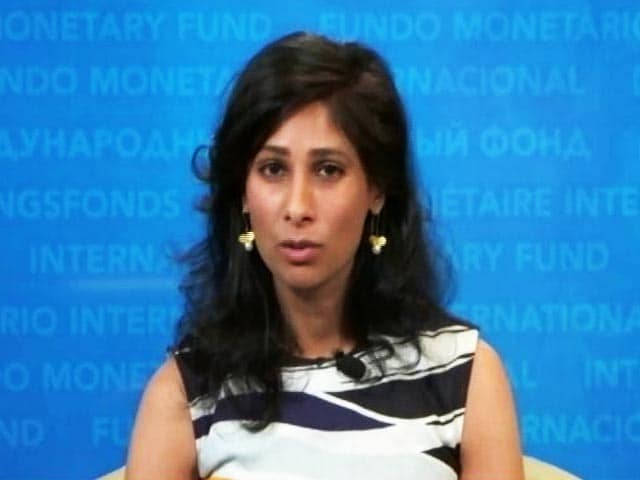
Washington: IMF's Chief Economist Gita Gopinath will leave her job in January next year and return to the prestigious Harvard University, according to the global financial institution.
The 49-year-old prominent Indian-American economist had joined the International Monetary Fund (IMF) as the Chief Economist in January 2019.
She was the John Zwaanstra Professor of International Studies and Economics at Harvard University when she joined the Washington-based global lender.
IMF Managing Director Kristalina Georgieva on Tuesday announced that the search for Gopinath's successor would begin shortly.
“Gita's contribution to the Fund and our membership has been truly remarkable - quite simply, her impact on the IMF's work has been tremendous,” Georgieva said.
Ms Gopinath, Mysuru-born, is the first-ever woman Chief Economist of the IMF.
Harvard University had extended her leave of absence on an exceptional basis by one year, which has allowed her to serve as Chief Economist at the IMF for three years.
“She made history as the first female Chief Economist of the Fund and we benefited immensely from her sharp intellect and deep knowledge of international finance and macroeconomics as we navigate through the worst economic crisis since the Great Depression.
“Gita also won the respect and admiration of colleagues in the Research Department across the Fund, and throughout the membership for leading analytically rigorous work and policy-relevant projects with high impact and influence,” Georgieva said.
The IMF said that as part of her many significant initiatives, Ms Gopinath co-authored the “Pandemic Paper” on how to end the Covid-19 pandemic that set globally endorsed targets for vaccinating the world.
This work led to the creation of the Multilateral Task Force made up of the leadership of the IMF, the World Bank, the World Trade Organisation and the World Health Organisation to help end the pandemic and the establishment of a working group with vaccine manufacturers to identify trade barriers, supply bottlenecks, and accelerate delivery of vaccines to low- and lower-middle income countries, the IMF said in a statement.
Among her other key accomplishments, Ms Gopinath helped set up a Climate Change team inside the IMF to analyse, among other things, optimal climate mitigation policies.
“I would like to express my personal appreciation to Gita for her impressive contributions, her always wise counsel, her devotion for the mission of the Research Department and the Fund more broadly, as well as her widely recognised inclusive and accessible approach to colleagues and staff,” Georgieva added.
Born in December 1971 to Malayalee parents, Ms Gopinath had her schooling in Kolkata and graduated from the Lady Shri Ram College of Commerce in Delhi. She did Masters from the Delhi School of Economics as well as from the University of Washington.
Ms Gopinath did her Ph.D in economics from Princeton University in 2001 and she was guided by Kenneth Rogoff, Ben Bernanke and Pierre-Olivier Gourinchas.
She joined the University of Chicago in 2001 as an Assistant Professor before moving to Harvard in 2005. She became a tenured Professor there in 2010.
She is the third woman in the history of Harvard to be a tenured professor at its esteemed economics department and the first Indian since the Nobel laureate Amartya Sen to hold that position.
(This story has not been edited by NDTV staff and is auto-generated from a syndicated feed.)

-
AI Bias In Investing Cannot Be Eliminated, But It Can Be Governed

Framing is a particularly important example as identical financial information presented in terms of gains rather than losses can lead an LLM to reach a different assessment.
-
Joining The Dots | Dark Skies, Steady Diya: Why Hope Holds This Diwali
With war, a weak rupee and foreign outflows weighing on sentiment, policymakers at the NDTV World Summit and market veterans at NDTV Profit Ignite: Diwali Edition offered the same advice: stay invested and filter out the noise.
-
The Curious Case of Equitas Small Finance Bank And A CEO Who Quit For Stock
PN Vasudevan believes persistent investor concerns over a perceived conflict of interest had become a governance overhang on Equitas Small Finance Bank's stock, even as the lender improved profitability and asset quality.
-
Talking Points This Week: AI Cash Burn, A Tiger Comeback And An India That Still Finds Its Own Path
India is not immune to higher oil or tighter global liquidity, yet its earnings base is broader, its domestic policy levers are still available.
-
Foreign Investors Own Half Of HDFC Bank and ICICI Bank. An LTCG Cut Could Matter Most Here
Foreign portfolio investors have US$115 billion parked in HDFC Bank, ICICI Bank. If the government cuts long-term capital gains tax, Jefferies says returning foreign money could land here first.
-
'Never Seen This Level Of Negativity': Sandeep Tandon Says The Next Rally May Be Closer Than You Think
Veteran investor Sandeep Tandon says foreign selling is easing, large-caps are due a comeback and mid-caps are crowded, while he turns positive on gold, power and pharma this Diwali.
-
Indians Stay With Family, Not In Hotels | The Reason Why
India still lacks enough clean, reliable and affordable hotels for budget-conscious travellers.
-
The Economic Imperative: Analysing The Material Driving Force Behind India-Canada Strategic Reset
This economic complementarity is further reinforced by deep institutional investment ties and talent mobility, which form the bedrock of the bilateral framework.
-
Medicine Pricing: Where Must Profit Stop?
India must confront excessive margins, hidden incentives and regulatory gaps that threaten the integrity of medicine.
-
Why Amazon And Flipkart Are Struggling To Beat Meesho In India's Smaller Cities
With 274 million users and lowest-cost logistics, Meesho is defending its value commerce crown against giants like Amazon and Flipkart.










